Sir Paul McCartney’s new album — perhaps his final one — is deservedly being hailed as a triumph. The Boys Of Dungeon Lane is a sweeping reflection on his Liverpool childhood, and one song in particular, Days We Left Behind, is deeply moving.
At 84, Paul’s voice has acquired a slight tremor, but it remains unmistakably his. I find myself returning to that track again and again, and every listen seems to leave me unexpectedly misty-eyed.
Having passed my own 70th birthday, I increasingly understand McCartney’s pull towards the past. To put it plainly, when the years behind you feel longer and more vivid than the years ahead, it becomes difficult not to spend a good deal of time travelling back in memory.
My own journey into those old echoes began in earnest after my wife, Sue, died nearly ten years ago. We first met at university in Nottingham. She later became a reporter on BBC’s Woman’s Hour before going on to find success as a writer of popular romantic fiction.
After her death, I began revisiting places that had mattered to us during our 40 years together. Partly, it was about remembering; partly, it was about stepping directly into the sadness rather than trying to avoid it. For me, that became a way of grieving.
It might be the quiet corner of our favourite beach in Devon, a beloved diner in New York, or the London restaurant where we celebrated her 62nd birthday, only
days before she was told she had terminal lung cancer. Returning to those places was, in a strange way, cathartic.
During Covid, I even challenged myself to walk around the hospice where she died, in an effort — partly successful — to make the memory feel less frightening. Later, I had coffee in the hospital Costa where we told my younger daughter that her mother had only months to live. Perhaps that sounds unusual, but for me, going back to places where painful things happened has often brought a measure of comfort.
I later started ghosting around one or two of the more significant of the homes we’d lived in, houses I had dreamed about regularly – nightly to be honest. I found that familiarising myself with them, demythologising them, defused the emotional bombs even more effectively.

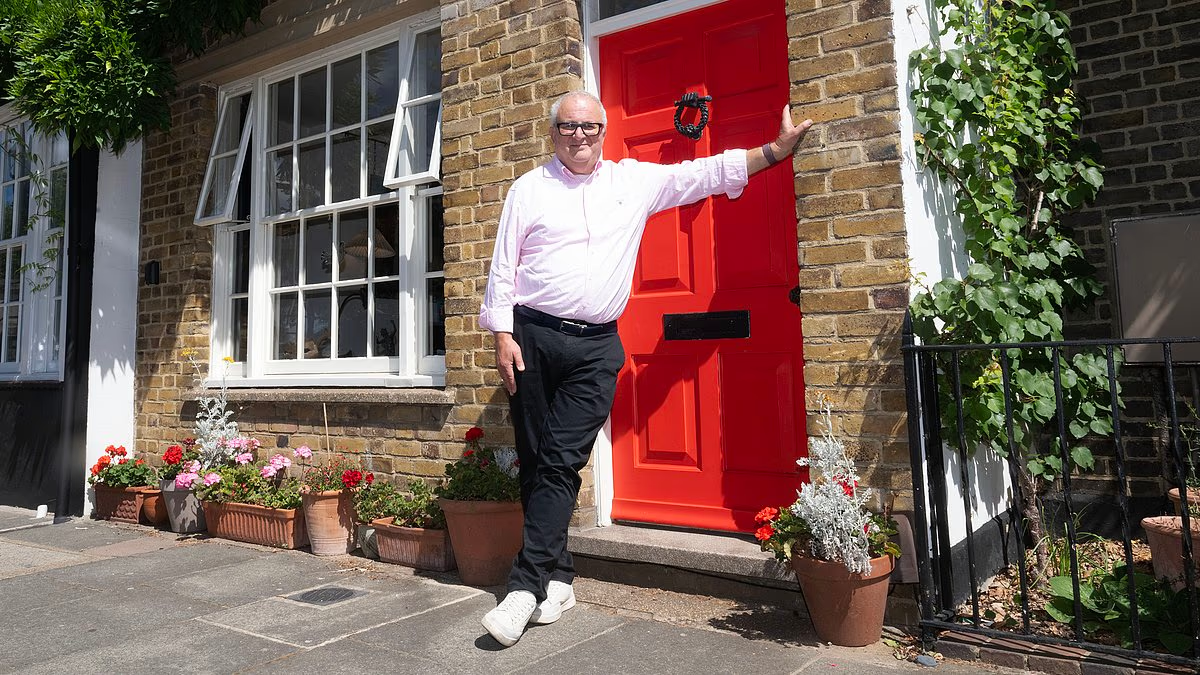
Journalist Jonathan Margolis outside his home in Kew. Jonathan took a trip down memory lane and revisited all the places he called home
Our children referred to what I was doing as my ‘magical misery tour’, even as a ‘secular exorcism’. The sadness aspect didn’t only relate to Sue. Both my parents died at 50 while my family and I lived at the little house in Gants Hill, Essex, where I was born.
Walking past that house one evening, I saw that the hardstanding at the front that my dad had concreted over in 1966, destroying a lovely front garden and privet hedge in the process (don’t judge – it was the thing at the time), was crumbling at the edges.
At the time, I was working in China and on an impulse I discreetly prised away a little piece of the concrete. My dear dad had never been beyond Europe, so I placed the bit of concrete in a
flowerbed in People’s Square, Shanghai. It’s still there. He never made it anywhere exotic, but his handiwork did.
Today, having made it to be an OAP, in a wonderful new relationship and living in a house I intend to move from only horizontally in a box, I find a need to make friends with my history.
So, prompted by McCartney’s wonderful swansong, I’ve set out to visit as many of the significant homes I’ve lived in as I can, from the terraced house in east London where I was born in the back bedroom to the student home in
Nottingham, to family homes in Leeds, and in later years, back to London, but the west side now – including the home where Sue spent her last months.
Revisiting the homes that have meant the most to me has been both intensely moving and also plain interesting. I thoroughly recommend doing it if you can. Some owners were understandably suspicious when I knocked on their door or wrote them a letter, and declined to let me in. Most, however were hugely hospitable.
What I especially loved was that while all the houses have changed, it’s remarkable how many forgotten details survive the decades and shock you in ways you’re not expecting.
Bannisters, doors, cupboard handles and quirky little corners you’d never given a moment’s thought to when you lived in the house, or since, now stand out.
When my parents bought the Gants Hill house in 1947, being nominally observant Jews (ie not very), they nonetheless put up mezuzahs on many of the door posts, as commanded by, if I remember rightly, Deuteronomy.
A mezuzah is a little capsule containing a hand-written prayer, and I was amazed to find one of the mezuzahs in our house, nailed up a bit clumsily by my dad just after the war, is still there, coated in countless layers of paint. I asked the friendly Muslim family, who have lived in the house much longer than I did, if they knew what it was. They very much did and were adamant about keeping it up there.
The other thing that should be obvious, but wasn’t to me, was that homes are lived in by generation after generation. Your time in a particular house can be long, happy, unhappy, full of episodes and dramas. But the bricks and mortar have seen the peaks and troughs of successive people’s lives again and again.
There’s a distinctive bathroom door lock, made of brass but, again, painted over in this house, where I lived from birth to 18 years. I hadn’t given it a moment’s thought, but it’s still there, and now I realise it was probably there when the house was built in the 1920s. So in a subliminal way, it must have lived in the minds of dozens of people over the years.
One detail that was mine alone amazed me. When I was intent as a young teenager on being a photographer, my marvellously indulgent dad built a darkroom in the loft space. I would spend countless nights at the top of the little house learning the old photographic skills. Today, not only is the room still in use, but many bits and pieces and traces of my time up there over 50 years ago are still visible. I used to stick the labels from 35mm film cassettes on the darkroom door as trophies; they are still there.
The thing that struck me even more, though, was that long after my time, another young man used the room as his quiet exam revision space when he was studying to get into medical school. He had gone on to become a leading surgeon. For him, the room is one thing, for me another, and doubtless for someone else in the future, it will be equally important.
I recognise that for people who had an unhappy past, ghosting around like I have been doing
may be too painful to bear. But the kind of mythical, often disturbing quality my old houses assumed for me when I was regularly dreaming about them is now reassuringly gone, replaced by a fond familiarity.
The nostalgia, as the old joke goes, is not what it used to be.
And so here they are – time gaps are periods abroad or in rentals…
Collinwood Gardens, Gants Hill, Essex, (1955 to 1974)
I was born in the back bedroom and spent my entire childhood here. In 1970, the house became world-famous – no exaggeration – when my radio ham brother and dad were in contact with King Hussein of Jordan during the Jordanian Civil War.
Our house was literally the only source of direct news from the Middle East for several days and was full of journalists for two weeks, in our back room to hear the king’s side of things. The BBC evening news was even presented live from our back room one night. Inspired by this, I set my heart on being a journalist and won three writing competitions.
Dad and Laurie’s radio hobby, lethal as it was to the neighbours’ TV reception, regularly made the news. There were quite often such episodes as rescues of marooned sailors in the tropics, straight out of Tony Hancock’s hilarious The Radio Ham episode, but for real.
Alongside the amazing, happy, fascinating times, there was also unspeakable family tragedy in our years there. There was the day when, aged seven, I opened my parents’ bedroom door to see my mum naked for the first time but without breasts – not that I would have noticed.
Aged 33, she had just had a radical double mastectomy due to raging, untreated cancer, which killed her finally when she was 50. I remember my dad leaping across the room to slam the door and shouting that I must never come in without knocking. I was 13 before I understood what that had all been about.
Another standout moment was when my dad was slowly dying of infective hepatitis, a side effect of which was that if he knocked into anything, he suffered extreme pain. In bed, swotting for my O-levels, I heard a thump and a yell from the bottom of the stairs. I came out to see Dad, a tough former amateur boxer, on the floor sobbing in pain. Quite a jolt to a 15-year-old who worshipped him.
I know now of some extraordinary things that have happened in the same house since. Yes, our homes are silent witness to all kinds of stuff.

Jonathan and his family outside the family home in Gants Hill, Essex
Bramcote Road, Beeston, Nottingham, (1974 to 1977)
Sue and I got together very early and this was our rather cushy student house, when grants went a long way.
It’s outside Nottingham, near the university. Our neighbour was a miner.
Sue made sure the house always smelled of freesias and there was a wood pigeon cooing every day – not a sound we knew in Gants Hill. I’ve since become friends with the family who lived there subsequently and we go to watch our beloved Nottingham Forest together.
Parkside Road, Meanwood, Leeds, (1977 to 1980)
A derelict 18th-century farm cottage we found and restored in north Leeds. It had last been used in the 1950s as a storage room for Pathe newsreel cinema films. Our first daughter, now aged 46 and living in New York, came home here from the maternity hospital.
We have no photos because Kodak lost the precious roll of colour slide film I took them on. I was a trainee journalist at the Yorkshire Post and Sue became the Northern reporter for Radio 4 Woman’s Hour. She would edit tapes on the kitchen table.
Parkland Drive, Meanwood, Leeds, (1980 to 1982)
We had our second child, David, while living here, and in another highlight I was standing in the front bay window when I got the call from Fleet Street to offer me a job in London.
We also lived here when I was covering the Yorkshire Ripper murders, which sounds a bit grim, but was actually my opportunity to get to Fleet Street. Decades after we left, the house became famous locally as ‘the Emmerdale House’. Although far from the country, it featured prominently in two series of Emmerdale Farm.

Pictured: Parkland Drive in Leeds where Jonathan lived between 1980 and 1982
Forest Road, Woodford Green, Essex, (1982 to 1986)
We loved this little house deep in Epping Forest. It had a spiral staircase that David, aged three, inevitably fell down and cut his head. In summer, all the children in the street would play in the forest until it got dark while all the adults sat out drinking wine. A blissful time.
Monkhams Lane, Woodford Green, Essex, (1986 to 1990)
We bought this one when Sue became pregnant with Ellie, now aged 36. We did a huge amount of work on it and I wrote my first book here. But its value plummeted by a third or more in a price slump in 1990, when we needed to move to west London. I wrote my first book, a biography of John Cleese, in the conservatory.
Richmond Hill, Richmond, (1989 to 2013)
An amazing four-bedroom flat on Richmond Hill, where the older kids grew up. The view across the Thames was amazing, but having no garden wasn’t ideal. Sue began her career as a bestselling novelist in David’s bedroom, using his Amstrad word processor.

The amazing four-bedroom flat where Jonathan and his family lived on Richmond Hill
Ferry Lane, Brentford, (2016 to 2023)
This was our big downsize move – the top flat in a Queen Anne former factory on the Thames in up-and-coming Brentford. A fantastic home, and scene of some terrific Christmases, but also where Sue became ill and died, and where I saw out Covid alone. Also had a lot of trouble from lead-eating, wire-destroying, fighting, growling squirrels infesting the loft. No joke, squirrels.
Something weird happened when we first viewed the flat, with its fantastic view across the Thames at the exact spot where in 54BC, Julius Caesar crossed the river.
In 1642, on the same spot, the Civil War Battle of Brentford took place, in which 150 of Oliver Cromwell’s soldiers were killed.
Bad historic vibes or not, Sue walked into the main room in early 2016 and said out of the blue, ‘Ooh, this would be a lovely spot to die.’ She had no symptoms whatsoever at the time.
A year later, she was in a bed at the window, looking out at the view and dying.

Jonathan and and his late wife Sue Margolis. Sue died while they were living in Brentford
Kew Green, Richmond, (2023 to date)
My new partner, Sarah Jane, and I bought this listed cottage as a damp, leaking wreck and spent three years living in it while restoring it.
Think cold showers in a freezing bathroom in winter, buckets under the terrible roof and discovering the lady who lived here for 60 years – who incidentally was the creator and producer of Rumpole Of The Bailey – had been in danger all the time from lethal electrics – the wiring had been unearthed since 1962.
An amazing house now, and one neither of us ever wants to leave. Takes some maintenance, mind.


