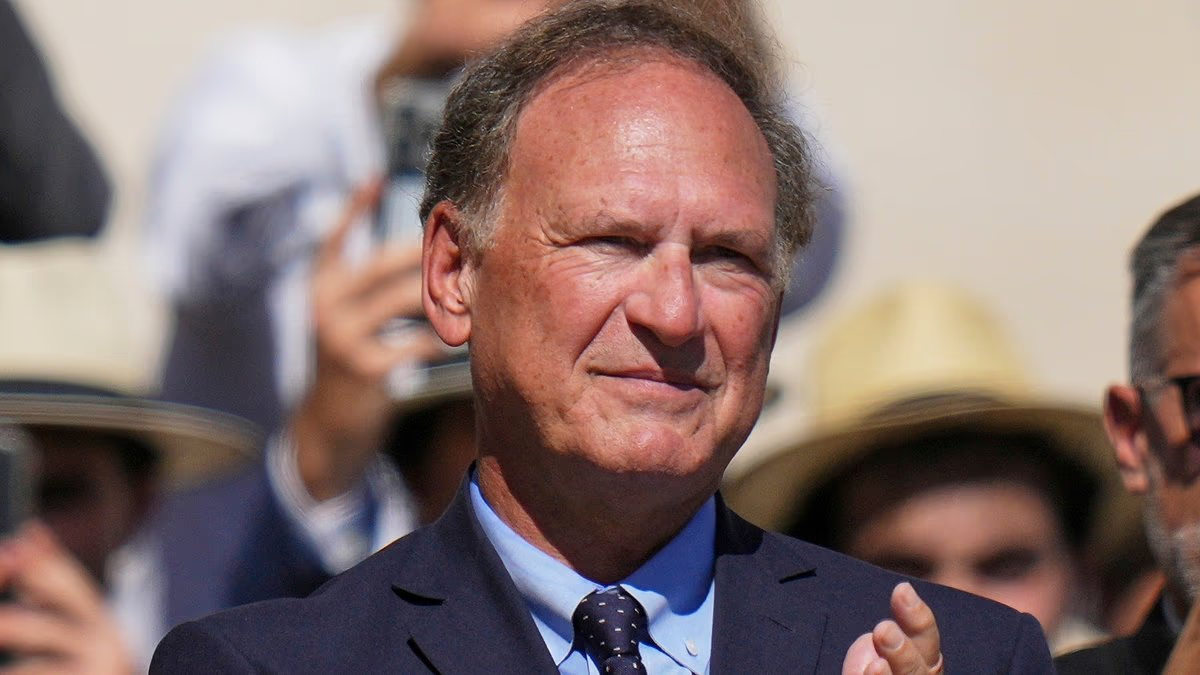

Supreme Court Justice Samuel Alito used a rare public appearance Thursday to discuss the growing role of artificial intelligence in the courts, the expansion of the court’s so-called “emergency docket” and his belief that the judiciary remains the least dangerous branch of government.
In a conversation with Mollie Hemingway at the Scalia Memorial Dinner, Alito spoke at length about the challenges facing the Supreme Court. He addressed both broader institutional concerns and the increasing number of emergency appeals reaching the justices.
Asked about the “shadow docket”—the process through which presidents ask the Supreme Court for urgent relief—Alito said the recent surge in applications can be traced to two main developments.
“The first is that presidents have become very frustrated with their inability to get Congress to enact their wider legislative agendas,” he said. As a result, presidents have sought to accomplish more through unilateral executive action.
The second factor, Alito said, is the growing number of lawsuits filed by both political parties in federal district courts around the country.
The United States now has 680 district judges, he noted. “They are dedicated and they are skillful, but they are not perfect,” Alito said. “They make mistakes. And in some instances, I think they have gone too far,” including by altering rules in recent years.
Earlier in the evening, Alito used an analogy involving a hand grenade, a 500-pound bomb and a nuclear weapon to distinguish the relative power of the three branches of government. His point was that the federal judiciary is the least dangerous branch, although it still presents risks.
The hand grenade, he said, “is the least dangerous, but that’s not to say it’s not dangerous.”

Justice Samuel Alito said the Supreme Court’s first concern is the frustration of presidents who cannot persuade Congress to pass their broader legislative agendas

Alito likened the three branches of government to a “hand grenade,” a 500-pound bomb and a nuclear weapon while describing the federal judiciary as the least dangerous branch
SEE ALSO: Texas High School Girls’ Basketball Brawl: Adult Bodyslams Player

The comments came as Alito, 76, has pushed back against speculation that he may retire before the end of the term, saying he believes he can “still make a contribution”
The federal judiciary, Alito said, “is the least dangerous branch,” though “that is not to say that it cannot be dangerous when it moves astray.”
Alito also reflected on the changing nature of public debate, drawing a comparison to his lifelong support for the Philadelphia Phillies.
“For a time,” he recalled, baseball “really was our national pastime.” People from all walks of life could discuss the sport, engage with one another and disagree without turning those differences into hostility.
That dynamic has changed, Alito said. Americans now follow a broader range of sports, which he described as a positive development, but he suggested the shift has also weakened a shared sense of community and made it harder for people “to disagree well.”
The appearance comes as Alito, 76, continues to reject speculation that he is considering retirement.
The George W. Bush appointee has used several recent interviews connected to the release of his book to emphasize that he does not plan to leave the Supreme Court before the end of the term.
“Retirement is something I think that somebody at my age has to think about every term,” he told CBS News’ Jan Crawford earlier this year.
Some observers have suggested that an Alito retirement could give President Trump an opportunity to nominate another justice. Alito has rejected that idea, saying politics was “not a factor” in his decision-making.
Instead, Alito said, “I think I can still make a contribution.” He added: “It’s hard to give up the opportunity to do something that I think will be good for the Constitution and good for the country as long as I’m able to do it.”
MORE ON THIS: Sticky Fingers Frontman Dylan Frost and Girlfriend Caught in AVO Dispute