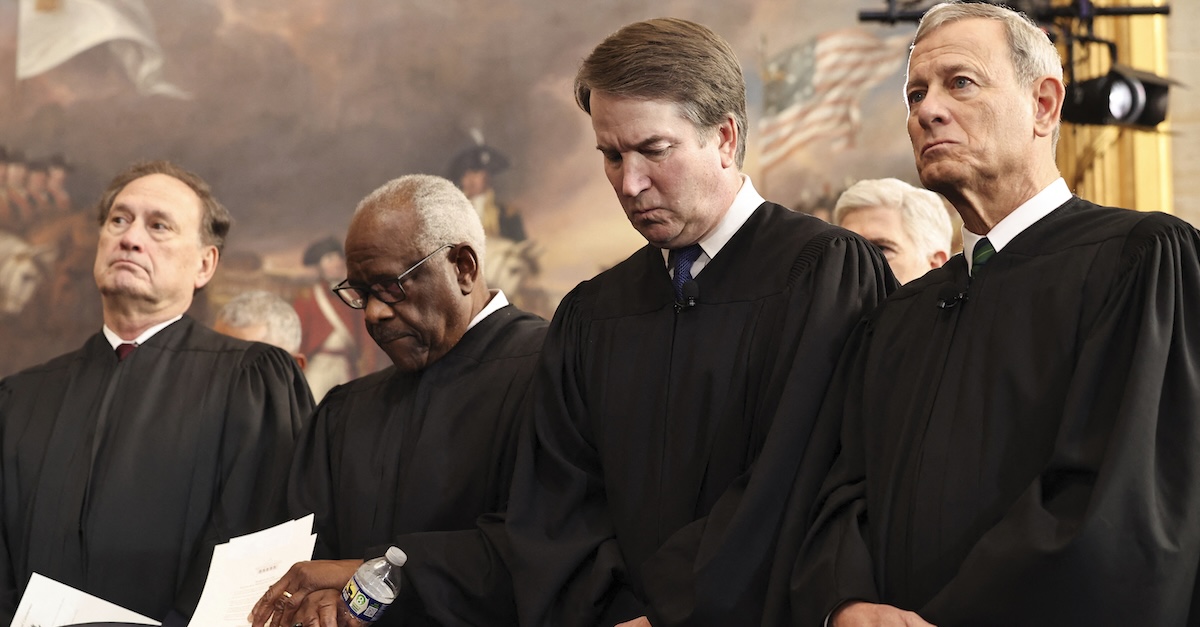

U.S. Associate Supreme Court Justices Samuel Alito, Jr., Clarence Thomas and Brett Kavanaugh and U.S. Supreme Court Chief Justice John Roberts look on during inauguration ceremonies in the Rotunda of the U.S. Capitol on January 20, 2025 in Washington, DC, USA. Donald Trump takes office for his second term as the 47th president of the United States. Photo by Chip Somodevilla/POOL/Abaca/Sipa USA (Sipa via AP Images).
Justice Clarence Thomas highlighted a significant rift among the conservative justices on Wednesday by aligning with an Army veteran who was severely injured in a 2016 Taliban suicide bombing at a U.S. military base in Afghanistan.
In a notable stance, Justices Neil Gorsuch, Amy Coney Barrett, Ketanji Brown Jackson, Elena Kagan, and Sonia Sotomayor agreed with Thomas that the 4th U.S. Circuit Court of Appeals had erred in its decision. The court had previously determined that federal law “preempted” former Army specialist Winston T. Hencely’s efforts to hold a military contractor liable in state court for the negligent hiring and supervision of the bomber, Ahmad Nayeb.
Justice Thomas recounted the harrowing incident of November 12, 2016, where Hencely identified Nayeb, a Taliban operative, approaching a Veterans Day 5K race. As Hencely attempted an intervention, Nayeb triggered his explosive vest, resulting in five deaths and 17 injuries. At just 20 years old, Hencely sustained a fractured skull and brain injuries, and the Army later acknowledged that his actions “likely prevent[ed] a far greater tragedy.”
While Thomas often resists expanding the scope for suing the government over civil rights infringements, he has consistently expressed his stance on the Feres Doctrine. This doctrine asserts that the Federal Tort Claims Act (FTCA) does not permit claims related to injuries occurring as part of military service.
On Wednesday, Thomas seized the opportunity to make an impactful statement, asserting that the “preemption rule on which the Fourth Circuit relied” against Hencely was unfounded in the Constitution, federal statutes, or precedent. He emphasized that Nayeb’s actions “were neither ordered nor authorized by the Federal Government.”
He further argued, “The Constitution’s war powers do not necessitate the dismissal of all tort claims linked to a war zone, contrary to what the Fourth Circuit’s rule demands. The allocation of these powers to Congress and the Executive has never been interpreted as a prohibition on all war-related tort lawsuits.”
“To the contrary,” Thomas concluded, “barring other statutory or constitutional considerations, plaintiffs have been able to enforce their legal rights even when they are violated during war.”
Justice Samuel Alito, joined by Chief Justice John Roberts and Justice Brett Kavanaugh, then swooped in with a rare break from Thomas.
Alito said the majority essentially gave states a green light to regulate the federal government’s “security arrangements on a military base in an active warzone[.]”
“Under the Constitution, the power to make war and conduct combat operations is entrusted exclusively to Congress and the President. The Constitution expressly excludes the States from this field, and thus no state law, including state tort law, may intrude on the Federal Government’s authority over combat-related operations,” Alito said. “This suit violates that cardinal principle.”
Looking ahead, Alito expressed “concerns” about the implications for trial, predicting the high court’s decision is “likely to implicate the Government’s policy decisions about the operation of Bagram Airfield during the War on Terror.”