
Share this @internewscast.com
Prime Minister Anthony Albanese is gearing up for a major policy reversal as he considers establishing a royal commission into the Bondi Beach terror attack.
This shift isn’t driven by a change in principle but rather appears to be a strategic move to safeguard his political standing. Albanese is now focused on maneuvering this policy pivot without any missteps.
In recent weeks, the Prime Minister dismissed the call for a Commonwealth royal commission, labeling it as an emotional and divisive endeavor that could potentially disrupt the national atmosphere.
Both Albanese and Immigration Minister Tony Burke have expressed concerns that such a commission could threaten social cohesion, amplify extremist voices, and fuel antisemitism. Burke, in particular, has reportedly been a vocal opponent of the idea, advising Albanese against pursuing this course of action.
Questions arise as to whether these earlier apprehensions have dissipated or were perhaps exaggerated from the start.
Now, the Prime Minister appears to be reconsidering; he is no longer dismissing the possibility of a royal commission. Reports indicate that he is becoming more receptive to the idea, engaging in daily discussions to evaluate the need for additional responses.
Not because the facts have changed. Not because the logic has changed. Not because the public suddenly became less cohesive. But because the politics changed and he knows it. His base instincts are kicking in.
That’s the part that should anger people who care about leadership rather than performance.

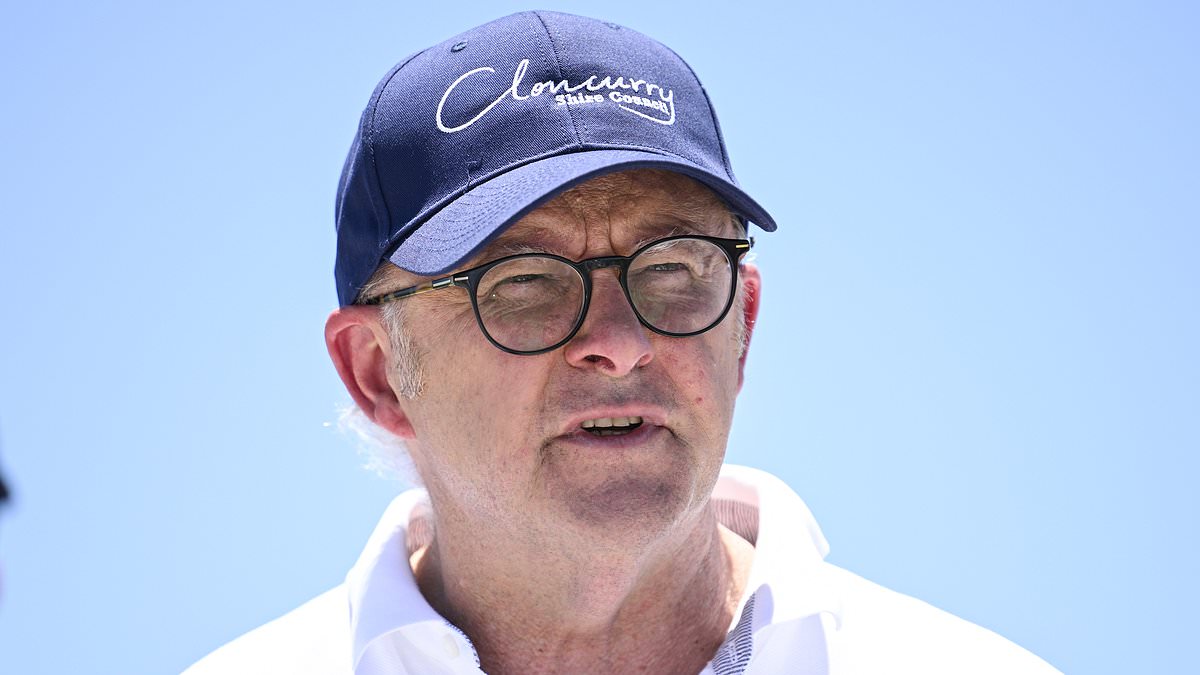
Anthony Albanese (pictured in Queensland on Tuesday) is preparing to backflip and call a royal commission into the Bondi Beach terror attack
A royal commission was either an unacceptable risk to social cohesion, or it wasn’t. It was either an inappropriate vehicle for scrutinising national security, or it wasn’t. It either took too long to be useful, or it didn’t.
Albanese cannot spend weeks selling one story with moral certainty, only to pivot when the political pressure rises, without exposing what the earlier story really was: absolute rubbish.
The government tried to box this up as a choice between urgency and delay. That was a rhetorical trick.
The choice was never binary, there was no choice that had to be made. Albanese claimed the country needed ‘unity and urgency’ rather than ‘division and delay’, and he framed the Richardson review as the mature, practical alternative.
But a PM doesn’t get to pretend there are only two options: either a narrow review now or a royal commission later. That’s a false narrative.
It was always open to him to do both: move immediately on operational gaps and security settings, while committing to a full, properly empowered Commonwealth inquiry to answer the bigger questions the public is asking.
The idea that one precludes the other is convenient nonsense.

This isn’t a minor controversy that fades with time. Families want answers and communities want confidence restored (pictured, a memorial at Bondi Beach in December)
And what about those ‘actual experts’ that Albanese so arrogantly said were advising him against a royal commission?
It was a rhetorical device used at a media conference to bat away questions about the growing list of experts putting their names next to demands for a royal commission.
The PM never named his ‘actual experts’, of course, because they possibly don’t exist. But he certainly tried to hide behind their illusory shadows to repel calls by named experts to do something Albanese didn’t want to.
Is he now planning to go against the advice of his unnamed ‘actual experts’ if he backflips?
The trouble with anonymous expert advice is that it functions like a ventriloquist’s dummy. It says whatever the politician needs it to say at the time.
If the PM now slides into supporting a royal commission, what exactly happened to that expert advice? Did the experts change their minds in a fortnight? Or did the PM’s interpretation of their advice simply become more flexible once the polls and the headlines demanded it? Or did the advice never exist?
The same applies to the social cohesion argument. It was used as a trump card: the moral high ground that allowed Albanese and Burke to paint critics as reckless and themselves as responsible.
Burke went further, warning a royal commission would ‘provide a public platform for some of the worst statements and worst voices’ and ‘effectively relive’ the worst antisemitism.

It is understood Immigration Minister Tony Burke (pictured) leaned hard on dissuading the PM from calling a royal commission
After such strong words of concern, I can only assume that if Albanese does announce a royal commission Burke will resign on principle on the spot, because to not do so would expose the callowness of his warnings. I won’t hold my breath, however.
Did all those cohesion concerns simply evaporate? Were they overstated? Were they made up? Or were they simply an excuse to avoid accountability until the political cost of avoidance became greater than the political cost of action?
That is what this episode reveals about Albanese’s instincts: a reflex to manage, contain and defer. Not to lead. Not to confront. Not to take the hit early to earn trust later.
He tried to outlast the moment, to let outrage burn off, to swap a big public reckoning for a smaller process he could frame to his liking.
It hasn’t worked because this isn’t a minor controversy that fades with time.
Families want answers. Communities want confidence restored. And a widening group of serious voices has kept pushing because the question isn’t just what happened at Bondi, but what the attack says about the environment that produced it and the failures that didn’t stop it.
Perhaps that’s what Albanese wanted to hide from. It’s potentially where his next slippery step will lead to: attempts to frame any royal commission’s terms of reference in a way to help the PM weasel out of political blowback in the years to come. Watch this space.
Former New Zealand PM Jacinda Ardern’s response to Christchurch was not perfect and it should not be mythologised. But she understood something essential: in a national trauma, the public looks for clarity, empathy and purpose.

The response to the Christchurch shooting by former New Zealand PM Jacinda Ardern (pictured with UK PM Keir Starmer) was not perfect and it should not be mythologised
Speed matters, but so does symbolism. Accountability matters, but so does the sense that a leader is not hiding behind process.
Albanese had an opportunity to show that kind of authority after Bondi. Instead, he built a case for why he couldn’t do the one thing everyone was asking for, what the families of the victims were pleading for.
And now, after insisting a royal commission was the wrong tool, he is edging towards it anyway. Not because he suddenly discovered its virtues, but because the cost of saying ‘no’ became politically unsustainable.
That is the very definition of self-interested government: decision-making calibrated to personal survival, dressed up as national interest until the costume no longer fits. It’s the very worst of politics the public intensely loathes.
If Albanese does announce a royal commission, he will no doubt try to claim it as proof of responsiveness. Or he’ll try to spin that he was always open to having one. Pull the other one.
He will talk about listening. He will cite the evolving conversation. He will present it as the natural next step.
But the truth will be much simpler. He resisted until he couldn’t. He delayed until the delay became the story. He clung to excuses until the excuses started to damage him more than the decision itself.
That is not statesmanship, it is a salvage job and a messy and painful one at that.