
Londoners have been warned to prepare for elevated air pollution after dense fog settled across south-east England on Monday.
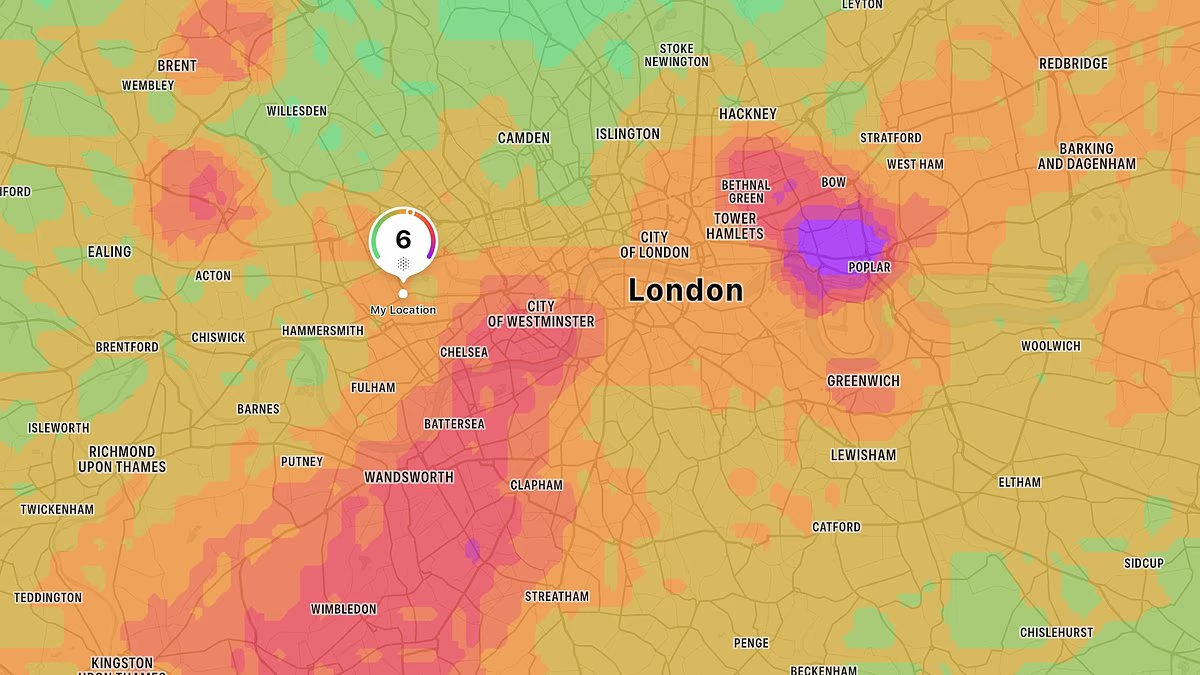
Mayor of London Sadiq Khan issued a high-pollution alert for the capital on Monday evening, urging people most at risk to take precautions.
Motorists have been asked to switch off their engines while stationary, while homeowners are advised not to burn garden waste, which could further worsen air quality.
The alert followed a yellow fog warning from the Met Office covering large parts of England and Wales. Visibility was expected to fall below 100 metres in some areas.
Fog and light winds that arrived over the weekend allowed pollutants to build up through Monday morning. Smoke from Bonfire Night and Diwali fireworks may also have added to the problem.
Mr Khan wrote on Monday evening: ‘I’m triggering a high air pollution alert for London on Tuesday 10 November.
‘I urge everyone in the capital, particularly those most vulnerable, to stay safe and follow health advice to limit their exposure.
‘Please switch off engines when idling and avoid burning garden waste, which contributes to pollution.’

Londoners have been warned to expect high air pollution after dense fog descended across south-east England on Monday

A train travels towards Wimbledon in south-west London through dense fog yesterday

An Apple map shows forecast air quality around London on Tuesday morning
The poor visibility also disrupted flights at London’s airports, with several services from Heathrow and London City cancelled on Monday morning.
By 6.30am, seven Heathrow flights and three from London City Airport had been cancelled.
Heathrow later urged passengers driving to the airport to allow extra time, saying overnight fog had reduced visibility on roads in the area.
DISCOVER MORE: Manhunt Underway After Armed Suspects Shoot at California University Dormitory
‘We advise passengers to check with their airline before leaving home and to drive with care,’ the airport said on X.
Niamh Murray, an operational meteorologist at the Met Office, described the current conditions as the ‘perfect recipe’ for fog.
‘During autumn and winter, we get fog at this time of year because the nights are much longer, allowing temperatures to fall,’ she said.
‘There is a longer period of cooling, and temperatures are lower, bringing them closer to the point at which the air becomes saturated and fog forms.
‘We also need relatively light winds to form fog, rather than completely calm conditions.
‘At the moment, we have the perfect combination: light winds, clear skies and long nights, all allowing fog to develop. If temperatures fall below freezing, it can be particularly stubborn and may linger into the following day.’
The AA has urged motorists to take extra care during the yellow warning. Drivers should slow down, leave a larger gap between vehicles and ensure their lights are switched on.
Join the discussion
Should drivers and homeowners face tougher penalties for disregarding pollution warnings on foggy days?
The motoring organisation cautioned that automatic headlights should not be relied upon because they may fail to detect fog. Instead, drivers should use dipped headlights, which also help illuminate the rear of the vehicle.
The AA also reminded motorists to turn off their fog lights once visibility improves, warning that their brightness can dazzle other road users.
AA president Edmund King previously said: ‘Fog can transform a familiar road within minutes, so drivers must be ready to adjust their speed and leave more space between their vehicle and the one ahead.
‘One of the biggest mistakes is simply following the rear lights of the car in front. That can create a false sense of security and may leave you travelling too close to stop safely if the vehicle ahead brakes suddenly.
‘There is no reward for arriving a few minutes early. Allow extra time, slow down and drive according to what you can actually see ahead.’


