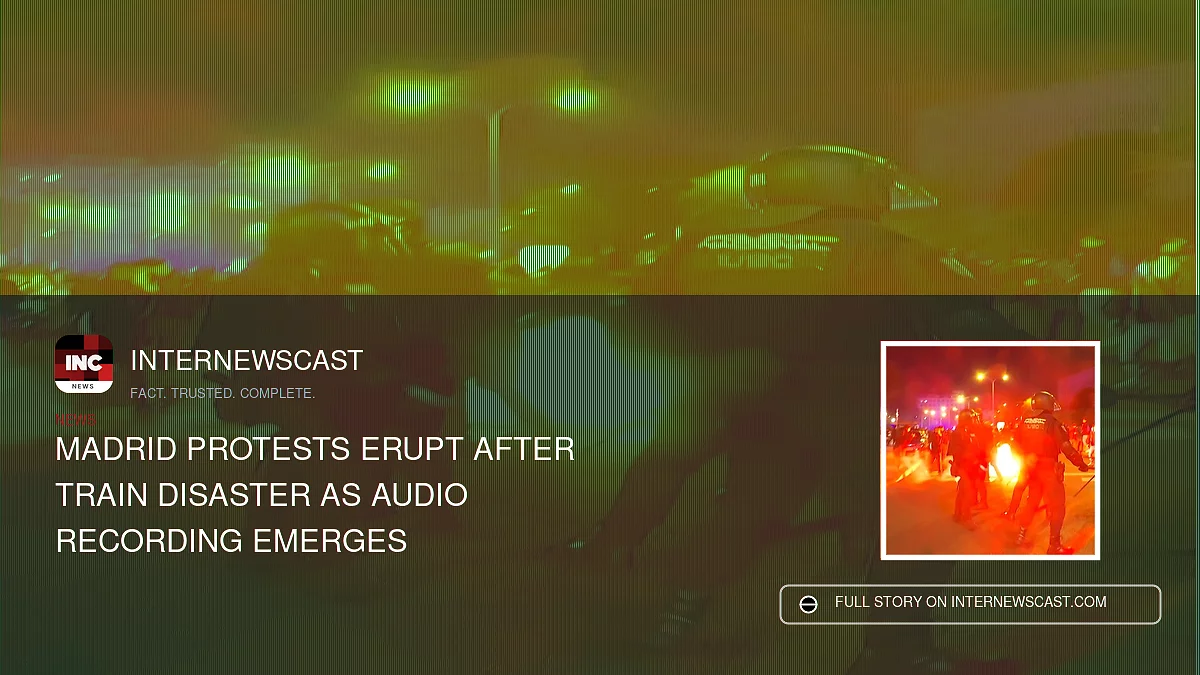

Violent protests broke out in Madrid last night as public fury intensified over the failures surrounding Wednesday’s catastrophic train collision, which claimed 69 lives.
The unrest followed the release of an audio recording from the control centre, captured just minutes before the crash, which appeared to show operators failing to warn one of the drivers about the imminent danger.
The disaster is Spain’s third fatal railway accident this year. Two crashes in January killed 47 people in one incident and the train driver in another, while dozens more were injured.
Protests began outside the Ministry of Transport on Wednesday evening, with demonstrators calling for Prime Minister Pedro Sanchez and Transport Minister Oscar Puente to resign.
The collision occurred shortly before 9am when a Renfe train travelling from Madrid to Seville struck a stationary Iryo train on the same route near Toledo. Three carriages were derailed.
The crash killed 69 people and injured more than 100, leaving behind scenes survivors described as “apocalyptic”. One passenger said the wreckage looked “as if a bomb had been planted”.
The death toll increased by one on Thursday, rising from the previously reported figure of 68.
Local reports said a demonstration that began near Nuevos Ministerios at 8pm was initially peaceful before protesters and police became involved in direct clashes.
Some demonstrators overturned rubbish bins and at least one person started a fire. Video footage showed officers forcefully pushing back protesters carrying banners and Spanish flags.

A protest that began near Nuevos Ministerios at 8pm reportedly turned violent after initially passing off peacefully

Crowds chanted “Pedro Sanchez is to blame” and “Oscar Puente is a murderer” while demanding the politicians step down

Police officers push protesters back during clashes on Wednesday night

A protester holds a flag featuring Pedro Sanchez alongside the words “Get out!”
Protesters were heard shouting “Pedro Sanchez is to blame” and “Oscar Puente is a murderer” as they called for both politicians to resign.
Riot Control Unit officers used pepper spray and rubber bullets to break up the crowd.
One protester told El Mundo: “We weren’t doing anything, and at one point they pushed us violently and started telling us to leave. When they realised many people were not moving, they tear-gassed us. There are elderly people here.”
Several hard-Right organisations, including Revuelta, which has been endorsed by Spain’s VOX party, are reportedly urging people to stage further demonstrations across the country.
The recordings from the control centre indicated that operators failed to tell the Renfe driver about the signal failure that had left the Iryo train stopped on the tracks.
At 8.41am, the Iryo driver informed the control centre that its LZB safety system had failed and that she was stationary at the Urda entry signal.
The controller authorised her to continue normal operations while issuing the same instruction to the approaching Renfe train, without warning its driver about the failed signal or the stationary train ahead.
At 8.48am, five minutes before the collision, the Iryo driver called again to say she still could not restart the system. The controller told her to try once more and call back if she encountered further difficulties.
Transport Minister Oscar Puente said on Wednesday that an automatic control system had failed along 69 kilometres (43 miles) of track, bringing all trains in the area to a halt.
However, the control centre decided to “resume traffic in circumstances that, from our point of view, are inexplicable”, Puente said. The Renfe train travelled 25 kilometres before hitting the Iryo service.
The control centre “had more than enough time to verify the error, and they did not fix it”, he added.
Spain suffered another railway incident on Thursday when a train near Toledo was halted inside a tunnel after an event disrupted the electricity supply.
The 454 passengers on board were forced to leave the train, which became stranded inside a tunnel more than one kilometre long, according to El Espanol.
FIND OUT MORE: Wegmans Confirms Upper West Side Store After 2 Years of Silence
Flags were lowered to half-mast on public buildings on Thursday as Spain observed a national day of mourning. Official ceremonies and public events were cancelled or scaled back in memory of those killed in Wednesday’s crash.

Investigators inspect debris scattered among damaged carriages after the collision between two high-speed trains

Heavy machinery removes a damaged carriage from the site of the high-speed train crash
Emergency crews worked through the night, searching the wreckage for more victims on the key rail route connecting Madrid with Seville. Cranes lifted sections of twisted metal from the scene.
At dawn, police drones were again deployed over the crash site, located a few kilometres from the small village of Urda.
A school in Urda, about 130 kilometres south of Madrid, has been converted into a centre where relatives can seek information about missing loved ones.
Red Cross teams offered assistance to groups arriving at the centre, with some relatives in tears as police and journalists from around the world gathered nearby.
Red Cross psychologist Carmen Garcia warned that “long and hard hours” lay ahead because “every person will manage it in their own way”.
“We have people who are in shock, who haven’t taken on board what has happened, angry people, sad, worried people. The grieving will be complicated,” Ms Garcia said.
Sebastian Herrero, 46, who was travelling on the Iryo train, said the impact threw him against the seats and sent him “in the air for about four or five seconds”, a period that felt “like a lifetime”.
He said: “There are three carriages of the Iryo, the three at the end, from which they keep taking people out and putting sheets on them. Corpses. It’s apocalyptic.
“In those carriages, I find it very hard to believe there are any living people. It’s a twisted mass of metal. It’s as if they had planted a bomb.”
A survivor named Jesus said: “I saw a boy with an amputated arm walking away from the wreckage.”
Architect Joaquín Torres also described the death of a fellow passenger who suffered devastating injuries.
He said: “I went up to a woman who said she was cold… she died in my arms. It was horrible, [she was] without legs, without arms.”

A passenger rescued from one of the trains arrives at the support centre in Urda, Spain

Two people wait outside the Urda centre for relatives of missing passengers

A Red Cross volunteer comforts a woman outside the support centre in Urda
One carriage caught fire, and smoke continued to rise from the mangled wreckage as emergency responders arrived.
It also emerged last night that Fatima Banez, Spain’s former employment minister, was among those killed.
Harrowing images showed one carriage impaled by a long steel rail that had pierced the floor and emerged through the roof.
Other photographs showed passengers escaping from carriages torn apart in the collision. David Gomez, a construction worker, was nearby on a job with his brother and a colleague when they heard the crash and rushed to help.
“People were trying to get out through the windows. We cut through some fences to access the area and treated people with first-aid kits we brought,” he said. “As I was trying to pull a young woman out, there was a piece of a leg.”
One survivor said his carriage had been “completely wrecked”, adding: “The impact was tremendous.
“The carriage was completely destroyed. A man fell on top of me, but we were able to help him. It was a very dramatic scene.”
Another passenger said the force of the collision left her “spinning on the floor”.


