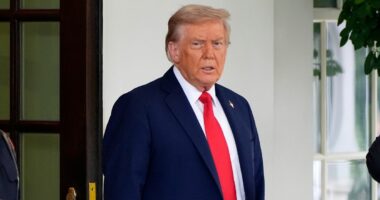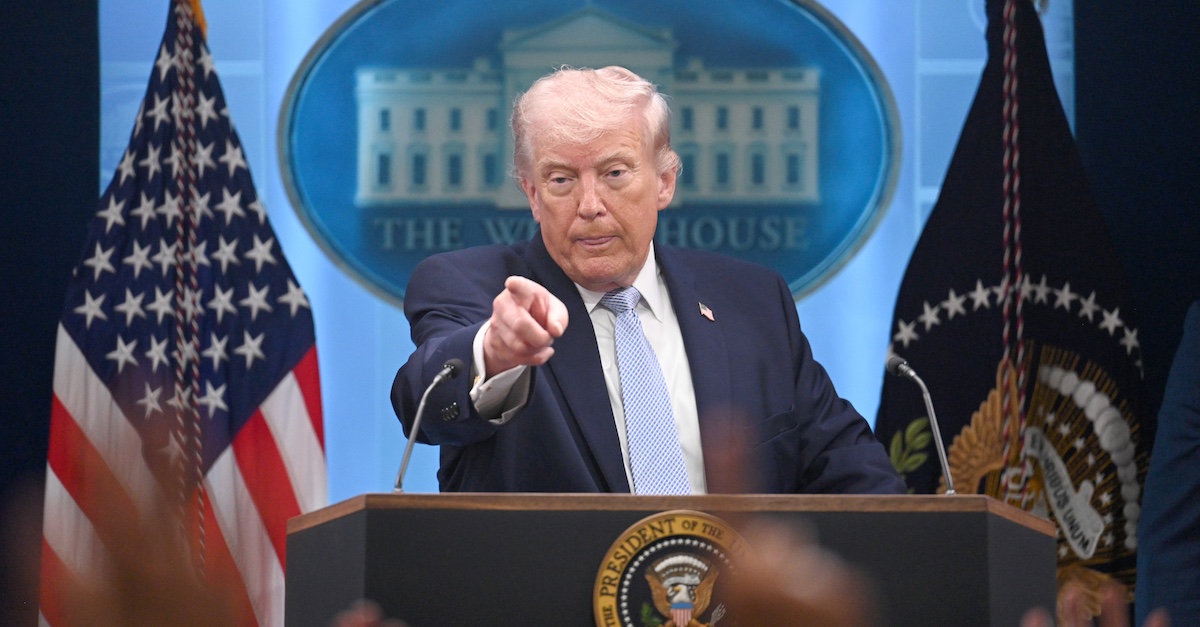

The United States President Donald Trump holds a Press Conference in the James S. Brady Press Briefing Room at the White House on April 6, 2026 in Washington DC. (Photo by Chen Mengtong/China News Service/VCG via AP).
Less than a week after the Department of Justice (DOJ) laid out a rationale allowing President Donald Trump to discontinue adherence to certain legal obligations, a new lawsuit has emerged, raising the alarm that there is a “substantial likelihood” Trump might retain or destroy significant records post-presidency.
The American Historical Association (AHA) and American Oversight have jointly filed a 46-page complaint in Washington, D.C. This legal action challenges a memo from the DOJ’s Office of Legal Counsel (OLC), which they argue effectively grants Trump a “permission slip” to disregard the Presidential Records Act (PRA). The lawsuit contends that this interpretation of the law harms their interests.
The PRA was established in the wake of the Watergate scandal and Richard Nixon’s failed attempt to contest the Presidential Recordings and Materials Preservation Act. This law was designed to ensure that the United States maintains “complete ownership, possession, and control” over presidential records. It mandates that the president thoroughly document all “activities, deliberations, decisions, and policies” related to their official duties for submission to the National Archives (NARA) and, by extension, to the American public.
Despite this, on April 1, the OLC issued an opinion stating that Trump was not required to comply with the PRA, declaring it “invalid in its entirety” and “unconstitutional.” The memo went so far as to argue that Congress lacks the authority to preserve presidential records solely for historical purposes.
Previously, Law&Crime highlighted that the OLC memo made references to Trump’s dismissed Mar-a-Lago classified documents case. It criticized efforts to hold a former president criminally liable for handling presidential records, which historically would have been under his sole discretion.
Interestingly, Acting Attorney General Todd Blanche had unsuccessfully made a similar argument while representing Trump in court. U.S. District Judge Aileen Cannon eventually ruled that Special Counsel Jack Smith had been improperly appointed, leading to the dismissal of the case on those grounds.
Now Blanche’s DOJ has to defend against a lawsuit from “historians, researchers, and educators” and a nonprofit legal group who “rely heavily on access to historical records about the inner-workings of the federal government to undertake their missions.”
Because the Trump administration’s policy “does not prohibit” Trump, Vice President JD Vance, or their staffs from using apps that “auto-delete” messages and “does not require the President to preserve all paper records and other physical records in his possession that constitute Presidential records under the PRA,” it “nullified” the PRA, overrode the Supreme Court, and must be blocked, the plaintiffs said.
“The Executive Branch has declared the power to override the legal determinations of the U.S. Supreme Court, in order to override the laws passed by Congress to preserve and provide public access to official records of the President’s activities. The Executive Branch has nullified the determinations of the other two branches of government so that the President may claim these official government records to be his own,” the filing said. “As of this moment, the Administration believes that the President is legally free to destroy records of his official government conduct, or even spirit away the records for his own future personal use.”
The lawsuit asked a judge to declare that the PRA is constitutional, to force acting Archivist Ed Forst to comply with the law, and to ensure the defendants “disclose to the Court any known instances in which the President destroys, converts for personal use, or otherwise fails to maintain Presidential records as required by the PRA.”