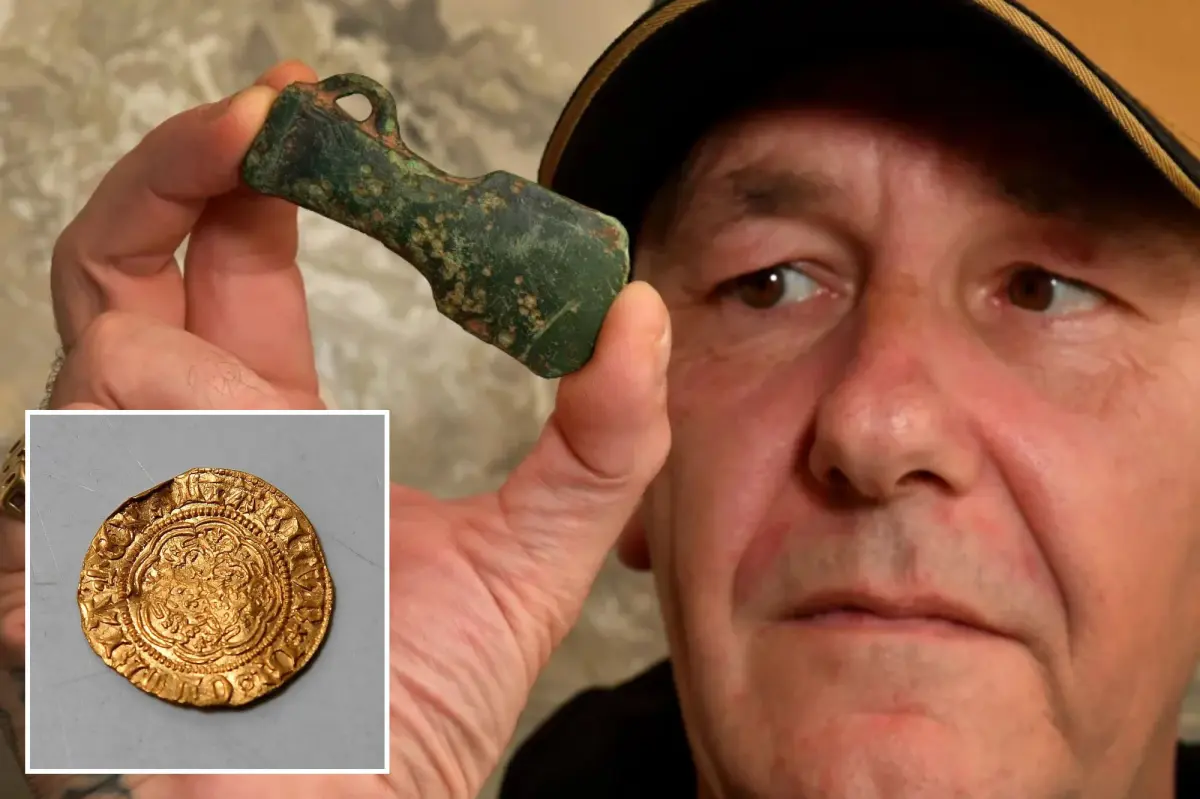

A metal detectorist has struck Bronze Age gold after uncovering an exceptionally rare 3,000-year-old axe head thought to be the first example of its kind found in Britain.
Paul Pritchard, 49, was scanning a field in Shropshire when his detector produced what initially seemed to be a weak and unimpressive signal.
After digging, however, he revealed a complete socketed copper-alloy axe head dating to between 1140 and 950 BC. Experts have described its design as having “no British parallel.”
The extraordinary Bronze Age discovery came only a few months after Paul unearthed a medieval gold coin, giving him two major finds in the same year.
The detectorist, who lives in Willenhall in the West Midlands, called the ancient artifact a “bucket list moment” for anyone involved in metal detecting.
He said: “The signal was really poor at first, but I hadn’t found anything else, so I thought, ‘I’ll give it a go.’
“As I dug down, the signal became stronger. Then it appeared from the soil.
“I had just turned the earth over with my spade when I saw it sticking out. I knew immediately that it was a socketed axe.”
Paul feared the valuable-looking object could have been damaged, but the almost 3,000-year-old artifact turned out to be remarkably well preserved and completely intact.
He said: “Finding the gold coin was a different kind of excitement. With the axe head, it was disbelief because it is a metal detectorist’s bucket list moment — something every detectorist hopes to find.
YOU MIGHT ALSO LIKE: Kushner: Israel Risks Global Pariah Status, Touts Saudi Ties
“Once I realized it was complete, I immediately asked another club member, Bob, to take a look.
“He is very knowledgeable and, as luck would have it, was only about 20 feet away. I showed it to him, and he instantly said it had a very unusual shape.”
The rare find soon became the talk of the gathering, sparking excitement among the other detectorists.
Paul said: “After that, people kept asking, ‘Did you find the axe head?’ and ‘Can I see it?’ They were all commenting on its unusual shape and saying they had never seen anything like it.”
The discovery was made during an event hosted by the Shrewsbury and Shropshire Metal Detecting Club in Hinstock, North Shropshire.
News of the find spread even further after the club shared a post about it on Facebook.
Paul said: “It just took off, with people liking the post and commenting about how rare it was.”
Experts later confirmed the importance of the Bronze Age artifact, noting that its shape was “unusual for socketed axe heads” and that it may have been created for use as a specialist tool.
Looking back on the discovery, Paul said: “It is a bit surreal. I still can’t believe how significant it is.”
He added: “There is a lot of dedication involved, as well as the equipment you use, but I feel incredibly lucky that I was the person who walked over it. There were around 44 other people there that day, and any one of them could have found it.”