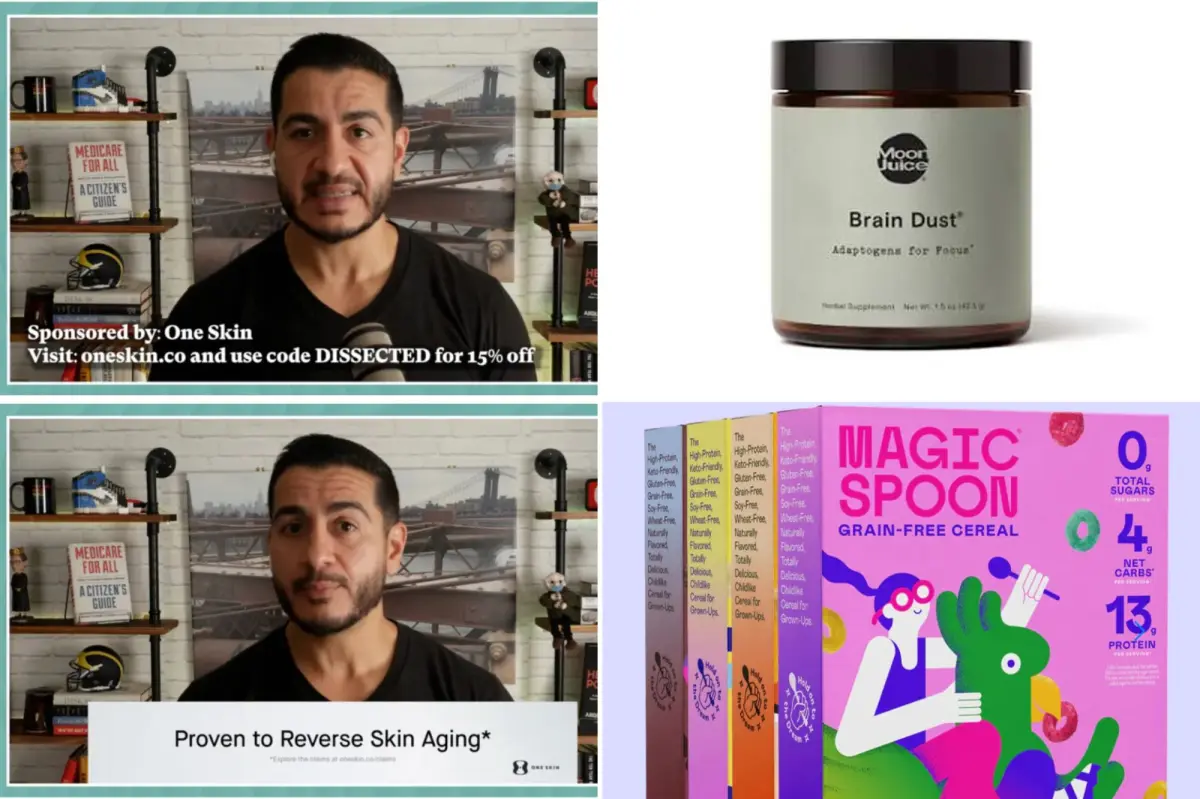

WASHINGTON — Democratic Senate hopeful Dr. Abdul El-Sayed has previously used his podcast to advertise health-related products that have faced skepticism, even as he criticized other medical personalities for promoting similar offerings.
El-Sayed — who polling indicates is ahead in Michigan’s Democratic primary against state Sen. Mallory McMorrow and Rep. Haley Stevens — sharply criticized Dr. Mehmet Oz during Oz’s 2022 Senate campaign, accusing him of trying to “sell people s— they didn’t need.”
“He hasn’t been telling it like it is, he’s been telling it like some companies pay him to tell it like it is,” El-Sayed said of Oz during a 2021 appearance on the “Bad Faith” podcast.
“He is, in fact, part of the same kind of medical industrial complex that exists to sell you things that you don’t need that are not actually based in any level of science,” he continued. “Yet he can … say, ‘Well, I’m a doctor, so you should trust what I have to say.’”
During that period, El-Sayed — an epidemiologist who later became director of the Department of Health, Human, and Veterans Services in Wayne County, Mich. — hosted “America Dissected,” a podcast centered on health care and politics that included advertisements from at least 35 sponsors over 316 episodes.
In March 2022, several months after his comments about Oz, El-Sayed drew criticism on social media for promoting Magic Spoon Cereal, a brand widely marketed through social media platforms and podcasts.
“I broadly reject any advertisements that are for products making claims about health,” El-Sayed replied in a since-deleted post on X. “Magic spoon [sic] is simply a high-protein, low-carb cereal. They’re not claiming to improve your sleep or add years to your life, which is why I read them.”
Although he had said he would avoid endorsing products “making claims about health,” El-Sayed read ad copy for companies whose broad wellness claims have been questioned by some medical professionals.
Across multiple episodes, he promoted the Lumen metabolic coach, a breathalyzer-like device marketed as a tool that can indicate whether users are burning fats or carbohydrates during exercise and then offer nutrition guidance.
“[T]o maximize what it was I was going to eat, or when I was going to work out, I really wanted to know what it was that my body was using for fuel. And that’s why I turned to Lumen,” he explained in one ad read in 2024.
Some health experts have dismissed the device as “quintessential marketing over science,” pointing out that it only measures carbon dioxide output while Respiratory Exchange Ratio (RER) metabolism readers examine other gases.
MORE STORY: Unexpected New Chapter: Texas AG's Mistress After Scandal Unraveled
“If you’re more than three hours without eating, you’ll burn more fat. If you’ve recently consumed some carbohydrates, you’ll burn less fat,” Harbor-UCLA Medical Center researcher Nicholas Tiller told Outside Magazine in May 2022.
“Do you really need an expensive gadget to measure your carbon-dioxide output and tell you this? I just don’t see a practical use for the product in helping people achieve their weight-loss goals.”
El-Sayed also promoted Thrive Market, which sells organic food products and various supplements, hailing it as a way to get all “my healthy essentials delivered.”
The company boasts products such as “Moon Juice Brain Dust” and “Royal Jelly Brain Fuel,” claiming they boost cognitive function and focus. Many of those types of brain supplements have been widely panned by health experts and El-Sayed did not endorse specific Thrive products on his podcast.
“There’s no evidence to suggest there’s an ingredient in supplements that can improve brain health,” Dr. Pieter Cohen, an internist with Harvard-affiliated Cambridge Health Alliance who has researched dietary supplements, warned this past February.
“Nothing legally contained in supplements has been proven to improve your thinking or prevent memory loss.”
In 2024, Thrive settled a lawsuit for $1.4 million for allegedly hoodwinking customers into automatic subscription renewals and making false claims about its subscription terms.
El-Sayed maintained his health podcast from 2019 through 2025, when he launched his Senate bid. The podcast was initially launched with Crooked Media, but the host formed his own company for it in 2024.
Financial disclosures indicate that he made over $100,000 from the production company he formed and that the firm’s value was up to $250,000. Most of that revenue appears to come from sponsorships.
Recently, El-Sayed accused his top primary foe, Stevens, of selling out to “corporations and special interests” despite his own history of shilling for questionable health and wellness companies.
El-Sayed’s campaign did not respond to repeated requests for comment.


