
Share this @internewscast.com
In a dramatic overnight operation, 800 residents in Plymouth were evacuated from their homes after a 50-kilogram Nazi-era bomb was found and subsequently detonated at sea.
Residents were abruptly awakened as authorities maintained a safety cordon around the bomb’s transport route from 11 p.m. until 3 a.m. the following morning.
The discovery of two separate unexploded World War II bombs on Wednesday prompted officials to declare a “major incident.” One bomb was unearthed at a construction site in Plymouth, while another was found in a marina in Exmouth after a local spotted a large device being dredged from the water.
In the early hours of Friday, bomb disposal teams worked diligently to safely detonate both devices on Devon’s seabed, ensuring the safety of nearby communities.
The first bomb to be neutralized was the German SC50 found in Plymouth. It was carefully loaded onto a vehicle and transported to Millbay docks and King Point Marina.
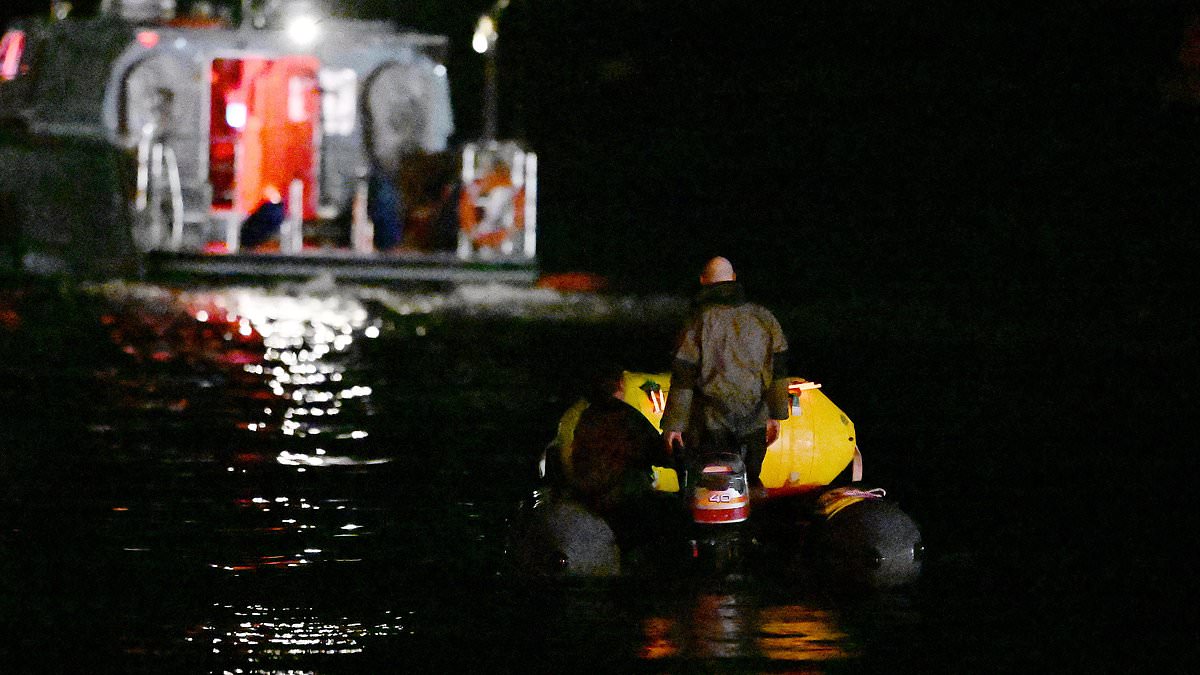
Upon arrival at the shore, the bomb was transferred to a small RIB boat with a team of bomb disposal experts. It was successfully detonated in a controlled explosion, which authorities confirmed was completed shortly before 3 a.m.
Plymouth Government said at 2.50am: ‘Military Operation now complete.
‘The operation to safely remove and dispose of the wartime device in Millbay has been successfully completed and people can return to their homes.
‘Over the past couple of hours around 800 residents were asked to evacuate from their homes to allow specialists to carry out the removal work safely.

The Royal Navy and EOD officials worked together in the dead of night on Thursday to detonate a 50kg WWII bomb that was discovered on Wednesday

The German SC50 was placed on a small RIB boat with a floater and heaved into the middle of the sea

Up to 5,000 people were displaced in the 48 hour operation, but it’s not the first time Devon locals have had to flee from old Nazi bombs
‘Once the area was confirmed clear, Royal Navy bomb disposal experts secured the device and transported it in a military convoy to King Point Marina. From there, it was transferred out to sea for a safe, controlled detonation.’
‘The cordon is now being lifted and everyone who has been evacuated can return to their homes,’ they added, thanking people for their patience and cooperation and the council staff, police and Royal Navy who helped in the 48-hour mission.
Next, a few hours later at 8.13am on Friday morning, the other WWII bomb found in Exmouth’s marina was detonated on the seabed.
Assistant Chief Constable Nikki Leaper, from Devon and Cornwall Police, told the BBC: ‘Everyone has pulled in really long hours to get this safely to a conclusion with minimum hours.
‘We didn’t want this going on for days and days.
She said: ‘Luckily some people were only out of their houses for a couple of nights, but this could have gone on, but because of the experts in their fields we’ve managed to bring it to a safe conclusion quite quickly.’
Army Colonel Darren Fisher said that identifying the fuse type used in the bombs was the key to ensuring they would not detonate when being moved.
Colonel Fisher told the BBC: ‘Having to X-ray and trying to understand the types of fuse that was in both those devices was key.’

The road at Martin Street in Plymouth was closed on Wednesday as the Royal Navy’s bomb disposal team attended the scene

Officials put a plan in place to safely move the bomb through built up residential streets to its final destination – the sea

Schools were closed and 800 people were asked to leave their homes on Thursday night while the Nazi bomb was being exploded – but some said the experience showed them the ‘spirit’ of their country
‘Really the complexity of the task was the state in which those devices were and also the positioning in which they were found by the operators to identify that fuse.’
Up to 5,000 people were evacuated across two days and a secondary school was forced to close on Thursday following the discoveries in Devon, as residents living within 1,300ft were warned to stay away.
Around one hundred people slept in makeshift accommodation at Exmouth’s leisure centre on Wednesday night and a further 20 on Thursday night as the bombs were examined meticulously and government officials put plans in place for their removal.
But many south coast locals were initially defiant at their forced removal, as cafes refused to close and pubgoers didn’t let the threat of a massive Nazi bomb get in the way of their plans.
Exmouth resident Eleanor Bradburn said she saw large numbers of police arrive on Wednesday night before getting a ‘knock on the door’ and an order to evacuate. She said: ‘I just grabbed a few things.. and went to the pub’.
While parts of Plymouth have been brought to a standstill, one defiant cafe owner insisted they were staying open.
Blooming Brew in Plymouth – which sits just outside the city’s no-go zone – told its customers: ‘No WW2 bomb will stop us from closing. We are still open today.’
News of the discovery in Plymouth was something of a Groundhog Day for locals, with one posting on X: ‘When you hear a WW2 bomb has been found in Plymouth’ along with a viral meme of ‘Brenda from Bristol’ and her famous slogan: ‘You’re joking, not another one!’
Others rather enjoyed the drama, with one couple who stayed at Exmouth’s LED Leisure Centre describing it as ‘like a holiday’.
Lawrence and his wife Sue told the BBC: ‘The last 24 hours we have lived in the leisure centre, it’s been magnificent from the top to the bottom, everyone has been smiley faced, we’ve all enjoyed it.
‘We bought a couple of bottles of wine last night, we’ve had fish and chips, I thought we’d been on holiday.’
He added: ‘Anybody tells me we’ve lost our spirit in this country, I’d say we’ve got it back.’
It is not the first time that Devon’s residents have stumbled across historic German bombs however.
In February 2024, Plymouth famously went into lockdown with 10,000 people evacuated when an unexploded WW2 bomb was discovered in a back garden by a father digging the foundations of his daughter’s new extension.
The discovery brought out the best of the city’s community spirit as kind locals took in evacuated residents while the 500kg explosive was extracted and transported by a military convoy through the city before being dropped into the sea.
Plymouth has had more than its fair share of unexploded bombs because the town was a primary target for the Luftwaffe during WWII as it houses HMNB Devonport – the largest naval base in Western Europe.
The city thus was a critical hub for the Allied forces and was a constant focus for Nazi air raids, suffering 59 bombing raids between 1940 and 1944.