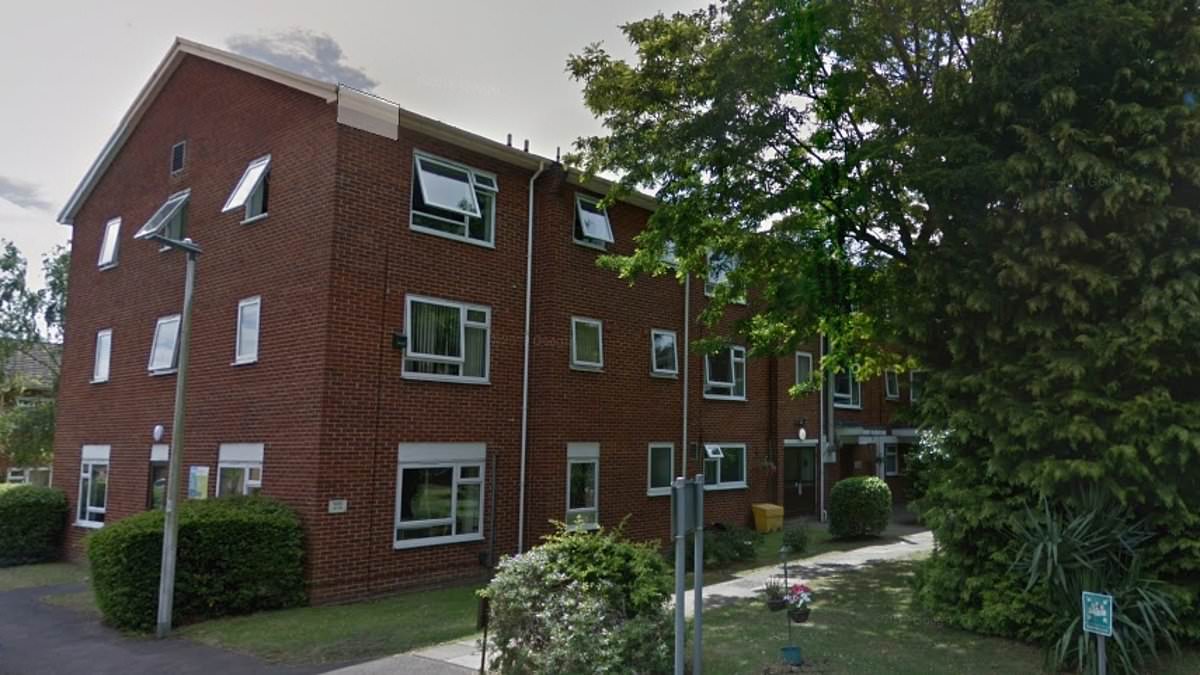

A migrant family of four with two young children are using human right laws to avoid being evicted from a retirement home reserved for over-55s.
Shahidul Haque, age 59, mentioned that he was unaware moving his wife, age 28, and their three-year-old daughters into the specialized housing was not permissible, largely due to his limited English proficiency which hindered his understanding of the tenancy agreement.
Haque, who is on benefits and disabled, arrived at David Smith Court in Reading in July last year after being made homeless.
In October, he submitted an application to have his family—his 28-year-old wife Jakia Sultana Monni and their twin daughters—join him in the UK, and they moved in on December 20.
Complaints about ‘excess noise levels and anti-social behaviour’ led the owners of the home to begin action to evict the family.
Lawyers representing Haque now argue that evicting his family from the accommodation would violate his rights under Article 8 of the European Convention on Human Rights (ECHR), which upholds the right to a family life.
Isobel Ballsdon, a Conservative councillor on Reading Borough Council, called the situation ‘outrageous’.
“It appears this individual is exploiting the system,” she commented to the Mail. “Housing designated for retirees is inappropriate for children. There’s also the concern of equity—we have veterans who are homeless.”

Haque, who is on benefits and disabled, moved into David Smith Court in Reading in July last year after being made homeless
Court documents do not provide Haque’s immigration status but say his children are British citizens and his wife is in the UK on a spousal visa.
Taiwo Temilade, an attorney with Southern Housing, the owners of David Smith Court, pointed out that his one-bedroom, self-contained flat—which costs £110.70 per week—is specifically allocated for individuals over the age of 55.
“The presence of the Defendant’s two young children has led to excessive noise levels and antisocial behavior, disrupting other residents by misusing safety features like the emergency pullcord and generally unruly actions,” he noted in a claims form.
After neighbours complained to Southern Housing, its officers held a meeting with Haque and told him his family living there was a breach of his tenancy agreement.
It took him to Reading county court to seek possession of the property.
In a written defence, barrister Isabel Bertschinger argued: ‘It is averred that the Terms and Conditions of the tenancy agreement were never explained to the Defendant via a Sylheti interpreter or translated into Sylheti in a written document such that the Defendant could understand them.’
Sylheti is mainly spoken in a region of Bangladesh, with other speakers living in India.
Ms Bertschinger said Haque was in receipt of benefits and was considered disabled – having been diagnosed with diabetes, obstructive sleep apnoea, hypertension and depression – adding: ‘Disabled tenants are more likely to struggle to manage anti-social behaviour by others who live or visit their home.
Haque claimed that he had informed Southern Housing on January 2 that his wife and children had very recently arrived in the UK and had nowhere else to live, other than the property, adding the local council had not offered them alternative accommodation.
Ms Bertschinger argued: ‘The Claimant’s decisions to institute, pursue continue to seek possession of the property are incompatible with the Defendant’s rights under Article 8 of the European Convention of Human Rights and possession would constitute a disproportionate interference therewith.

Last week, Attorney General Lord Hermer said Labour would consider ‘robust’ changes to the way British courts interpret Article 8 of the ECHR over concerns it is being abused
‘He is disabled and has limited English language skills, and that he is in receipt of benefits and therefore has a low income. His wife and children have only recently arrived in the UK and would be particularly vulnerable if made homeless.
‘To evict him from his home would have a serious and drastic impact on the Defendant’s health and wellbeing and therefore on his private life, and to prevent him from living with his wife and children would have a severe and disproportionate impact on his family life.’
Haque also denied that his wife or three-year-old children had become ‘a source of ongoing and persistent antisocial behaviour’, negatively impacting neighbouring residents.
At a previous hearing on August 4, deputy district judge Simon Lindsey declined to immediately order that Southern Housing could take possession of the flat, saying there were ‘a number of issues’ in the case.
The judge said: ‘Fundamentally, I think the defendant probably should not be in this property with his wife and two children, but the question of how he came to be in this place appears to be unresolved and we have to get to that another time.’
The case is due to be heard on January 6 next year at Reading County Court. Southern Housing declined to comment.
Last week, the Attorney General said Labour would consider ‘robust’ changes to the way British courts interpret Article 8 of the ECHR over concerns it is being abused.
Article 8 has been repeatedly used by illegal migrants and serious criminals to frustrate efforts to deport them from the UK.
Appearing before the Lords Constitution Committee, Lord Hermer said Strasbourg case law was very ‘permissive’ and allows states an ‘enormous margin of appreciation’ on what they can do in the asylum and immigration space.
‘It has developed particularly over the last five or six years, and I am concerned to ensure that domestically, we have kept pace with that,’ he said.
‘Some of our colleagues on the Council of Europe have, I think, more effective, more robust mechanisms that are compliant with Article 8 that we need to look at. We are kicking the tyres hard at every level.’