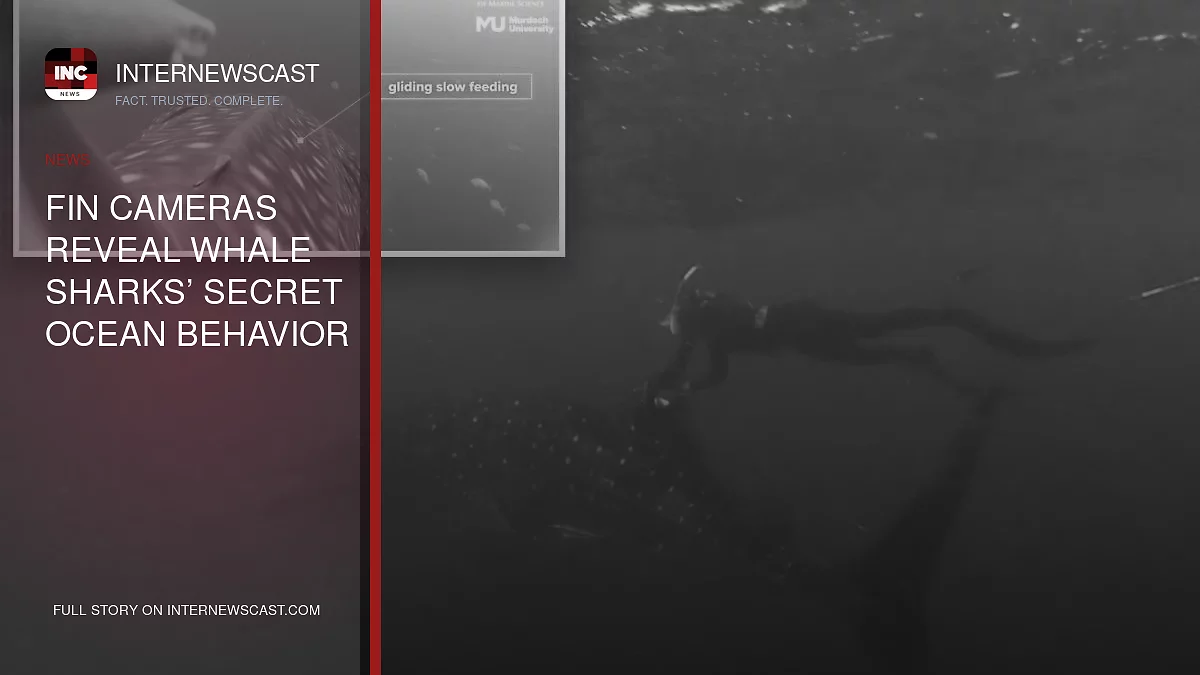

NINGALOO REEF, Western Australia — Newly obtained point-of-view footage is giving scientists a rare look at how whale sharks feed, revealing 36 separate behavioral traits in the world’s largest fish.
The Australian Institute of Marine Science (AIMS) said the video, combined with findings from more than 100 scientific papers, has helped produce “the largest catalog of whale shark behaviors to date.”
Whale sharks inhabit tropical seas, where food can be limited and patchily spread across vast areas. That means the animals must constantly adapt their movements and feeding strategies to find enough to eat.
While the comprehensive study was published in late July 2026, the footage at the heart of the research dates back to a 2018 field study.
Researchers captured the footage by attaching data tags fitted with small cameras to the fins of several whale sharks, creating an underwater view from the animals’ perspective.
“Unbothered, these gentle giants continued to swim while we watched them disappear into the open blue water,” AIMS said. The institute noted that the tags were set to remain attached for 24 hours before releasing naturally, avoiding any lasting impact on the sharks.
AIMS said tagging has long been an important tool for tracking the movements and patterns of marine animals, but conventional tags cannot show researchers exactly what those animals are doing in real time.
“Through our new study, we could finally address the question: ‘What do whale sharks do when no one is watching?’ Filling these research gaps is essential so we can help protect these majestic yet endangered filter-feeding animals,” AIMS said.
The research revealed that whale sharks use a wider range of feeding behaviors than previously documented, feeding throughout the water column and along the seafloor.
Although whale sharks were already known to make deep dives, they were often thought to primarily feed near the surface.
Researchers found that whale sharks use a variety of strategies, from low-energy behaviors like slowly sinking to the seafloor with their mouths open, to high-energy behaviors like actively chasing krill swarms at the surface.
Whale sharks have developed a diverse set of feeding strategies that help them survive in tropical oceans, where food sources are often scattered and unpredictable.
“If researchers can attach more cameras to whale sharks at aggregation sites around the world, we will hopefully discover new insights and continue to grow our understanding of this iconic species,” AIMS shared.