
Share this @internewscast.com
A wave of strikes is set to commence on Monday after protracted contract negotiations failed to yield a resolution. Key issues fueling the impending walkout include disputes over health insurance coverage and chronic understaffing.
The conflict pits the New York State Nurses Association, representing a significant number of nurses in New York City, against major health systems including Montefiore, Mount Sinai, and New York-Presbyterian.
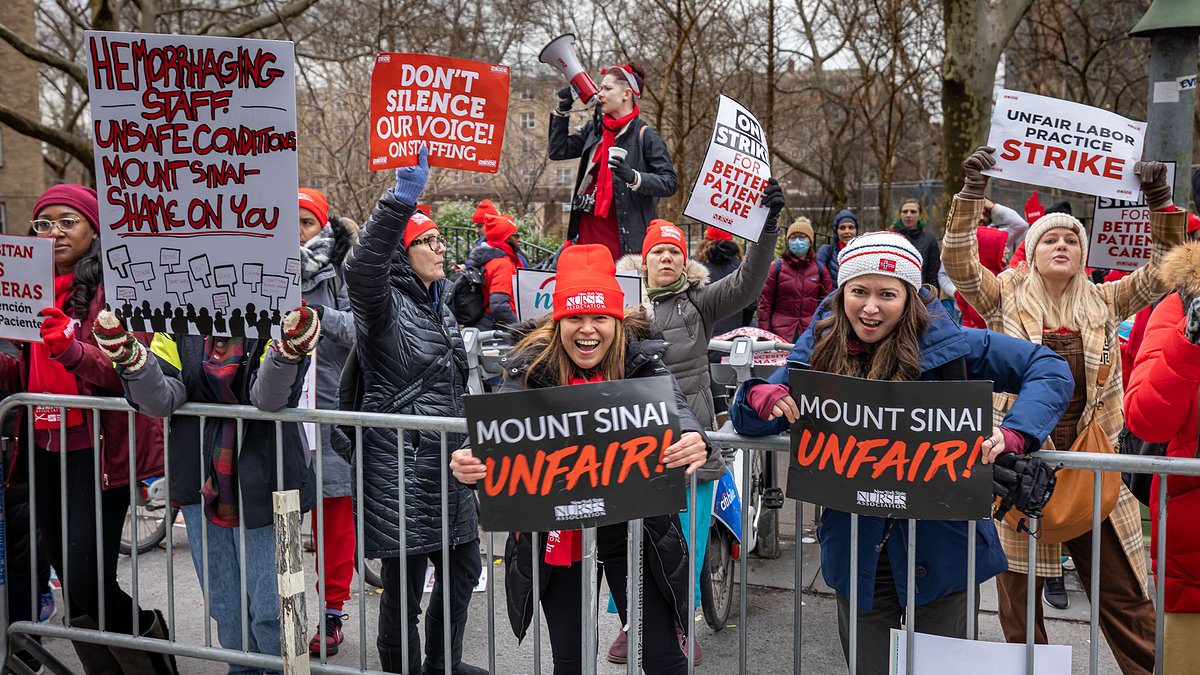
In anticipation of the strike, nurses rallied on Friday outside the Manhattan offices of the Greater New York Hospital Association and the League of Voluntary Hospitals and Homes of New York, who are negotiating on behalf of the hospitals, according to a report by Politico.
At the protest, frustrated workers expressed dissatisfaction with hospital executives, citing failed negotiations as a source of their discontent.
“We are going to continue to fight to get what we feel our patients and our communities deserve,” declared Michelle Gonzalez, a nurse at Montefiore Medical Center, during the rally.
Nurses are also advocating for enhanced protections against workplace violence and the authority to prevent ICE agents from accessing hospitals throughout New York City.
With an agreement reportedly out of reach, Beth Loudin, a pediatric nurse for New York-Presbyterian, said at the rally on Friday: ‘They’re ready for us to walk on Monday.’

Almost 16,000 nurses at some of New York City’s largest private hospitals are preparing to launch a mass strike over pay, health insurance coverage and understaffing

A hostile atmosphere between the nurses and hospitals escalated Thursday with a shooting at New York-Presbyterian’s Brooklyn Methodist Hospital, which saw the NYPD fatally shoot a man armed with a knife who took a patient and hospital worker hostage (pictured)
A hostile atmosphere between the nurses and hospitals escalated Thursday with a shooting at New York-Presbyterian’s Brooklyn Methodist Hospital, which saw the NYPD fatally shoot a man armed with a knife who took a patient and hospital worker hostage.
The incident sparked concerns over the safety of hospital workers, who say they are understaffed and underpaid despite demanding schedules.
Contracts the union had with 12 New York City hospitals expired at the end of 2025.
At many of the 12 hospitals, the union agreed not to launch its strikes as they often serve low-income patients who are uninsured or on Medicaid.
But the strikes will instead hit the Montefiore, Mount Sinai and New York-Presbyterian health systems, three of the largest in the city.
The potential strikes are set to present an early headache for newly sworn-in mayor Zohran Mamdani just weeks into his new administration.
Mamdani was endorsed by the New York State Nurses Association union after he won the Democratic primary, but he is yet to wade into the clash or attempted to end it publicly.
A spokesperson for the city’s emergency management department told Politico that it has plans that can be activated to ensure emergency services are not impacted.
An individual close to the negotiations also told the outlet that the strikes appear ‘inevitable’ because there was little movement on issues over pay and wages with hospital executives.

The potential strikes are set to present an early headache for newly sworn-in mayor Zohran Mamdani, while New York Governor Kathy Hochul issued an executive order on Friday declaring a state disaster emergency over an ‘immediate and critical need’ to help staffing shortages in hospitals due to the strike

In a joint statement from Montefiore Medical Center, Mount Sinai, and New York-Presbyterian, the hospitals said they were urging union leadership to reconsider the strike and return to the negotiating table
While Mamdani has not yet stepped in, New York Governor Kathy Hochul issued an executive order on Friday declaring a state disaster emergency over an ‘immediate and critical need’ to help staffing shortages in hospitals due to the strike.
Hochul said as she issued the executive order that the strike ‘could jeopardize the lives of thousands of New Yorkers and patients, and I’m strongly encouraging everyone to stay at the table — both sides, management and the nurses — until this is resolved.’
Brian Conway, a spokesperson for the Greater New York Hospital Association, said in a statement that the hospitals could not meet demands from the nurses union for higher wages as they would be too expensive.
‘A rally doesn’t change the fact that NYSNA leadership’s demands are unreasonable,’ Conway said.
‘There’s a reason why they’re not talking about their wage demands, in particular — because even they know it’s wildly divorced from economic reality.’
In a joint statement from Montefiore Medical Center, Mount Sinai, and New York-Presbyterian, the hospitals said they were urging union leadership to reconsider the strike and return to the negotiating table.
‘NYSNA leadership has chosen to abandon patients in their time of need, but Montefiore Medical Center, Mount Sinai, and New York-Presbyterian will not. Their decision to walk out on our patients can only be described as reckless,’ the statement shared Friday said.
‘A strike will pose challenges for sure, but our institutions will do whatever is necessary to minimize disruptions to the delivery of the safe, high-quality care we are known for.’