AI-made songs are pouring onto streaming platforms, raising fears that human musicians could be pushed out of the spotlight. Now, one major service is responding with one of the industry’s most forceful measures yet.
Tidal, the streaming platform partly owned by Jay-Z, is preparing to remove millions of songs it identifies as being entirely generated by artificial intelligence.
The purge is scheduled to begin on December 9, with the company aiming to complete the removals by the start of the new year.
Tidal’s decision follows a dramatic rise in machine-made music. The company said 43 percent of tracks delivered to its platform during the past 90 days were detected as fully AI-generated.
Robert Andersen, Tidal’s lead at parent company Block, said the platform’s current safeguards were no longer sufficient to contain the problem.
In a post on X on Tuesday, Andersen said 96 percent of AI-generated tracks had attracted no streams at all during the previous three months.
“Something more drastic needs to be done,” he wrote, confirming that Tidal would remove every song it determined to be 100 percent AI-generated.
Andersen estimated that the policy could affect millions of tracks, while Tidal may reject between 80,000 and 85,000 uploads each day.

Tidal, partly owned by Jay-Z, is preparing to delete millions of songs identified as entirely computer-generated in one of the toughest AI crackdowns announced by a major streaming platform
The company also reported that 27 million songs in its catalogue—about 6.3 percent of the total—had been labeled as completely AI-generated.
The scale was especially pronounced on November 6, when Tidal identified 60 percent of all songs uploaded that day as being made entirely by AI.
Yet despite the enormous supply, most of these tracks appear to be attracting little interest from listeners.
Tidal said it had separately removed 65,000 tracks believed to be impersonating established artists, another growing misuse of generative AI.
The platform says such uploads can redirect streams and royalties away from legitimate musicians while making it more difficult for listeners to find the artists and songs they are seeking.
Under Tidal’s new policy, songs created entirely with AI tools will be rejected. Music that uses AI only as part of the production or creative process will continue to be allowed.
However, the company has suggested that the rules could eventually expand to cover tracks it considers substantially AI-generated, leaving open questions about how that threshold will be defined.
Andersen has called on other streaming platforms to take similar action as the music business confronts an unprecedented wave of machine-produced content. Spotify and Apple Music have so far followed a different path, permitting AI-generated songs while developing systems to identify and label them.
Spotify said in October that it had removed more than 50 million tracks categorized as AI-generated “slop and spam” from user recommendations this year.

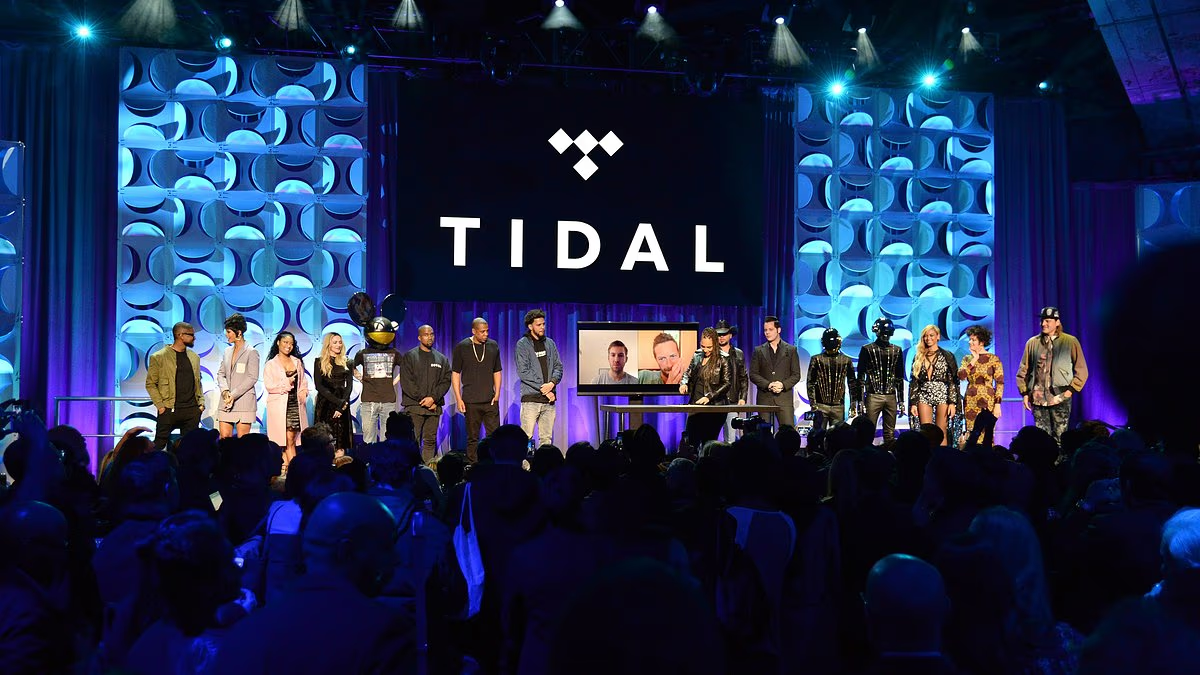
Usher, Rihanna, Nicki Minaj, Madonna, Deadmau5, Kanye West, JAY Z and J. Cole perform at Tidal’s launch event

Jay-Z bought Aspiro, the Swedish company behind Tidal, for a reported $56 million in 2015 and relaunched the service as an artist-owned platform
Spotify has also said it removed more than 75 million “spammy tracks” from its service for serious or repeated violations of its policies.
Bandcamp has adopted a stricter position as well, announcing a ban earlier this year on music created wholly or substantially with AI.
Tidal’s announcement has prompted a lively response online, with many listeners backing the move as an attempt to prevent human creativity from being buried under an endless supply of computer-generated music.
One Reddit user likened the AI music surge to the video game crash of the 1980s, when an oversupply of poor-quality titles threatened to overwhelm the market.
Another argued that streaming platforms should introduce an “organic” certification system so listeners could tell the difference between human-made music and AI productions.
Others said the sheer quantity of automated content was making it harder to discover original work, increasing the need for carefully curated playlists and collections.
The policy nevertheless creates difficult questions for musicians who use AI selectively as one tool among many, rather than relying on it to generate an entire song.
For now, Tidal is placing human artistry at the center of its policy, arguing that musicians should be able to release their work without being drowned out by unwanted machine-made tracks.

Tidal said 43 percent of the tracks distributed to the service over the past 90 days were identified as fully machine-generated

Headquartered in New York, Tidal has built its brand around high-fidelity audio and support for musicians
The service began in Scandinavia in 2010 under the name WiMP before expanding into the United States and United Kingdom as Tidal in 2014.
Jay-Z acquired Aspiro, the Swedish company behind the platform, for a reported $56 million in 2015. He then relaunched Tidal as an artist-owned service with prominent backers including Beyonce, Rihanna, Madonna and Alicia Keys.
In 2021, payments company Square—now known as Block—agreed to pay $297 million for a majority stake in Tidal. Jay-Z joined Block’s board, while other artist investors kept their holdings.
Tidal is based in New York and is known for high-quality audio streaming and its emphasis on supporting artists.
Our News Outlet has contacted Tidal for comment and is awaiting a response.