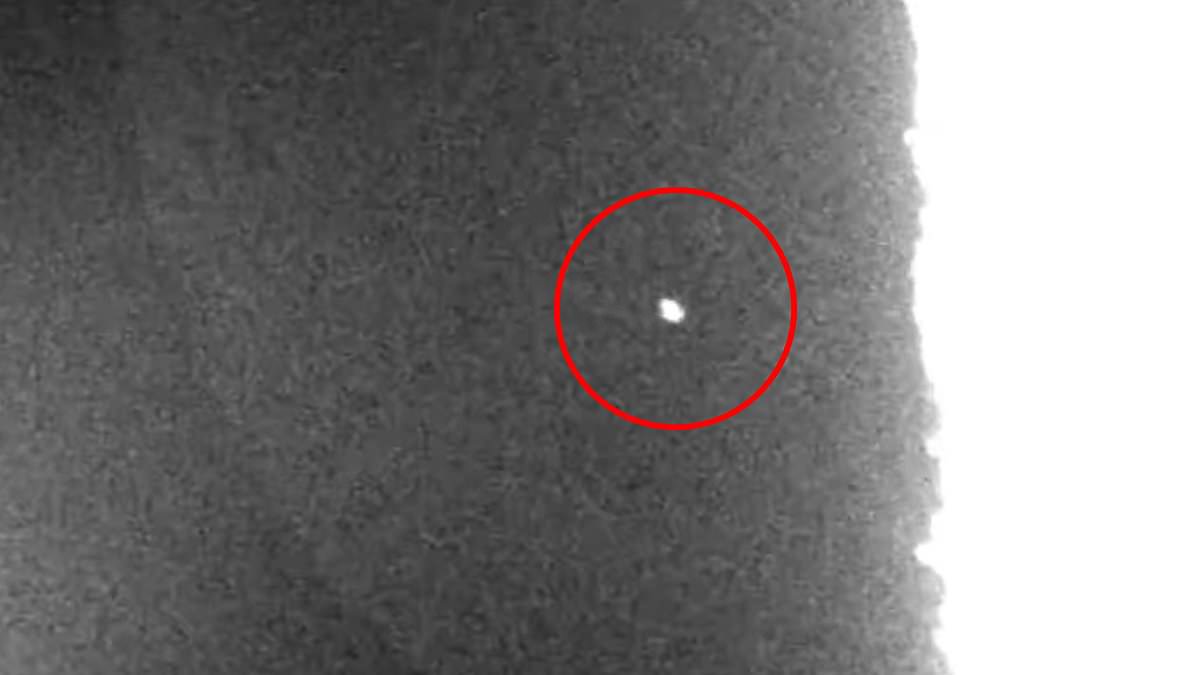

Two enigmatic flashes have recently stirred curiosity and debate among astronomers, as they were observed on the moon’s surface. These sudden bursts of light have left experts speculating about what might have struck our celestial neighbor.
Daichi Fujii, an astronomer and curator at Japan’s Hiratsuka City Museum, documented the first of these intriguing flashes on October 30. The event featured a significant, round spot that briefly illuminated the lunar surface before fading away.
Just two days later, on November 1, Fujii noticed a second flash. This time, the phenomenon was visible near the moon’s horizon from his vantage point here on Earth.
The leading theory suggests that these bright flashes resulted from impacts by space rocks, possibly linked to the Taurid meteor shower, an annual celestial event that occurs around late October to early November.
The Taurid meteor shower is the result of Earth passing through a trail of dust and rock debris left by the comet Encke. This cosmic encounter usually graces the night sky with harmless, yet mesmerizing, shooting stars.
It’s caused by Earth traveling through bits of dust and rock left behind by the debris trail of the comet Encke, creating nights full of harmless shooting stars.
Fujii noted while revealing the mystery flashes that the moon has no atmosphere, meaning we can’t see meteors nearing its surface until they light up at the moment of impact and form a fiery crater.
Fujii added in a post on X that the Taurid meteor shower was currently at its peak when he spotted the bright flashes on the moon.

Japanese astronomer Daichi Fujii captured the first mysterious flash on the moon on October 30 near the giant Gassendi Crater

Just two days later, Fujii recorded a second flash, with both believed to be high-velocity impacts by space rocks in the Taurid meteor shower
The astronomer had been watching the night sky using several telescopes from two locations in Japan, Fuji and Hiratsuka.
Special equipment helped him to instantly detect motion and explosions on the lunar surface.
Fujii noted that this high-tech setup has helped him spot nearly 60 impacts on the moon’s surface over the last 15 years.
‘With my 20cm telescope, I typically detect about one impact flash every few dozen hours of observation,’ he told Space.com.
‘Because the thin crescent moon is visible only briefly and often low in the sky where thin clouds are common, I only observe a few dozen flashes per year.’
That makes back-to-back impacts a space rarity, with the first one on October 30 appearing to land just east of the Gassendi Crater.
The crater is a massive impact scar measuring about 68 miles across that sits at the northern edge of the vast, dark plain known as Mare Humorum.
The second impact flash likely landed to the west of Oceanus Procellarum, one of the moon’s largest seas of ancient lava that covers about 1.5 million square miles.

The Taurid meteor shower (Pictured) can be seen from Earth every year in late October and early November as the planet passes through the debris trail of the comet Encke
‘I want the public to enjoy science,’ Fujii told The New York Times.
The space rocks, which likely hit the moon, are believed to have been traveling at close to 60,000 mph.
With no atmosphere to slow anything down that’s on a collision course with the moon, asteroids can sometimes strike the lunar surface at up to 160,000mph, creating a massive flash and extreme heat at the point of impact.
These same meteors, especially from the Taurids, vaporize in Earth’s thick atmosphere, which acts like a protective shield against falling debris from space.
Smaller meteors burn up as they encounter friction in the atmosphere, creating the streaking effect stargazers see while watching the meteor shower.
However, new research has warned that the Taurids could become more of a danger to humans within the next decade.
A study in Acta Astronautica has found that the risk will spike around 2032 and 2036 when a swarm of larger, undetected chunks of space rock may get clumped together by Jupiter’s gravity.
These more dangerous meteor fragments could pass over populated areas, causing hazardous air bursts, where the meteorite pierces the atmosphere and explodes in the air.
Larger meteorites could also make it all the way to the ground, potentially landing in crowded cities and causing significant damage.


