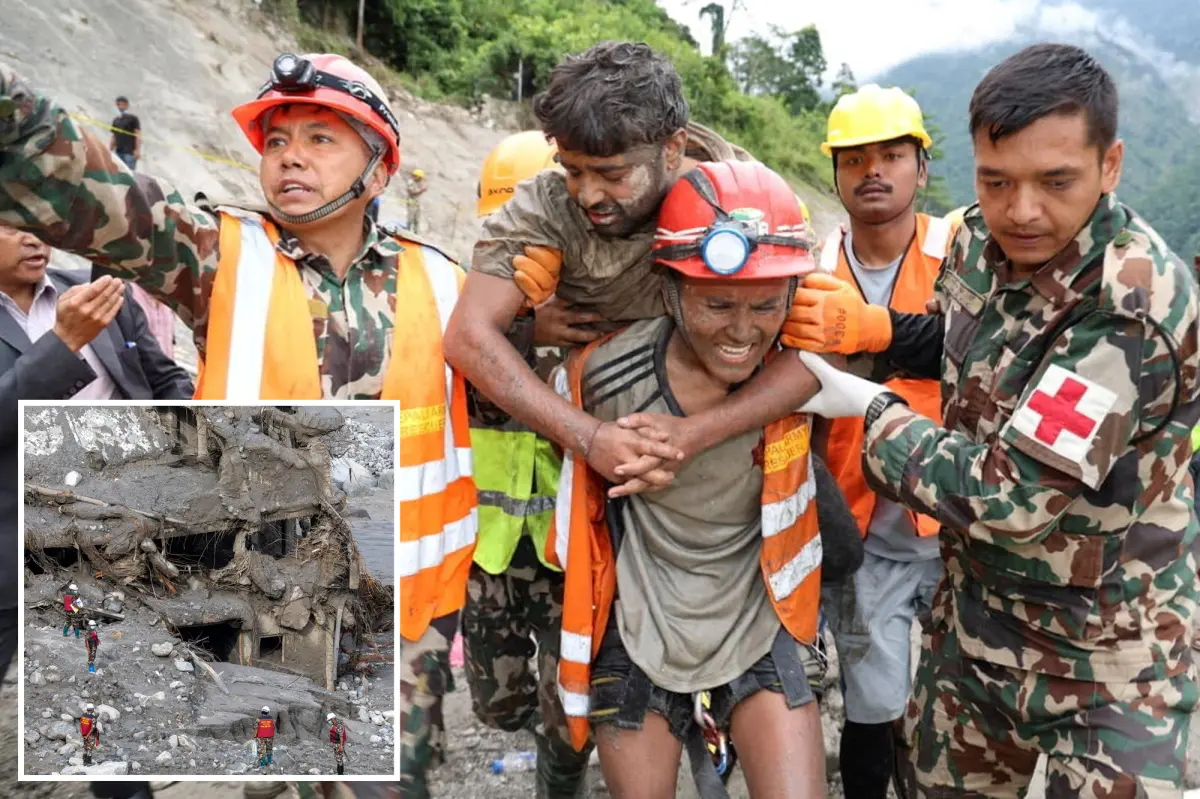

Nepal entered the final day of traditional Hindu mourning on Monday for the hundreds killed in a devastating flood along the country’s border with China, as rescue teams pressed on with searches after four people were found alive in recent days.
The Home Ministry said government offices across the Hindu-majority nation of about 30 million people, as well as Nepali missions overseas, would lower the national flag to half-mast to mark the 13th day after the deaths. For many Hindus, the 13th day concludes the formal mourning period and is observed with prayers, rituals and food offerings.
The disaster struck on Aug. 26, when a glacier broke loose and sent a massive surge of mud, rock and debris crashing into a river near the Himalayan frontier between Nepal and China’s Tibet region. Entire towns and villages were swept away, while key roads and highways were left buried under thick layers of sludge and rubble.
Authorities say at least 1,380 people have died in the mudslide, with more than 5,500 others still unaccounted for.
Despite the scale of the destruction, rescuers in Nepal have reported a series of remarkable survivals. Four people were pulled out alive in recent days, including a Chinese national rescued from a tunnel on Saturday, two hydropower workers found in another tunnel on Friday, and a Nepali woman freed from the remains of her buried home on Saturday.
Army spokesperson Raja Ram Basnet said rescue efforts in Nepal were now concentrated around hydropower stations in the affected area, where officials believe more survivors could still be trapped.
Chinese authorities said Sunday that recovery teams had found 12 additional bodies as searches continued for hundreds of people still missing in Tibet.
No ceremonies amid ongoing search
With emergency crews still combing through debris and unstable terrain, Nepal’s government has not announced any broader public ceremonies for the final day of mourning.
“There are no government programs organized as the rescue and search operation is still going on in the flood-hit areas,” Phanindra Paudel of the National Emergency Operation Centre (NEOC) told Reuters.
President Ram Chandra Paudel, the ceremonial head of state, was touring flood-hit areas on Monday and would survey damage caused by the disaster, his aide said.
Security personnel at the district jail in Nuwakot, one of the two worst affected districts, saved 923 prisoners by shifting them to a building in a higher location before flood waters entered their low-lying building, Prime Minister Balendra Shah said in a social media post.
Authorities also captured 50 prisoners who had broken the prison wall and gates as flooding began, and had fled barely 100 meters, Shah said.