
Emmanuel Macron has access to a secret bunker outside Paris where he could be sheltered if rioters attacked the Elysee Palace, according to a new book.
The alleged refuge in the Paris suburbs is revealed in La Nouvelle Armee des Ombres (The New Army of Shadows), written by investigative journalists Pierre Gastineau, Antoine Izambard and Franck Renaud.
The claims emerge as France faces nationwide unrest over the policies of President Macron’s government.
Protesters are calling for higher wages while supporting a student movement that began over staff shortages and inadequate education funding.
French unions and student organisations are preparing for another day of demonstrations, while Yellow Vest activists plan a separate rally in central Paris despite an official ban.
According to the book, preparations for the bunker were partly influenced by the 2018 Yellow Vest uprising, during which Mr Macron was confronted while visiting Le Puy-en-Velay.
‘The government trembled’ during the unrest, one of the authors told France Inter on Friday.
The authors say officials also studied the riots of February 1934, which brought down a French government, as they considered contingency plans to evacuate the president during a major outbreak of civil disorder.

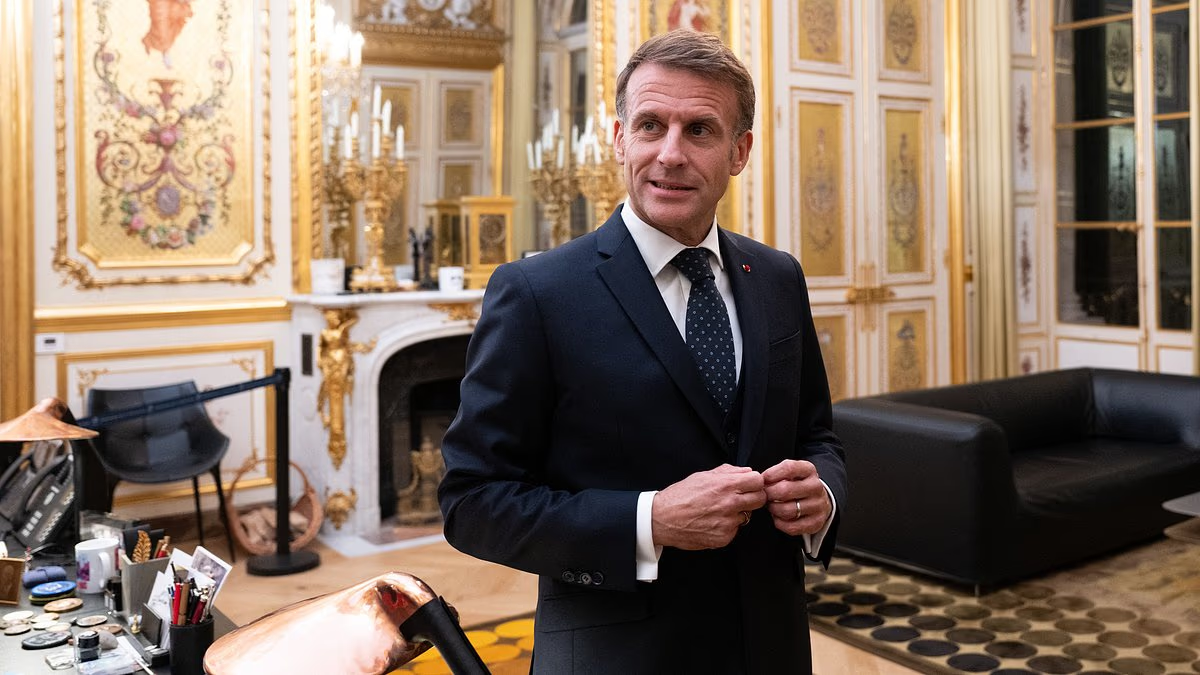
French President Emmanuel Macron prepared to meet a French astronaut from the European Space Agency at the Elysee Palace in Paris on Monday

A protester throws back a tear-gas canister during a demonstration in Strasbourg on Thursday, part of nationwide strikes and student-led protests that have gripped France for weeks

Police officers stand near a burning rubbish bin during a demonstration between Place de la République and Place de la Nation in Paris on Thursday
The journalists claim officials fear a victory for Marine Le Pen’s National Rally could trigger a ‘third round’ of unrest, bringing radical left-wing activists, young people and rural militants onto the streets to challenge the result.
They also suggest that a victory by hard-left politician Jean-Luc Melenchon, who polling indicates could reach the presidential run-off, might lead to ‘passive resistance’ within the police force.
After interviewing senior sources, the authors say Paris police chief Patrice Faure has chaired a series of meetings examining the threat of an insurrection.
France’s foreign intelligence service has also reportedly rehearsed scenarios involving possible electoral interference.
In the capital, police spent an entire day working without smartphones to test their ability to operate during a potentially paralysing cyberattack.
The preparations follow a warning from a senior intelligence official who told the authors in April that major revolts in France were imminent.
However, intelligence chiefs underestimated the disorder that erupted on October 17. Their estimate of 60,000 protesters fell far short of the half a million people who eventually took to the streets.
The unrest comes less than six months before voters choose a successor to centrist President Macron, with the hard right leading the opinion polls.

Thousands clash with riot police across France for a fourth consecutive weekend of protests against the government. Protesters are pictured in Marseille

Riot officers deploy in force to contain a demonstration as it moves through Paris

A protester kicks the window of a grocery store in Strasbourg on Saturday

A protester burns a rubbish bin during nationwide strikes and student demonstrations in Bordeaux on November 5

A protester dressed as the superhero Deadpool rides a toy unicorn during a demonstration for higher wages and in support of a high-school protest movement in Lyon on Thursday, November 5
Student organisations and trade unions have called a march through central Paris ‘against the high cost of living and in support of young people’.
Yellow Vest activists have declined to take part, instead announcing a separate gathering at Place de la Concorde, close to parliament and the presidential palace, despite an official ban on demonstrations in the area.
Interior Minister Laurent Nunez said 70,000 police officers and security personnel would be deployed nationwide.
‘If rioters or looters appear, we’ll be ready and waiting for them,’ he said.
Most of the demonstrations have remained peaceful, although there have been clashes with police and acts of vandalism on the margins. France experienced its worst rioting in years on October 17.
On Thursday, hundreds of thousands of striking workers marched across the country in largely orderly protests, though confrontations between demonstrators and police were reported in several cities.
The protests have tapped into anger over rising fuel costs and wider resentment that has lingered since the Yellow Vest movement began.
The Yellow Vest movement gained momentum through mass grassroots demonstrations against Mr Macron’s proposed fuel-tax increases and has now urged supporters to attend its banned rally.

A car burns as demonstrators watch during nationwide strikes and protests in Lyon on November 5

French gendarmes in riot gear detain a protester during clashes at a demonstration in Lille

Riot police clash with young people during a demonstration organised by French trade unions and Yellow Vest activists in Lille

Protesters stand beside a burning rubbish bin during a demonstration in Lille

A masked protester appears to throw a water bottle during riots in Paris on Saturday

Riot police clash with young people during protests across France over the weekend
In 2018, thousands of people demonstrated while wearing the high-visibility vests that French motorists are required by law to keep in their vehicles, giving the movement its name.
Authorities are determined to avoid a repeat of the looting and destruction seen during the October 17 protests. The interior ministry said Thursday’s demonstrations had ‘generally gone well’, despite 642 arrests.
The police operation has drawn criticism for being excessively forceful, with dozens of internal investigations opened into allegations of brutality against protesters.
Following several apparent incidents of police violence involving AFP reporters covering the unrest, the international news agency called on Friday for journalists to be protected.
Reporters Without Borders, the press freedom organisation, said it had documented 40 cases in which security forces obstructed journalists covering the protests. Twenty-one of those cases involved physical violence.
Mr Macron’s government is searching for a way to respond as his presidency approaches its conclusion in May 2027.
Prime Minister Sebastien Lecornu is scheduled to meet trade union and employers’ representatives on Monday to discuss wages and household purchasing power.
‘The protests will end only when the demands raised for weeks by workers, civil servants, young people and pensioners receive a response,’ an inter-union coalition said on Friday.
Unions are seeking an increase in the minimum wage, which has not received a discretionary rise since 2012, as well as broad wage increases, tax changes and improved learning conditions for young people.
With the European Union’s second-largest economy under pressure to reduce its debt, the government has limited room to offer concessions.
READ MORE: Left-wing rioters clash with police as 170,000 take to France’s streets for a fourth consecutive weekend


