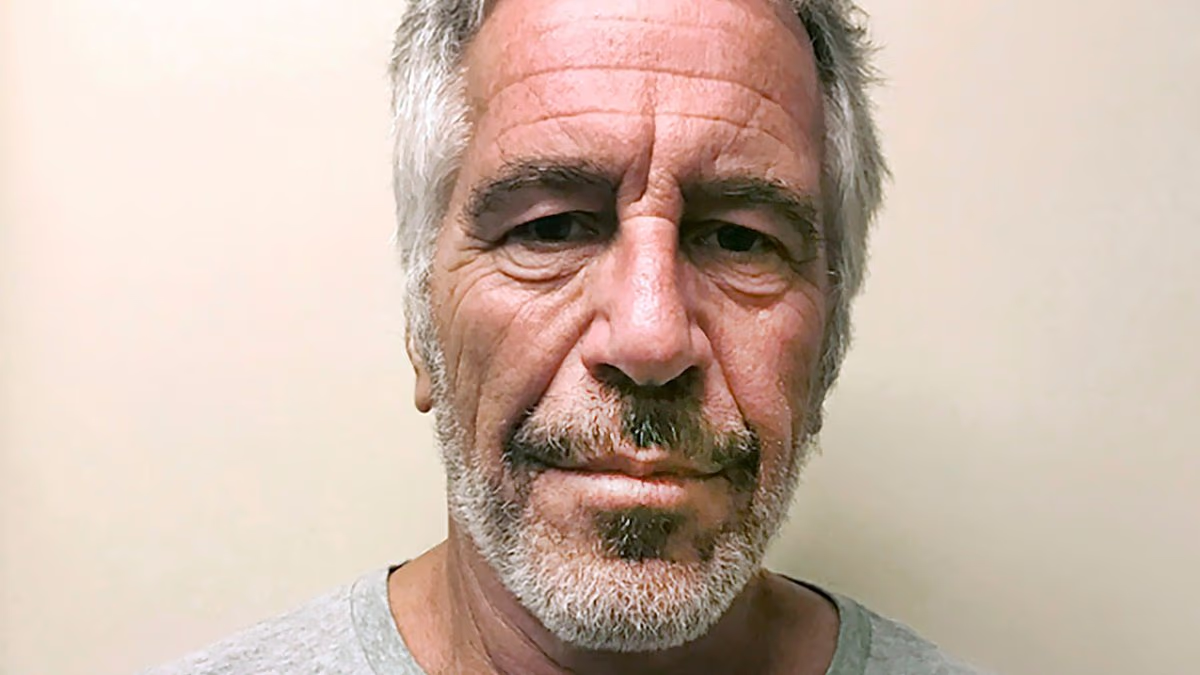

Newly published autopsy photographs are reigniting questions that have lingered for seven years: Did Jeffrey Epstein die by suicide, or was he killed?
Mark Epstein, the financier’s brother, has released the full collection of autopsy images amid renewed claims that Epstein’s death was a homicide.
Several of the photographs are too graphic to publish. Others appear to show marks around Epstein’s neck that forensic scientist Dr Michael Freeman says could be consistent with strangulation.
The images also provide the most extensive look yet at Epstein’s cell inside Manhattan’s Metropolitan Correctional Center, where he was found dead in August 2019, weeks after his arrest on federal child sex-trafficking charges.
Among the items visible in the cell is a double-knotted loop. Dr Freeman has suggested it may have been used to strangle Epstein, who had connections to prominent figures including Donald Trump, Bill Clinton and Andrew Mountbatten-Windsor.
Dr Freeman, who was consulted during the prosecution of Derek Chauvin, the Minneapolis police officer convicted of murdering George Floyd, presented his analysis in London this week.
After reviewing the photographs since November 2025, he said the “pattern and distribution and multitude of injuries” could not be explained by a suicidal hanging, according to comments reported by the New York Times.
The New York City Medical Examiner ruled Epstein’s death a suicide, but the case remains one of the most persistent modern conspiracy theories.

Mark Epstein has published the full set of his brother Jeffrey Epstein’s autopsy photographs as fresh allegations resurface that the 2019 death in his Manhattan jail cell was a killing

One image from the investigative file shows a forensic investigator using a tape measure to record the distance from the floor to the top bunk

The photographs offer a detailed view of Epstein’s cell, including a double-knotted loop that Dr Michael Freeman says could have been used as a ligature
A 2023 report by the Department of Justice’s Office of Inspector General said a combination of “negligence, misconduct and outright job performance failures” by the Bureau of Prisons gave Epstein an opportunity to take his own life.
Earlier this year, the DOJ released three million files related to Epstein, including hours of surveillance footage from inside the Metropolitan Correctional Center, in an effort to counter claims of a hidden explanation for his death.
Still, suspicion has persisted, fueled in part by Epstein’s relationships with politicians, business leaders and celebrities.
Julie K Brown, the Miami Herald journalist whose 2018 investigation helped lead to Epstein’s arrest, has also described the circumstances as “crazy,” saying that “too many things don’t make sense.”
The collection released by Mark Epstein includes graphic autopsy images that Our News Outlet is not reproducing.
Some photographs taken by the New York City Medical Examiner show Epstein with a tube in his mouth after attempts to resuscitate him.
Other images show dark marks on his back and close-ups of his eyes held open.
Dr Freeman said the most significant photographs show a dark-red mark around Epstein’s throat and a black line extending toward his ear, which he believes reflects pressure from a ligature.

The DOJ released three million Epstein-related files earlier this year, including hours of footage from inside the prison, in an effort to demonstrate that his death had no sinister explanation
“That doesn’t look like a hanging mark,” Dr Freeman said this week, describing his reaction to the photographs.
He did not examine Epstein’s body and based his opinion solely on the images. In an interview with CBS, he called the pattern “very unusual looking for a hanging on the neck.”
“The injury pattern described [by officials] as a sloped or as a peaked injury was a perfect description for a hanging,” he said.
“But that’s not what we saw when we saw the photos.”
Dr Freeman argues that the Y-shaped appearance of the mark is central to his contention that Epstein did not die by suicide.
He also pointed to a second ligature mark on Epstein’s neck, positioned at a different angle from the injuries below it.
“There is no mechanism [during suicide] to produce a second mark that would be lower,” Dr Freeman said.
“Even if the ligature was tied with two loops, both loops would go up to the point where it was tied because that’s the anchor point.”

Dr Kristin Roman, who performed the autopsy, wrote that it “didn’t show any signs of struggle” and that no marks were found on Epstein’s hands
Dr Freeman also highlighted a piece of torn orange fabric, which he says may support his theory that Epstein was murdered.
KEEP READING: Report Details Trump-Netanyahu ‘Shouting Match From Hell’
“That is a double-knotted, looped, narrow ligature that was found in the cell that was dropped in a corner near the desk,” he said.
“If we put those together in a format in which the knot, one of these knots, is applied as pressure to produce this irregular abrasion at the back of the neck, we actually have a fairly good explanation for all the injuries.”
He further suggested that injuries to Epstein’s face and left shoulder could indicate an assault or struggle.
A close review of the marks on Epstein’s neck, he added, may show possible fingernail injuries.
“And if you put it all together, it is most consistent with a homicidal strangulation from behind using a narrow knotted fabric ligature,” Dr Freeman said.
Photographs from the cell also offer a stark glimpse of Epstein’s final days. Medication can be seen scattered across the top bunk of the cramped room.
Torn orange sheets are spread across the cell, while one orange prison-issued sandal lies on the floor.

Dr Freeman identified a torn piece of orange fabric as potentially important evidence; he said it was “found in the cell that was dropped in a corner near the desk”


The cell photographs show torn orange sheets scattered across the room and medication lying on the top bunk

Several images show bedding hanging from the bunk ladder, with orange blankets spread throughout the cell
Investigators photographed the CPAP machine Epstein used while sleeping, along with its packaging.
A defibrillator remained on the floor after prison staff and paramedics made efforts to revive him.
In another image, a forensic investigator holds a tape measure to record the height from the floor to the top bunk.
Other photographs show a makeshift noose with a measuring tape positioned beneath it, as well as bedding hanging from the bunk ladder.
Summing up his findings, Dr Freeman said: “The injuries that were documented by the medical examiner were not consistent with the suicidal hanging.”
“And the injuries that were attributed to something other than potentially a physical struggle or assault were just overlooked.”
Dr Freeman is the second forensic specialist to challenge aspects of the official conclusion.

Dr Freeman said the documented injuries were “not consistent with the suicidal hanging,” while the medical examiner continues to stand by her conclusion

Dr Kristin Roman noted that Epstein’s hyoid, the U-shaped bone at the front of the neck, had been fractured

Mark Epstein has released the complete set of his brother’s autopsy photographs amid renewed claims that the 2019 death was a murder
In 2019, Mark Epstein commissioned Dr Michael Baden, a forensic pathologist who has worked on cases including Michael Jackson’s death, to review the evidence.
Dr Baden also said he believed homicide was more likely than suicide.
The newly circulated material includes an interview with Dr Kristin Roman, the medical examiner who conducted Epstein’s autopsy.
Roman said the examination “didn’t show any signs of struggle” and found no marks on Epstein’s hands.
She said the single abrasion on his arm was “probably from convulsing when being hanging (sic).”
“He was pretty much pristine,” Roman said, adding that the “pattern of fractures on the thyroid [neck] cartilage was consistent with hanging.”
“You see a very different pattern of fracturing if there has been a manual compression of the neck versus sustained pressure of hanging,” she said.
“And the pattern of his fractures was that of hanging.”
Our News Outlet has contacted Dr Freeman and Mark Epstein for comment.
- How did Russell Brand become a predator? What comes next? Get exclusive insight from The Crime Desk as we talk to police, psychologists, lawyers and more. Sign up by clicking here.


