
The Charity Commission is reviewing a complaint about Peta, the controversial animal rights organisation that criticised the Prince and Princess of Wales after their dog had puppies and urged the Archbishop of Canterbury to prohibit beeswax.
People for the Ethical Treatment of Animals has also called for the World Black Pudding Championships to adopt vegan alternatives and demanded that a mackerel festival replace fish with cabbage.
Peta Watch, a group that monitors the organisation, has now submitted a formal complaint alleging that Peta’s political stunts are incompatible with its charitable status.
Charity Commission rules state that political campaigning cannot be the principal purpose for which a charity exists.
In its complaint, Peta Watch claimed that Peta “is more concerned with gaining publicity and attention than it is for advancing animal welfare”.
The group said: “Peta operates no animal centres, no rescue facilities, no rehoming facilities, and no veterinary or sanctuary provision anywhere in England and Wales.”
Peta Watch described this as “a remarkable omission” for an organisation established to prevent or relieve animal suffering. Peta, however, said compassion for animals was central to all of its work.
Peta received £7.7 million in donations last year. Its accounts show that pay for its three highest-paid executives rose by almost 40 per cent, while nearly half of its income was spent on employee salaries in 2025.

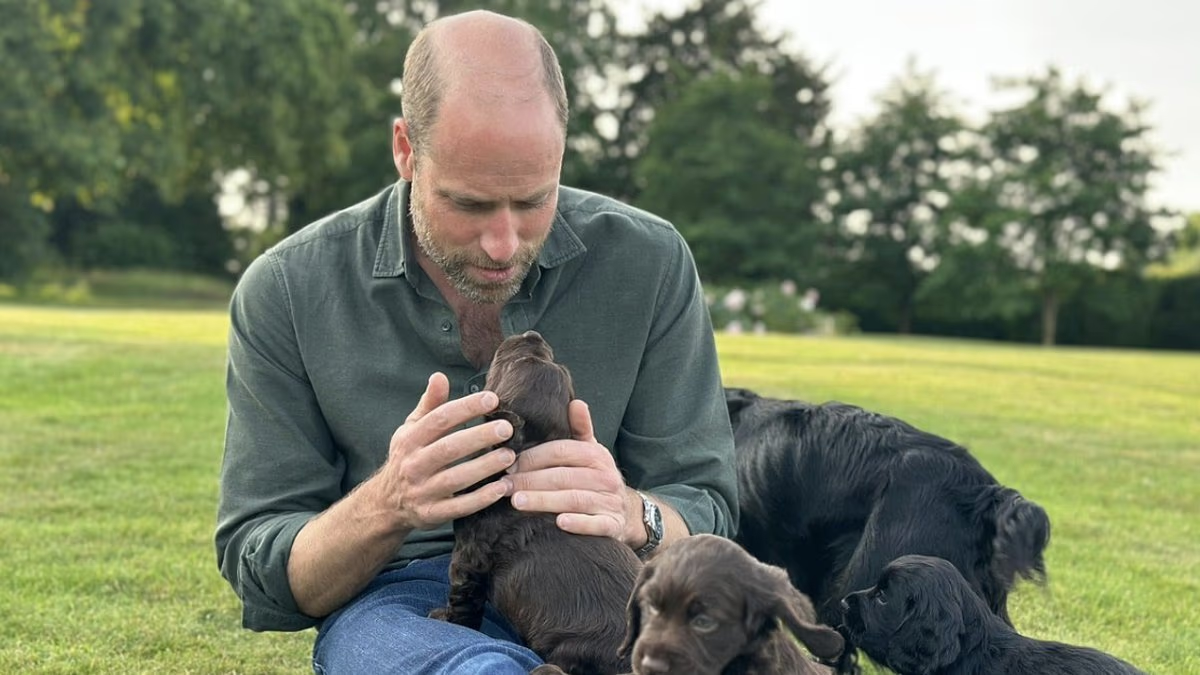
Prince William was pictured with his dog Orla and three of her puppies in a photograph taken by his wife Kate and released by Kensington Palace in 2025.

Last year’s annual black pudding-throwing contest was won by 18-year-old Harry Ogden, who knocked six Yorkshire puddings from a 20ft-high plinth.

Peta’s campaign to replace fish with cabbage at the annual mackerel festival is among the political stunts the Charity Commission has been asked to examine.
Last year, Peta urged the Archbishop of Canterbury to remove beeswax candles, leather Bibles and woollen clothing from churches.
The organisation’s founder also wrote to King Charles asking him to disown the Cavalier King Charles Spaniel breed, arguing that the dogs had been cruelly bred “for a certain appearance”. Peta sparked an outcry last year after condemning the Prince and Princess of Wales when their dog had puppies, describing the couple as “staggeringly out of touch” for “churning out a litter” while animal shelters were full of dogs needing homes.
Two months ago, Peta activists called on organisers of the World Black Pudding Championships to use vegan substitutes in the annual throwing contest held in the village of Ramsbottom, Bury.
They argued that it was wrong for pigs to have their “blood and fat thrown at a target for a bit of fun”. The tradition is believed to originate from a battle during the War of the Roses, when rival soldiers supposedly threw food at one another after running out of ammunition.
Peta also took aim at the annual mackerel fiesta in the Welsh coastal village of Aberaeron, demanding that the event be renamed a cabbage festival.
The organisation has faced criticism from people who say it functions as a “political protest group” despite holding charitable status.
Brian Monteith, Peta Watch’s communications adviser and a former Conservative Member of the Scottish Parliament, wrote in the complaint to the Charity Commission: “Instead of advancing animal welfare, Peta instead chooses to execute a wide-range of publicity stunts.”
He asked the regulator to investigate whether “political campaigning has become the reason for Peta’s existence”, citing Charity Commission guidance stating that “a charity cannot have a political purpose”.
The Charity Commission said it would review the complaint. Chief executive David Holdsworth and chairwoman Dame Julia Unwin “have requested that this be passed to the relevant team within the Charity Commission for their review and consideration”, it said.
Peta’s vice president of programmes Elisa Allen claimed Peta Watch had ‘no credibility’ and said: ‘Peta’s aim is, and always has been, to reduce animal suffering, and people are glad to receive information from our investigations and other resources that give them the ability to make compassionate decisions.
‘As a UK-registered charity for nearly 30 years, we have convinced hundreds of designers and retailers to drop fur, angora, and wild-animal skins, helped stop experimentation on animals in Europe for cosmetics, seen wild-animal circus bans, and many other ground-breaking victories for animals.
‘Despite, or rather because of, these achievements, there are those – mostly made up of industries that profit from animal exploitation – who seek to undermine our work via fake news smear campaigns, because it threatens their bottom line.’


