
The pilot of a commercial aircraft lost consciousness mid-flight over Europe, creating an emergency situation after confessing he hadn’t slept the night before the journey.
This unsettling event took place aboard a Tarom airline flight, during its return journey from the Netherlands to Romania.
The Civil Aviation Safety Investigation and Analysis Authority (AIAS) reported that the plane, which was scheduled to depart from Otopeni Airport at 6 a.m., was headed to Amsterdam.
During the initial leg of the trip, the co-pilot started feeling unwell.
Before embarking on the return flight, he assured that he felt fit enough to be in the cockpit but opted to abstain from taking control of the aircraft as a precaution.
Roughly 50 minutes into the flight back, the 57-year-old co-pilot fell ill and eventually lost consciousness while the plane was cruising over Europe.
The other pilot declared a state of emergency and requested medical assistance immediately after landing in the Romanian capital.
Once the aircraft landed, the 87 passengers on board were escorted out through its rear door, and ambulance workers immediately intervened on the runway to administer first aid.

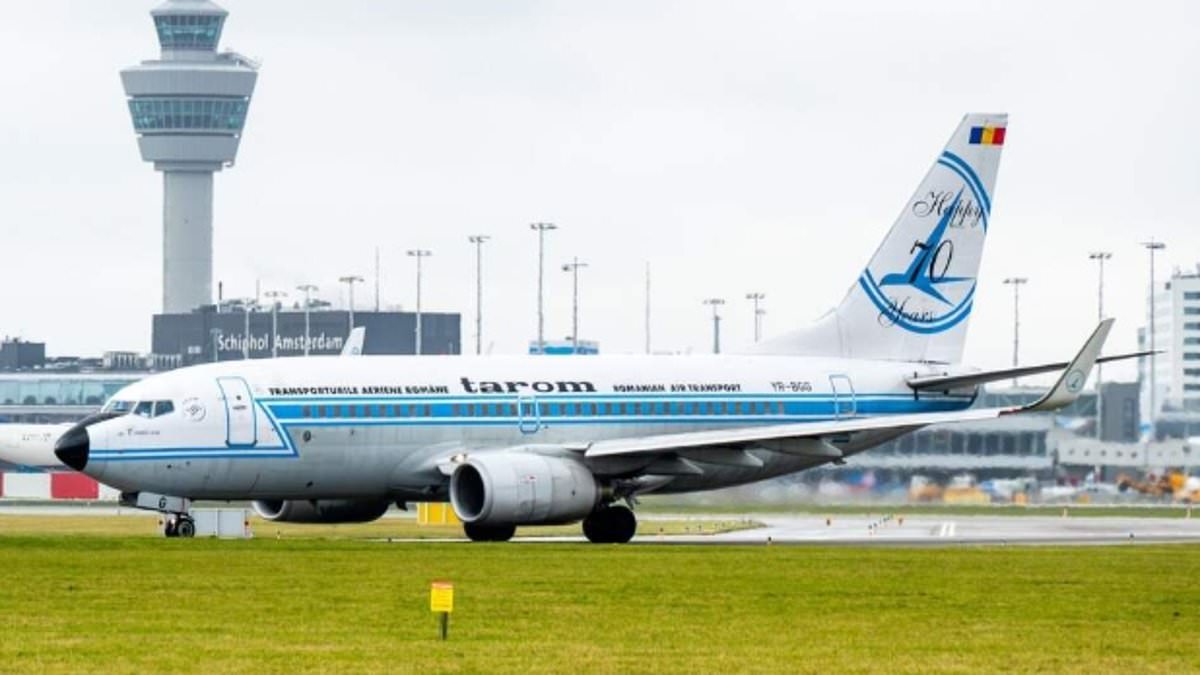
A Boeing 737 of the Romanian airline Tarom preparing for departure at Schiphol Airport in the Netherlands
The co-pilot boarded the return flight having not slept the previous night, according to the findings of the AIAS report.
Following the incident, the employee will only be allowed to perform flights in the presence of an additional captain, for the time being.
He will also no longer be assigned to night flights or flights lasting longer than two hours.
As a third measure, he will no longer be scheduled to work with the other pilot.
This is not the first time a pilot has fallen asleep while controlling an aircraft.
A Batik Air plane in Indonesia went off track on its flight path after both the pilot and the co-pilot fell asleep for nearly half an hour in 2024.
The incident, which occurred in January, saw the pair in the cockpit getting some shuteye, as the aircraft drifted off it’s planned path – something that could have led to a fatal disaster for all 153 passengers on board.
It is vital for pilots to keep an aircraft on the right flight path as it is carefully mapped out by air traffic controllers to ensure the plane doesn’t cross any other aircraft’s paths.
The plane was flying from South East Sulawesi to the capital Jakarta.
In a similar situation, one of the pilots had not rested adequately the night before the flight.
About half an hour after the plane took off, the captain asked permission from his second-in-command to rest for a while and he said yes.
The co-pilot took over command of the aircraft but then fell asleep himself.
A few minutes after the last recorded transmission by the co-pilot, the area control centre in Jakarta tried to contact the aircraft.
It received no answer.
Twenty-eight minutes after the last recorded transmission, the pilot woke up and realised his co-pilot was asleep and that the aircraft was not on the correct flight path.
He immediately woke his colleague up, responded to the calls from Jakarta and corrected the flight path.
The incident resulted in a series of navigation errors, but the Airbus A320’s 153 passengers and four flight attendants were unharmed during the two-hour-and-35-minute flight.
At the time, the transport ministry released a statement saying it ‘strongly reprimands’ Batik Air over the incident.
Air transport director-general M. Kristi Endah Murni called on airlines to pay more attention to their air crew’s rest time, before launching an investigation.