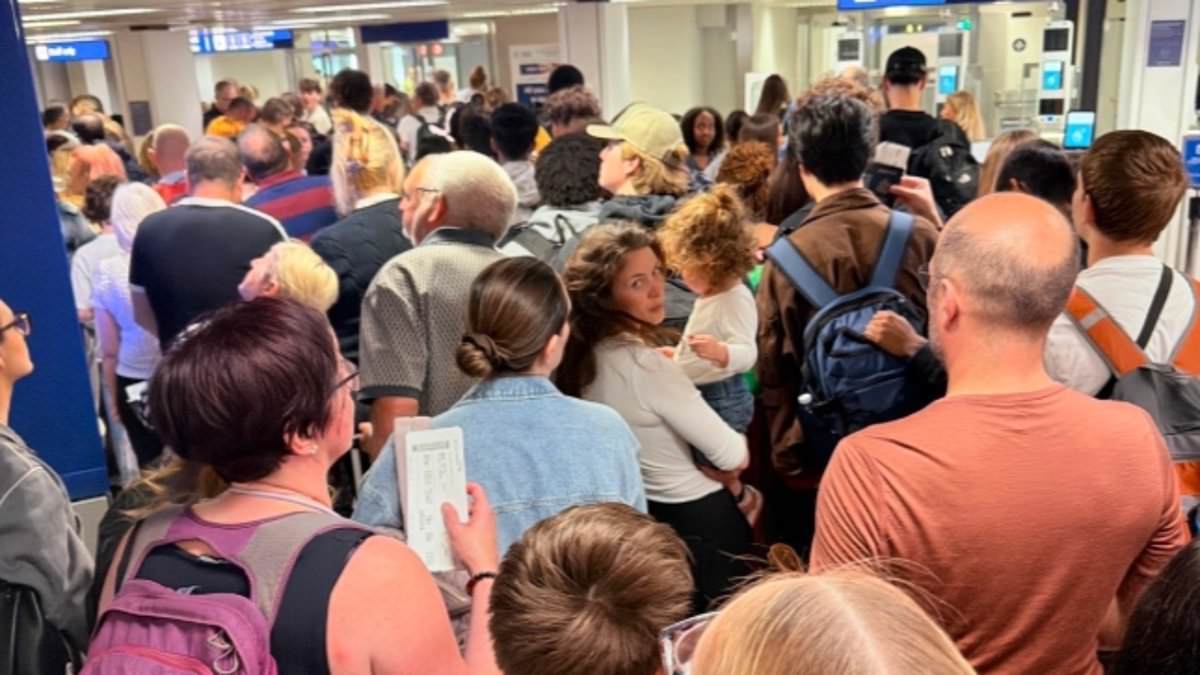

Portugal and Italy have decided not to halt the implementation of the controversial EU border checks that have been causing significant disruptions for British travelers at airports across Europe.
Earlier reports suggested that these two countries might follow Greece’s lead in pausing the new Entry-Exit System (EES). This system requires all non-EU travelers to use special kiosks at border crossings to undergo facial scans and fingerprinting. However, these procedures have overwhelmed some airports, causing major operational challenges.
As a result of these new measures, lengthy queues have formed at various airports, leading to chaos and causing some travelers to miss their flights due to the extensive wait times for processing.
Despite numerous appeals to alleviate the ongoing disruptions, especially with the busy summer season approaching, the European Commission announced on Thursday that airports in Portugal and Italy will continue to enforce the EES.
This decision comes amid speculation that other European countries, including Spain, France, and Croatia, might consider abandoning the EES, potentially leading to a broader collapse of the system.
It comes amid rumours that other European nations – such as Spain, France and Croatia – could opt to ditch the EES in a situation which could see the rules ‘collapse like a house of cards’.
Seamus McCauley, of travel company Holiday Extras, claimed this week that countries may be left with little choice but to defy the EU to protect the livelihoods of people dependent on tourism.
He added: ‘Countries are not going to sit back and let Greece take their trade because they won’t face EES delays at airports. To do so would be politically toxic as jobs are on the line.
The Entry-Exit System (EES) demands all non-EU travellers visit special kiosks at border crossings to submit facial scans and fingerprints
Long queues across Europe have caused mayhem, with some holidaymakers missing their flights after waiting hours at border checks (Malaga Airport is pictured on January 2, 2026)
‘The rollout has been an utter fiasco. British tourists are worth £3billion a year to the Greek economy and it has rightly decided it will not jeopardise that because EES is not working properly.’
Airlines such as Ryanair have also called on countries to suspend EES, describing the system as ‘half-baked’.
Its chief operations officer Neil McMahon said: ‘Governments are attempting to roll out a half-baked IT system in the middle of the busiest travel season.
‘Passengers are paying the price, being forced to endure hours-long passport control queues and in some cases missing flights. The solution is simple – governments should suspend EES until September.’
The biometric checks were first introduced in October 2025 and were meant to become fully operational by last month – however delays have continued.
Alicante Airport, one of Spain’s busiest, has been ‘pushed to breaking point’, local police said, by the system and a lack of staff.
Meanwhile Málaga Airport has also been impacted and a British holidaymaker was left stranded in the hub with her daughter after missing her flight.
Michelle Maguire, 38, and her daughter were due to fly back from Malaga to Liverpool but did not make it home until 24 hours later after being held up in travel chaos which eventually cost the family £1,000.
The airline explained how waiting times can reach up to two hours at many airports including Málaga, Alicante, Lanzarote, Tenerife South, Gran Canaria, Reus, and Fuerteventura.
On Reddit, a parent shared how they were forced to stand in line with their crying children for more than three hours with ‘nowhere to go other than the restroom’, while alleging airport staff did ‘nothing to help’.

Pictured: Holidaymakers in Milan Linate facing chaos caused by the EES system
In Italy, queues have been particularly bad in Bergamo, Malpensa, Fiumicino, Ciampino, Venice, Turin, Palermo, Pisa, and Naples.
Meanwhile, in France, there have been long queues at Beauvais, Marseille, and Nantes airports.
Greece pulled the plug on the rules recently in a decision made to ‘ensure a smoother and more efficient arrival system’, according to director of Eleni Skarveli.
The director of the Greek National Tourism Organisation in the UK added that the change could help to ‘significantly reduce waiting times’.
Greece’s decision is widely seen as a strategic move to protect its vital tourism sector, which relies heavily on British visitors flocking to hotspots such as Corfu, Crete and Rhodes – destinations that can each receive more than 2,000 UK arrivals per day during peak season.
Greece is expected to rank as the fifth most popular destination for British holidaymakers this summer, behind Spain, France, Italy and the United States, according to The Association of British Travel Agents.
The European Commission said it was ‘in contact with Greece to clarify the situation’.
The rules allow for checks to be suspended for short periods in exceptional circumstances but do not allow ‘blanket exemptions for nationals of specific third countries and for an extended period of time’.
It comes as airlines continue to grapple with sky-rocketing jet fuel prices caused by the ongoing war in the Middle East.
Airlines have cut 13,000 flights globally this month, though holidaymakers have been urged not to change their travel plans.
There is said to be no fuel shortage currently in the UK, and there are contingency plans in place if the situation worsens.


