
Share this @internewscast.com
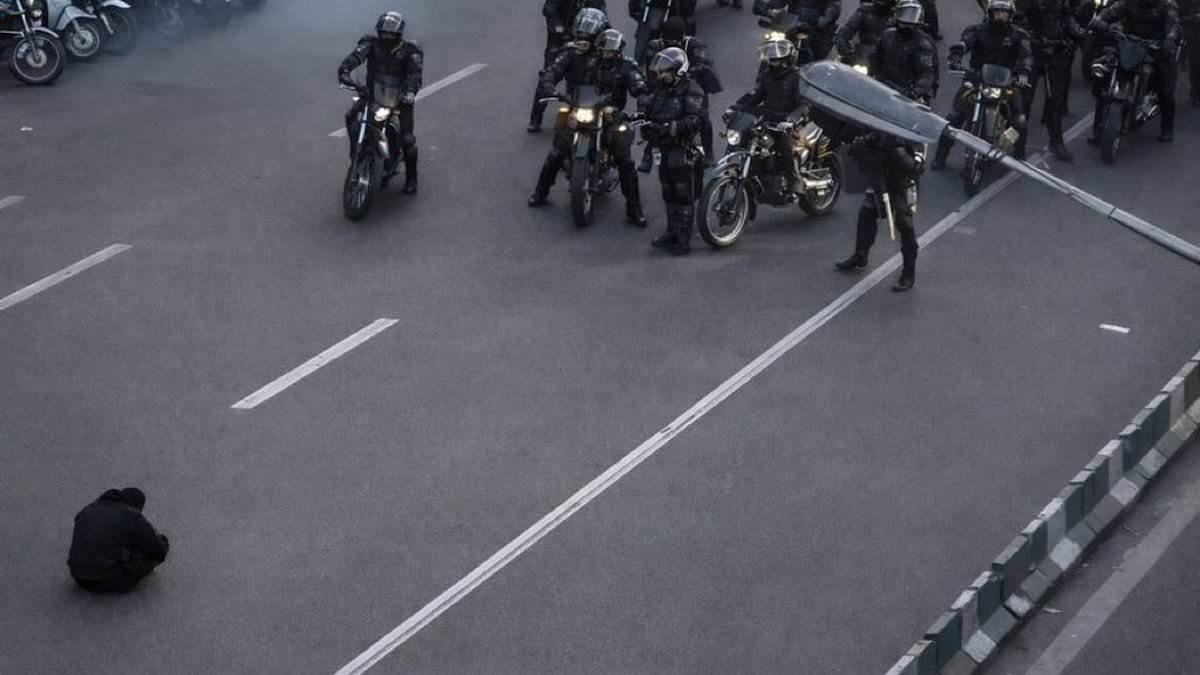
A powerful photograph capturing a solitary protester seated on a roadway in Iran, facing off against armed security personnel, is drawing comparisons to the iconic ‘Tank Man’ image from the 1989 Tiananmen Square protests.
This striking image, widely circulated by local outlets like Iran International, depicts a courageous individual in Tehran, attempting to halt the advance of police on motorcycles by blocking their path.
Emerging on social media overnight, the photo comes in the wake of Iran’s largest demonstrations in three years, sparked by the Iranian rial plunging to a historic low against the US dollar.
Many see echoes of the ‘Tank Man’ photo, also known as the ‘Unknown Rebel’, which captured global attention during the 1989 protests led by students against China’s authoritarian regime.
That image famously shows an unidentified Chinese man with shopping bags, standing resolute in front of a line of Type 59 tanks on Chang’an Avenue near Tiananmen Square in Beijing, taken on June 5, a day after military forces fired on and killed thousands of unarmed demonstrators.
Mirroring the events in China three decades ago, Iran is witnessing a wave of student-led protests that have expanded from Tehran to eight other cities, fueled by the nation’s deteriorating economic situation.
According to Ilna, a news agency associated with Iran’s labour movement, protests erupted at seven Tehran universities that are among the country’s most prestigious, and at the technology university in the central city of Isfahan.
The student action came after Monday’s protests in central Tehran by shop-owners and a day ahead of the temporary closure of banks, schools and businesses in the capital and in most provinces to save energy during the bitterly cold weather.

A photo of a lone demonstrator defiantly sitting on the road in front of armed security forces in Iran has gone viral on social media

It harks back to China’s ‘Tank Man’ photograph taken during the Tiananmen Square protests
The Iranian rial has dropped against the dollar and other world currencies – when the protests erupted on Sunday, the US dollar was trading at around 1.42 million rials, compared to 820,000 rials a year ago – forcing up import prices and hurting retail traders.
An enormous and aggressive police and security presence was today deployed at major intersections in central Tehran and around certain universities.
Spontaneous demonstrations erupted on Sunday at the city’s largest mobile phone market, before gaining momentum, though they remained limited in number and confined to central Tehran. The vast majority of shops elsewhere continued to operate as usual.
President Masoud Pezeshkian – who has less authority under Iran’s system of government than supreme leader Ayatollah Ali Khamenei – with labour leaders on Tuesday and made proposals to tackle the economic crisis.
‘I have asked the interior minister to listen to the legitimate demands of the protesters by engaging in dialogue with their representatives so that the government can do everything in its power to resolve the problems and act responsibly,’ he said in a social media post.
According to state television, parliamentary speaker Mohammad Bagher Ghalibaf, also called for ‘necessary measures focused on increasing people’s purchasing power’ but warned against foreign agents and government opponents attempting to exploit the protests.
On Monday, the government announced the replacement of the central bank governor with former economy and finance minister Abdolnasser Hemmati.
Price fluctuations are paralysing sales of some imported goods, with both sellers and buyers reportedly preferring to postpone transactions until the outlook becomes clearer.

The image surfaced on social media overnight after Iran was rocked by its largest protests in three years. Pictured: Protesters march in Tehran on Monday, December 29, 2025

Protests in Iran’s capital of Tehran kicked off on Sunday after the country’s currency plummeted to a record low against the US dollar

Reports in official Iranian media that the government plans to increase taxes in the Iranian new year that begins March 21 have caused more concern
According to the Etemad newspaper, one trader complained that officials had offered no support to storekeepers battling soaring import costs.
‘They didn’t even follow up on how the dollar price affected our lives,’ he complained, speaking on condition of anonymity.
‘We had to decide to show our protest. With this dollar price, we can’t even sell a phone case, and the officials don’t care at all that our lives are run by selling mobile phones and accessories.’
In December, inflation stood at 52 percent year-on-year, according to official statistics. But this figure still falls far short of many price increases, especially for basic necessities.
The country’s economy, already battered by decades of Western sanctions, was further strained after the United Nations in late September reinstated international sanctions linked to the country’s nuclear programme that were lifted 10 years ago.
Western powers and Israel accuse Iran of seeking to acquire nuclear weapons, a charge Tehran denies.
The current protests against the high cost of living have not reached the level of the nationwide demonstrations that shook Iran in 2022.
Those protests were sparked by the death in custody of 22-year-old Mahsa Amini, who was arrested for allegedly violating the country’s strict dress code for women.
Amini’s death triggered months of unrest, with hundreds of people, including dozens of security personnel, killed and thousands more arrested.
In 2019, protests broke out in Iran after the announcement of a sharp increase in petrol prices. The unrest spread to around 100 cities, including Tehran, and left dozens dead.