
Advocates are urging Transport for London to dismantle the perceived stronghold that militant unions have on the city by opening up Tube driver positions to external applicants.
These well-paid roles, offering an annual salary of £72,000, are rarely advertised to the general public. This is due to a longstanding agreement with union leaders, who are concerned that bringing in outside candidates might undermine ‘workforce solidarity’.
This arrangement has sparked renewed frustration, as London is currently grappling with another bout of industrial action, which is projected to cost the economy £250 million.
On Tuesday, a 24-hour strike by Rail, Maritime and Transport (RMT) union members resulted in significant inconvenience for commuters, with further disruptions expected from another planned walkout on Thursday.
A source from TfL clarified that there is no outright ban on hiring externally. However, union agreements stipulate that any job openings must first be posted internally, where they are quickly filled.
This internal-first policy contrasts with the strategy employed by train companies, which frequently publicize job openings for train drivers through public channels.
William Yarwood, campaigns director at the TaxPayers’ Alliance, criticised the arrangement.
‘It is an insult to Londoners that these closed shop roles remain a private members’ club for union buddies,’ he told the Daily Mail.
‘By blocking external recruitment, unions kill off competition and artificially inflate wages, leaving taxpayers to bankroll a gold-plated payroll for a protected few.’

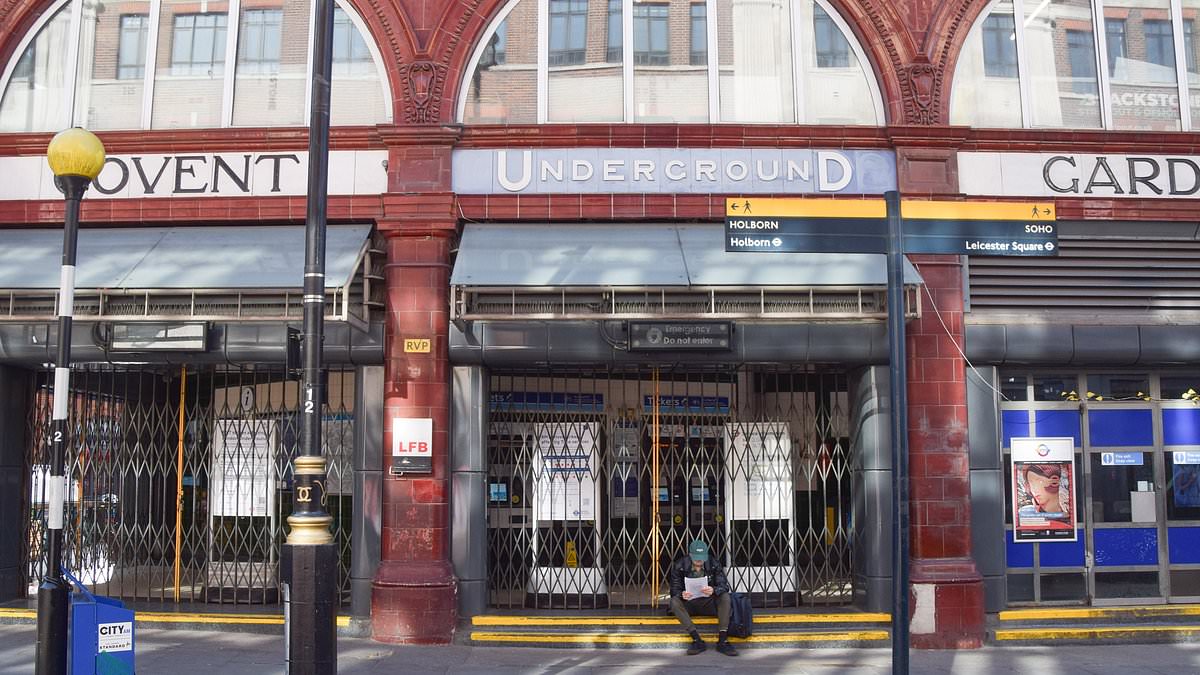
A shuttered Covent Garden Underground station this morning amid a walkout by Tube drivers
TfL insiders said that internal candidates bring ‘useful system-specific knowledge’ and suggested the policy of favouring existing staff was ‘not unusual’ across the British economy.
But Mr Yarwood called for the policy to be immediately reversed – even if that would inevitably mean yet another walkout by union members.
‘TfL must break this stranglehold and open recruitment to the open market immediately to ensure the best value for commuters and taxpayers alike,’ he said.
In 2013, the RMT lashed out against plans to open Tube driver jobs to non-TfL staff.
‘We believe that the ‘shortfall of successful applicants’ is because of failings in the assessment and training process, which are rejecting capable candidates,’ the union said, accusing Tube bosses of building a ‘a pretext to recruit externally, to weaken the workforce solidarity that internal recruitment supports’.
Union leaders are resisting the introduction of a four-day working week, which they claim could raise fatigue and compromise safety. RMT boss Eddie Dempsey said: ‘Transport for London (TfL) seems unwilling to make any concessions to avert strike action.’
But TfL has insisted the changes are voluntary, calling walkouts ‘absolutely unnecessary’. Train drivers’ union Aslef has accepted the changes, which would cut the average driver’s working week from 36 to 35 hours.
An Aslef spokesperson said its union was ‘surprised’ that the RMT was going on strike, adding: ‘It will be the first strike in the history of the trade union movement designed to stop people having a shorter working week and more time off’.
A Tube driver earns around £71,170 per year as a base salary, with total earnings often reaching £75,000 to £80,000 when overtime and allowances are included.

Commuters have taken to the roads on hire bikes in London today amid an ongoing strike by Tube drivers affiliated to the RMT union
Most are enrolled into the TfL pension fund, which requires drivers to pay in 5 per cent of their salary for an employer contributions of more than 33 per cent. Other perks include free TfL travel and 75 per cent off train season tickets.
Tube drivers do not require prior qualifications other than GCSEs in maths and English and training takes around six months.
On most Underground lines, the trains are semi-autonomous. This means a machine handles stopping and starting, with drivers operating doors and handling emergencies.
Simon French, chief economist at independent investment bank Panmure Liberum, has estimated the cost of the strikes as £210million.
The strikes have forced the hands of City firms that usually demand workers come into the office, with some telling workers they can work from home.
And commuters deprived of their usual Tube line have taken to the roads in droves as they try to find other means of getting to work.
Susan Hall, leader of the Conservatives’ City Hall group, told the Mail: ‘This is going to damage the tourist trade even more, while Sadiq Khan sits in his chauffeur-driven car.
‘He doesn’t understand how it is for the people trying to get to work, earning a lot less than these Tube drivers.
‘The unions are so used to striking they will find any reason to do so, it appears, knowing this Government will give them anything they want.
‘There is no way Labour is on the side of working people, otherwise it would be doing what it can to make sure they can get to work.’
The RMT has been contacted for comment.