Germany faced two fresh suspected attempts to disrupt its electricity network overnight, deepening security concerns as authorities remain on heightened alert after an alleged drone incident that Berlin has linked to Russia.
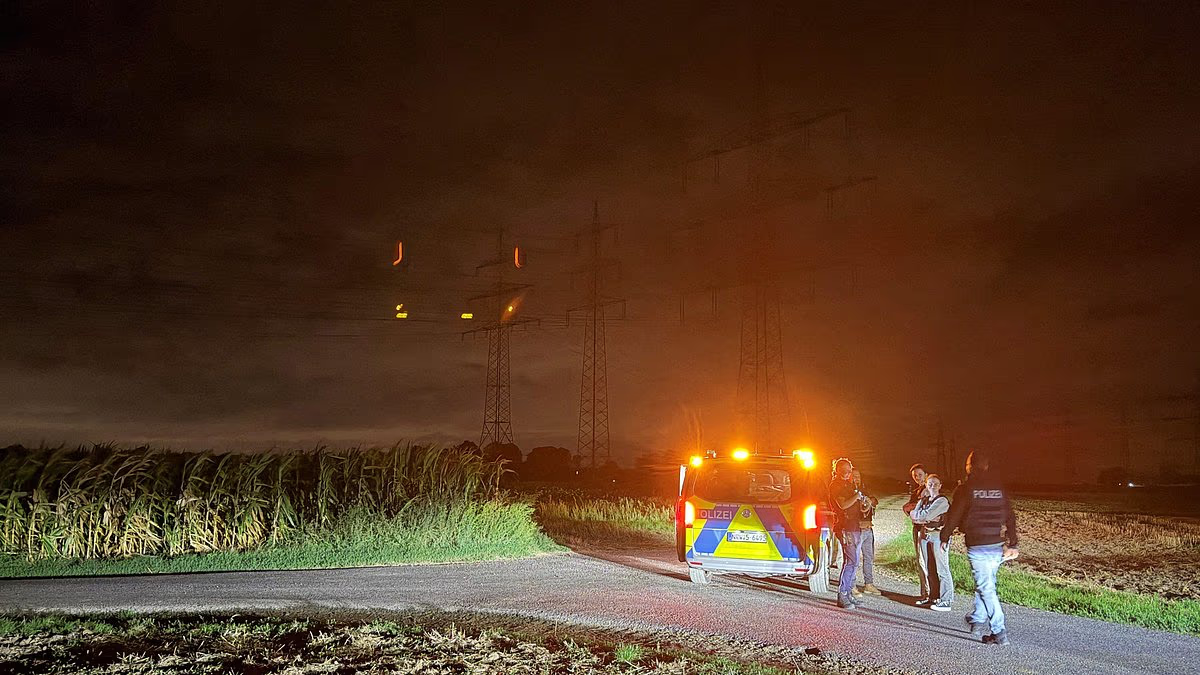
In Dormagen, North Rhine-Westphalia, local police said someone appeared to have tried to trigger a short circuit at a power grid facility, according to German newspaper Bild. Investigators have also received a letter claiming responsibility for the incident.
In a separate case, police in Ganderkesee, a town in Lower Saxony, sealed off a transformer station on Friday after reporting suspicious circumstances at the site.
A police spokesman said officers had found something overnight that required an official response, though he did not disclose further details. Authorities stressed there was no threat to the public.
The latest incidents come after German officials were already investigating two suspected acts of sabotage earlier in the week.
One inquiry centers on damage at a substation in Bergheim, roughly a 30-minute drive from Dormagen, where vandalism forced five brown-coal power plant units offline temporarily. Together, the units have a capacity of 4,200 megawatts.
Another case involved devices containing conductive material that damaged power lines at one of Brandenburg’s most important high-voltage junctions.
Germany, a NATO member and key supporter of Ukraine in its war against Russia, has repeatedly accused Moscow of waging hybrid operations on German soil, including espionage and sabotage. Russia has denied those allegations.

German police said an attempt had been made to short-circuit a power grid installation in Dormagen

Germany has long accused Vladimir Putin of targeting it with a campaign of hybrid attacks involving espionage and sabotage
Germany has repeatedly reported suspicious drone sightings over military and industrial sites. At the beginning of August, police defused a drone carrying explosives near a Ukrainian cargo plane in Leipzig.
And another drone was reportedly found weeks later near the airport, also with traces of an explosive substance.
The airport in eastern Germany plays a key role in the transport of military goods, including by the German military and Nato allies, and also serves as a base for Ukraine’s Antonov Airlines.
Chancellor Friedrich Merz later said Germany had increasingly ‘found itself in the crosshairs of hybrid attackers’.
Berlin has so far refrained from blaming Russia, speaking only of the possible involvement of ‘foreign powers’, until Tuesday, when it said Moscow was responsible for last month’s drone attack.
Interior Minister Alexander Dobrindt said the Leipzig airport attack followed the ‘well-established pattern of Russian hybrid operations in Europe’, and the assumption was that Germany would be targeted again.
Other EU members are also warning of Russia’s increasingly aggressive moves. On Thursday, Denmark’s national security and intelligence service (PET) warned Russia is recruiting Danish citizens to help plan sabotage against Danish defence firms with ties to Ukraine.
‘Russia is both planning and carrying out acts of sabotage against defence companies and the defence industry in Europe,’ PET’s head of counter-espionage Emil Gresholm said in a statement.
‘We see that Danish companies are also targets of concrete Russian sabotage planning, and that Russian intelligence services are actively preparing acts of sabotage directed at the defence industry in Denmark,’ he said.
Russia’s ambassador to Denmark, Vladimir Barbin, said in an emailed statement on Thursday that Mr Gresholm had failed to provide any concrete evidence to support the allegations.
‘Gresholm’s statements should also be seen as an acknowledgement that Copenhagen’s reckless involvement in the conflict in Ukraine and the transformation of Danish territory into a production and logistics rear base for the Ukrainian armed forces poses security risks to Denmark and its citizens,’ Mr Barbin said.
Mr Gresholm said PET has uncovered concrete examples of Russia attempting to recruit Danes on social media and gaming platforms for tasks such as taking photos of companies or infrastructure, which could be used in the planning of acts of sabotage.
‘It is extremely serious if ordinary Danes help Russian intelligence services – either deliberately or unwittingly,’ he said.