
Vladimir Putin has increased the size of the elite security service assigned to protect him, a move that comes amid heightened concerns about potential assassination threats.
More than two dozen officers are being added to the central command structure of Russia’s Federal Protective Service, or FSO, raising its staffing levels from 785 to 812.
It is the fourth expansion of the force since Putin launched the full-scale invasion of Ukraine in 2022, a period that has seen growing attention on the Russian leader’s personal security.
The increase comes as the war in Ukraine grinds on, with Russian attacks on Kyiv on Thursday killing at least 10 people and injuring more than 50 others.
The FSO is charged with protecting Russia’s top officials, including guarding the president, securing his residences, overseeing state communications and providing protection during official travel.
The service also provides security for members of Putin’s family and those within his closest circle. The broader agency is believed to have a workforce of more than 50,000.
The latest increase, which took effect on Wednesday, follows a years-long tightening of security around the Kremlin chief.
Prior to the invasion of Ukraine, staffing levels in the FSO’s central apparatus had remained broadly stable for more than 10 years.

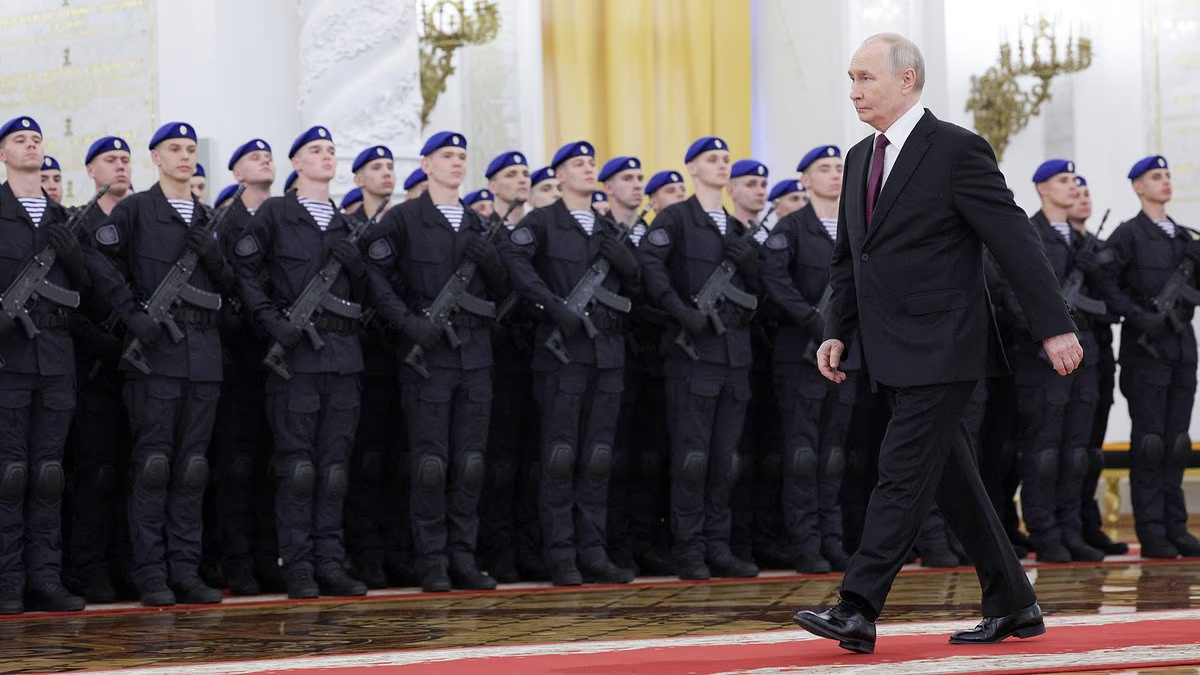
Vladimir Putin has expanded the elite security unit tasked with protecting him amid mounting fears of assassination attempts. Pictured: Putin hosts a ceremony to award the Presidential Regiment of the Federal Guard Service

Russian President Vladimir Putin chairs a Security Council meeting at the Kremlin in Moscow, Wednesday, July 1, 2026
Independent Russian media have reported that the agency’s influence has grown significantly during the war, becoming one of the Kremlin’s most powerful institutions.
European intelligence assessments suggest the FSO has introduced increasingly strict security procedures this year in response to the growing threat posed by long-range Ukrainian drones, as well as fears of a possible coup or assassination attempt.
Staff working in Putin’s immediate vicinity have been banned from using mobile phones or other internet-connected devices or using public transport, according to The Telegraph.
They have also had security systems installed inside their homes.
Even wristwatches have been blacklisted, with officials ordered to take them off in Putin’s presence since around mid-April, according to a source speaking to the Telegram channel Mozhem Obyasnit.
The FSO has become one of the Kremlin’s most influential institutions, with service in the elite agency often acting as a stepping stone to senior positions in Vladimir Putin’s inner circle.
Among its most prominent alumni is Alexey Dyumin, who rose from the Russian president’s personal detail to command the Special Operations Forces before becoming deputy defence minister.
Since 2024, he has served as secretary of Russia’s State Council.
Despite its formidable reputation, the agency has suffered embarrassing security lapses.
In 2024, journalists from Le Monde tracked Putin’s movements using public fitness data uploaded by FSO officers to the Strava app.

A woman looks at an apartment building burning after a Russian missile attack in Kyiv, Ukraine, Thursday, July 2

A woman cries holding a child near the site of an apartment building damaged during overnight Russian missile and drone strikes, amid Russia’s attack on Ukraine, in Kyiv, Ukraine, July 2
The running routes appeared to link the Russian leader to two luxury properties he has long denied owning – a sprawling palace overlooking the Black Sea and an opulent lakeside retreat in Karelia.
The data also exposed the movements of security personnel ahead of a highly secretive meeting with Kim Jong-un in Blagoveshchensk, as well as before other diplomatic meetings with world leaders.
It comes as Russian forces attacked Kyiv on Thursday as drones and missiles struck residential buildings in what Russia said was a retaliation for recent attacks on its civil infrastructure.
Ukrainian President Volodymyr Zelensky had earlier warned of a possible overnight attack and said he was cutting short his visit to Dublin for the start of Ireland’s six-month term in the rotating presidency of the EU.
Kyiv Mayor Vitali Klitschko, writing on Telegram, said 10 people were killed, while damage included six floors of an apartment building that had partially collapsed after a direct hit from a Russian projectile.
Reuters video footage showed emergency services working through the rubble of what used to be a nine-story building as the sun was rising over Kyiv and as fires flared up around the city.
Tymur Tkachenko, the head of the capital’s military administration, said 56 people, including two children, were injured and three dozen locations across the city had been damaged in the attacks.
‘The enemy has once again deliberately targeted residential neighborhoods and killed civilians. We have sustained extensive damage and a significant number of casualties, including children,’ he wrote on Telegram.
In an earlier post, Klitschko said the injured included paramedics and drivers at an ambulance station, and that some people were still trapped inside damaged residential buildings.
Pictures posted online showed a fire burning out of control at the top of a building on the central Shevchenko Boulevard, while elsewhere in the city, windows blew out and cars were destroyed.


