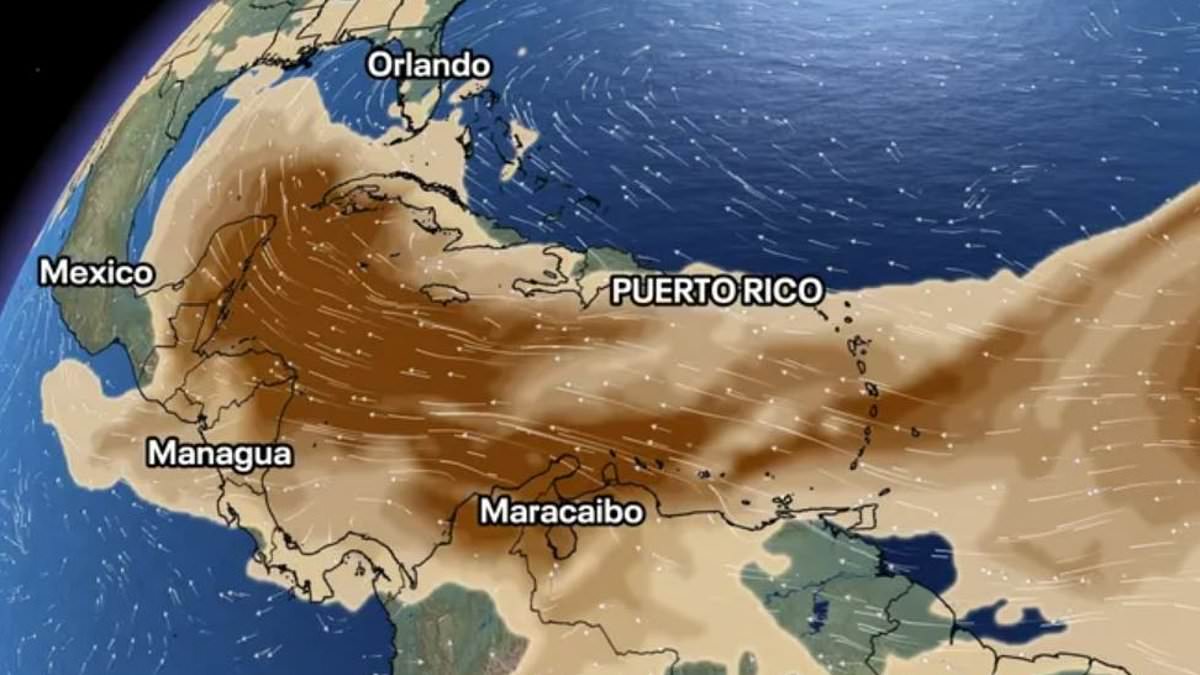

A massive dust cloud originating from the Sahara Desert is traveling across the Atlantic Ocean and is predicted to reach Florida and some areas in the southeastern United States in the next few days.
The dusty air may linger for several days, leading to poor air quality and potential health risks.
Specialists caution that this dust can lead to breathing difficulties, particularly for individuals suffering from asthma, allergies, or other respiratory problems, as it contains tiny particles that may cause lung irritation.
Meteorologist Matt Devitt from WINK Weather in Fort Myers, Florida, posted a time-lapse video on Facebook Tuesday. The video captures the movement of the Saharan dust cloud as it approaches Key West, spreads into the Gulf of Mexico, and returns to South Florida by Friday.
As of Wednesday, the cloud had reached the Caribbean Sea.
‘The Saharan Air Layer contains about 50 percent less humidity, which can weaken tropical systems and slow down activity in affected areas,’ Devitt said .
As a bonus, the plume can create stunning sunrises and sunsets, adding a warm, colorful glow to the sky.
Saharan dust clouds like this one can travel more than 5,000 miles and often reach the Gulf Coast and Florida each summer.

Saharan dust clouds like this one can travel more than 5,000 miles, often reaching the Gulf Coast and Florida every year during summer.
The Saharan Air Layer is a dry, dusty air mass that forms over the Sahara Desert, the largest and hottest desert in the world.
Each summer, seasonal weather patterns like the West African Monsoon and high-pressure systems create strong winds that sweep across the Sahara.
These winds pick up tiny particles known as aeolian dust and lift them into the atmosphere.
Meanwhile, the Bermuda-Azores High, a high-pressure system over the Atlantic Ocean, produces steady east-to-west winds that help carry the dust across the ocean.
Another pattern, the African Easterly Jet, helps push the dust higher into the air and even farther west.
Together, these wind systems can transport Saharan dust over 5,000 miles, often reaching the Caribbean, Florida, and the Gulf Coast.
Dust activity usually peaks between June and mid-August, though the amount of dust varies from year to year.
While the dust can lower air quality and pose problems for people with asthma or other respiratory conditions, it also has a silver lining: the dry air and strong winds help suppress hurricanes by making it harder for tropical storms to form and grow.

Meteorologist Matt Devitt of WINK Weather in Fort Myers, Florida, shared a time-lapse video on Facebook Tuesday, showing the Saharan dust cloud drifting near Key West, spreading into the Gulf of Mexico, and looping back into South Florida by Friday

As a bonus, the plume can create stunning sunrises and sunsets, adding a warm, colorful glow to the sky
The Saharan dust plume is expected to reach Florida by the weekend, bringing hazy skies, vibrant sunsets, and a drop in air quality.
Experts cite guidance from the Centers for Disease Control and Prevention (CDC) and the National Weather Service (NWS), which warn that elevated dust levels can trigger asthma attacks and worsen conditions like COPD and allergies.
The fine dust particles can also irritate the eyes, nose, and throat.
Health officials say children, older adults, and people with heart or lung issues are especially vulnerable during these dusty events.

In July 2023 (pictured), another thick wave of Saharan dust blanketed Florida, Texas, Louisiana, Alabama, and Mississippi, turning skies orange and pushing air quality into ‘unhealthy for sensitive groups’ in cities like Miami and Houston
In June 2020, a massive Saharan dust cloud, nicknamed the ‘Godzilla plume,’ swept from West Africa across the Atlantic, bringing hazy skies from Texas to the Carolinas.
The National Oceanic and Atmospheric Administration (NOAA) called it the largest event in nearly 50 years, with reduced visibility and air quality alerts issued across multiple states.
Then in July 2023, another thick wave of Saharan dust blanketed Florida, Texas, Louisiana, Alabama, and Mississippi, turning skies orange and pushing air quality into ‘unhealthy for sensitive groups’ in cities like Miami and Houston.
This year’s plume is different as it’s earlier, denser, and more concentrated, with higher levels of fine particles.
As a result, health officials and meteorologists are keeping a close eye on its impact.
The size and intensity of these dust clouds vary from year to year, but scientists believe that shifting wind patterns and climate change may be contributing to more frequent and powerful plumes.