Millions of Australian mortgage borrowers are facing another sharp increase in repayments after the Reserve Bank lifted interest rates to their highest point in nearly 15 years, placing fresh pressure on household finances.
The RBA board unanimously raised the cash rate by 25 basis points to 4.6 per cent on Tuesday, fuelling concerns that households could face another increase before Christmas.
The decision pushed the cash rate to its highest level since 2011 and marked the fourth interest rate rise Australian borrowers have endured in 2026.
Canstar estimates that, if lenders pass on the full increase, monthly repayments will climb by about $91 for a $600,000 mortgage, $114 for a $750,000 loan and $152 for a $1 million mortgage.
The broader impact is even more substantial. The four rate increases announced this year have added roughly $364 a month to repayments on a $600,000 loan, while borrowers with a $1 million mortgage would be paying about $606 more each month—equivalent to approximately $4,400 and $7,300 a year respectively.
Although the RBA left rates unchanged in August, governor Michele Bullock has acknowledged that she does not want to see people lose their jobs. However, she has also indicated that a rise in unemployment could be necessary to curb inflation, prompting one expert to warn that mounting joblessness could become a “human disaster”.
After Tuesday’s announcement, Bullock said she hoped the four rate rises delivered this year would be sufficient to bring inflation under control. She stopped short of predicting whether another increase would be needed before Christmas.
“We raised interest rates three times earlier in the year. A lot of that effect is still to flow through,” she said.

RBA governor Michele Bullock (pictured) has said she does not want Australians to lose their jobs, while warning that higher unemployment could be required to bring inflation under control

The Reserve Bank kept rates unchanged in August, but governor Michele Bullock has warned that reducing inflation could come at the cost of higher unemployment

Treasurer Jim Chalmers (pictured) acknowledged that the latest interest rate increase would add to financial pressure on households
“The hope here is that this will be restrictive enough. Will it be enough? I don’t know,” Bullock said.
“Every household has seen how the price of everything has gone up in recent years. Pay packets don’t go as far as they used to, and that’s why we need to stop this high inflation.”
Treasurer Jim Chalmers addressed reporters soon after the RBA’s decision and was questioned about whether he accepted responsibility for the latest blow to Australians already struggling with the cost of living.
“I do understand that a lot of Australians are doing it tough, and this decision today from the Reserve Bank will make things tougher for a lot of people,” he said.
“Australians were already paying a very hefty price for decisions taken about this prolonged war in the Middle East. Today, that price got a bit steeper.”
When asked whether he accepted responsibility for domestic issues identified by the RBA, including weak productivity growth and uncertainty in the housing market, Chalmers said he was accountable for “all of the ways that we can influence the fight against inflation”.
Critics say the consequences of higher interest rates will extend beyond mortgage holders, warning that a slowing economy could also cost Australians their jobs.
Cassandra Goldie, chief executive of the Australian Council of Social Service, said higher interest rates would put employment at risk, with the greatest damage falling on people who lose work or cannot secure enough paid hours.

ACOSS chief Cassandra Goldie (pictured) warned that rising unemployment could create a “human disaster” by leaving people shut out of the workforce for years
‘Since interest rates started to increase, an extra 200,000 people are out of paid work. We cannot be certain what the impact of another rate hike now will be on unemployment in a year’s time.
‘An increase towards or above five per cent would cause a human disaster, locking people out of jobs for years and forcing them to rely on grossly inadequate income support payments.’
Despite concerns about the impact on jobs, economists said inflation remains too high for the RBA to declare victory.
REA Group senior economist Eleanor Creagh said higher mortgage repayments will weigh on discretionary spending at a time when households are already contending with elevated living costs.
IN CASE YOU MISSED IT: Unknown Wanderer Identified as Likely Suspect in Tylenol Murders
Ms Creagh said the rate rise will drive down home prices and sales activity further.
‘While structural housing undersupply remains a long-term support for prices, in the near-term, affordability constraints, higher borrowing costs and weaker buyer demand are likely to keep downward pressure on prices,’ she said.
Beyond its impact on the housing market itself, the rate rise is also expected to make buying a home even harder for those trying to get a foothold.
Domain chief residential economist Dr Nicola Powell said the rate rise will push home ownership even further out of reach for many Australians, particularly first-home buyers already facing significant affordability challenges.

Treasurer Jim Chalmers said it’s possible to have full employment at the same time as having lower, more steady inflation
‘Every increase in interest rates reduces the amount buyers can borrow, limiting what they can afford to pay and pushing some aspiring homeowners out of the market altogether,’ she said.
‘For many, that means delaying their plans while they save a larger deposit or work to meet stricter lending requirements.’
Dr Powell said Sydney and Melbourne could be hit hardest just as the market was beginning to show early signs of stabilisation, however, the bigger challenge is what higher rates could mean for future housing supply.
‘The risk is that today’s fight against inflation becomes tomorrow’s housing shortage,’ she said.
‘Building approvals remain subdued, but that’s not because construction activity has disappeared. Housing is increasingly competing with infrastructure, renewable energy and data-centre projects for the same workers, materials and resources.
‘Australia’s construction industry only has so much capacity. As labour and materials are drawn into other major projects, it becomes harder and more expensive to bring new housing developments to market.
‘Higher rates may help cool demand in the short term, but they can also make it harder to increase housing supply and address Australia’s long-term housing shortfall.’
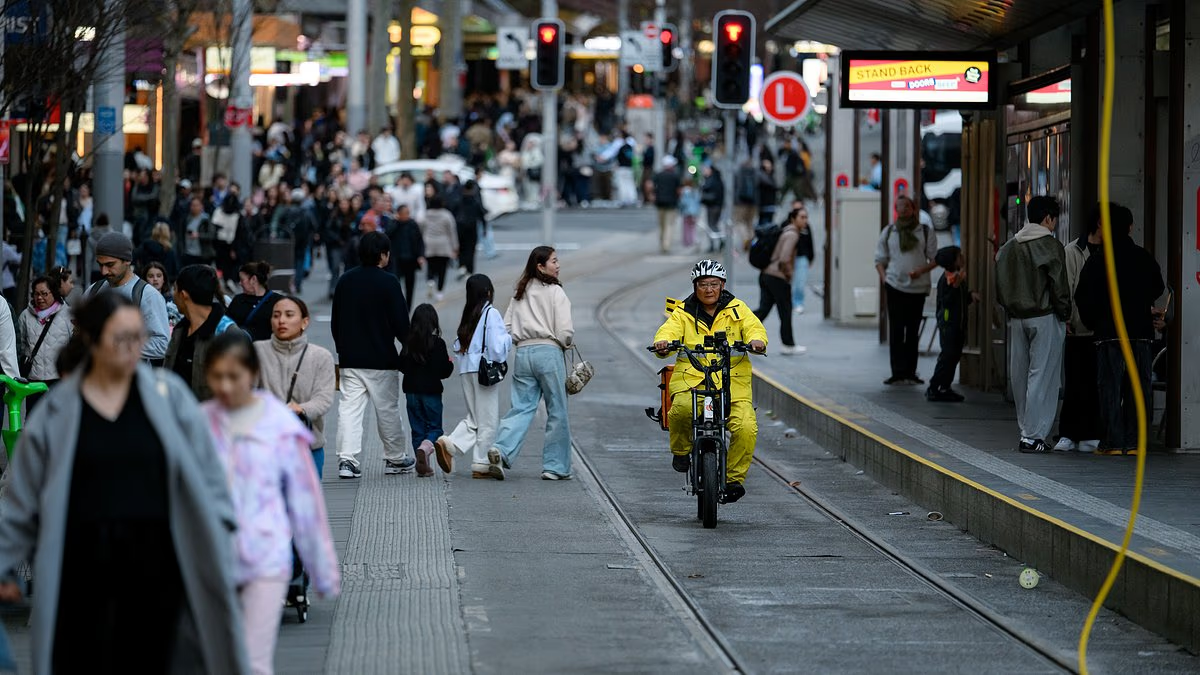
There are already signs higher borrowing costs are biting, with new ABS figures showing cash-strapped Australians are cutting back on non-essential spending with recreation and culture spending seeing the largest fall, down 1.4 per cent.

The latest spending figures from the ABS suggest cash-strapped households are cutting back on discretionary items such as trips the cinema, sporting events and concerts
Head of business statistics Tom Lay said clothing, footwear, recreational goods, food and health also fell.
‘These falls were offset by higher transport spending – up 2.3 per cent – leaving overall household spending unchanged from July,’ he said.
‘Both fuel spending and new vehicle sales contributed to this rise, especially electric vehicles sales as households respond to rising fuel prices.’
University of Sydney economics senior lecturer Dr Luke Hartigan said recent commentary by senior officials indicate the Bank is losing tolerance with persistently high inflation which has been above the RBA’s target band for over 4 years.
‘The RBA is worried, if this continues, households and businesses will start to expect higher inflation which will feed into prices, causing more inflation, creating a difficult cycle to break,’ he said.
‘With another rate increase by the RBA expected in November, the outlook for the local economy points to further downward pressure on housing prices, higher servicing costs for existing mortgage holders, an uptick in the unemployment rate, and a slowdown in economic activity.’
Compare the Market’s Economic Director David Koch said the rate rise was a heavy blow to a group of Australian households already under strain.
‘Yet another gut punch for Aussie families with a mortgage. Where are people meant to find an extra $5,500 a year? And that’s after tax… On top of that, households are getting hit at the petrol pump and again at the supermarket,’ he said.
‘Rates are higher, loans are bigger, and we have a whole generation of mortgage payers who have never seen rates this high. We can’t keep asking the same group of people to keep tightening their belts when there are forces pulling in the opposite direction.’
The latest CPI inflation data comes out on Wednesday.