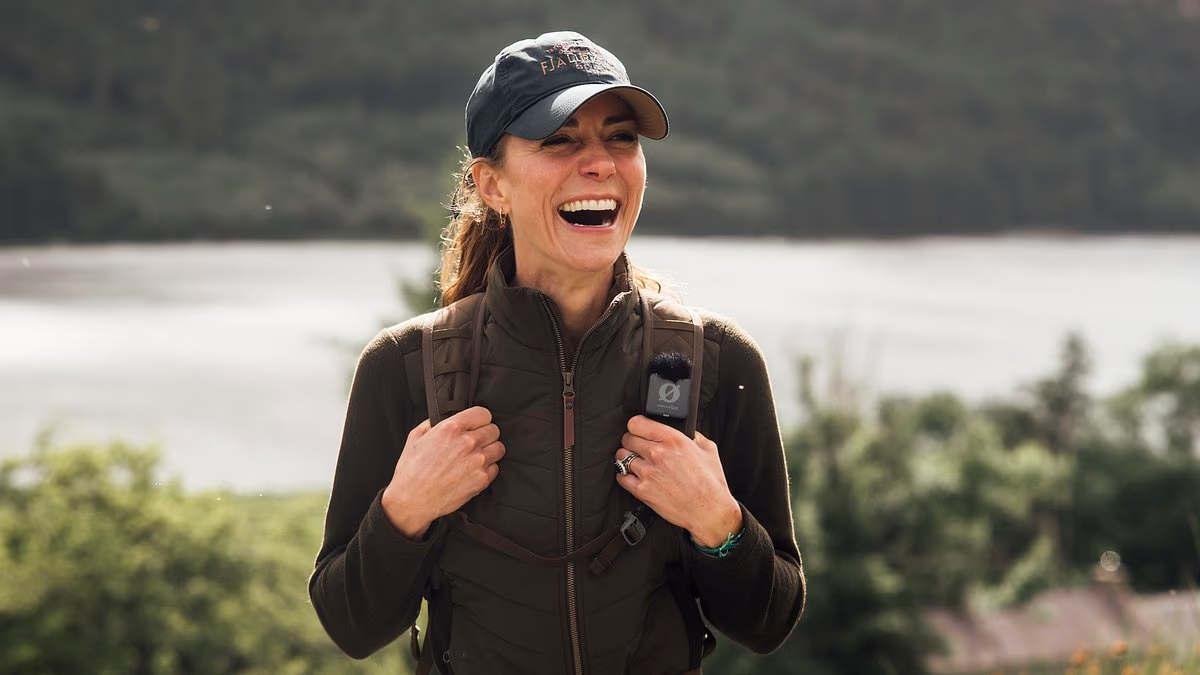

The Princess of Wales has emerged from the past few years changed in body, mind and spirit — and she makes no attempt to hide it. Instead, she appears to embrace the transformation.
As Catherine has said herself, it is often only when we come close to losing everything we love that we gain a clear understanding of what truly matters.
I saw that perspective first-hand earlier this week, when I was invited to a special screening of Heal, Catherine’s powerful new documentary about her Three Peaks charity challenge, at a boutique London hotel.
Just seconds before the screening began, the princess walked in, offering a shy smile before taking a seat nearby in the front row.
Holding a simple folder embossed with her cypher, she rose after a short introduction to explain why the project was so important to her.
“Every year,” she said, “hundreds of thousands of people receive the words no one wants to hear. Cancer doesn’t just affect the body. It changes how you think and feel, and profoundly affects every aspect of life. I know this personally.”
The National Three Peaks Challenge, she explained, gave her an opportunity to test her physical strength once more while raising money for the “lifesaving” work of the Royal Marsden Hospital, where she received treatment. She highlighted in particular the hospital’s holistic support, which helped her and is offered alongside conventional clinical care.

The Princess of Wales after completing The National Three Peaks Challenge, which included Scafell Pike in England, Ben Nevis in Scotland, and Snowdon (Yr Wyddfa) in Wales

The future queen hugging eldest son George, 13, and with Charlotte, 11, and Louis, 8 after the challenge
But Catherine said the film is about more than the challenge itself. It also carries what she described as a “deeper message”.
“Healing, whether personal or collective, is not just about fixing what is wrong,” she said. “It is about finding balance in how we live — between effort and acceptance, between control and trust, between thinking and simply being.”
A cancer diagnosis can bring “fear, anxiety, uncertainty and discomfort”, but it can also sharpen our understanding of what matters most. “We are reminded,” she said, “of the power of small acts of kindness and love.”
For Catherine, that included the anonymous hand she describes so movingly — someone holding hers as she drifted in and out of consciousness in hospital. It was a simple human connection during a period of immense pain and vulnerability. Above all, she said, “my hope is that this film will encourage compassion, showing the real value in standing alongside one another in the hardest of times”.
That is why Heal may be the most powerful piece of royal television you will ever see.
The documentary runs for just 30 minutes, and in my view it is all the stronger for its brevity.
KEEP READING: Colorado Driver Accused of Blocking and Egging Waymo Robotaxis in Bizarre Spree
It is a world away from the lengthy celebrity confessionals, complete with dramatic pauses, that audiences have seen from some members of the Royal Family in recent years. Instead, viewers watch the future queen walk and talk — sometimes reflecting aloud, sometimes speaking to people she loves — as she considers her experiences and what they have taught her.

The princess in her powerful new documentary, Heal. Rebecca English was invited to a very special screening of the 30-minute film earlier this week

Kate speaking with patients during a visit to The Christie NHS Foundation Trust in Manchester
Her story feels shaped by the camera rather than performed for it. She is open, candid and clear-eyed. At times, her tone is so raw and conversational that it feels as though we are being allowed to overhear her most private thoughts.
Just as striking is the absence of self-pity — a refreshing contrast with the tone many readers found in Prince Harry’s memoir, Spare.
Catherine has clearly looked into the abyss and come through the other side. Yet she is also quick to acknowledge that many people have endured experiences far more difficult than her own.
The film ends with her family around her. Her “kiddies” rush affectionately into her arms as her proud parents and husband watch on, making it unmistakably clear where her priorities lie.
I believe this programme will help put much of what the princess has said and done since her surgery and cancer diagnosis into perspective. She is willing to share more than may come naturally to her in public, while still maintaining a firm and fiercely protected boundary between her public and private lives.
Friends have repeatedly told me how deeply shaken she was by the worldwide torrent of abuse that followed her withdrawal from public duties in January 2024. The vicious online speculation and cruel comedy sketches were completely at odds with her character.
Yet rather than dwell on those who spread the darkest rumours, the Princess of Wales appears to have transformed that negativity into a source of strength — and into an almost spiritual determination to promote a kinder, more compassionate world.
Some people will inevitably dismiss this new, more open and pastoral style, particularly because the Royal Family has traditionally maintained a stiff upper lip when discussing illness.
But this documentary makes clear that both approaches have their place, depending on the circumstances and the moment.
In Catherine’s case, viewers will encounter a woman with a renewed sense of purpose and perspective: someone prepared to say no and set boundaries when necessary, but equally willing to push beyond them when the moment calls for it.
The Royal Family is likely to emerge stronger as a result.


