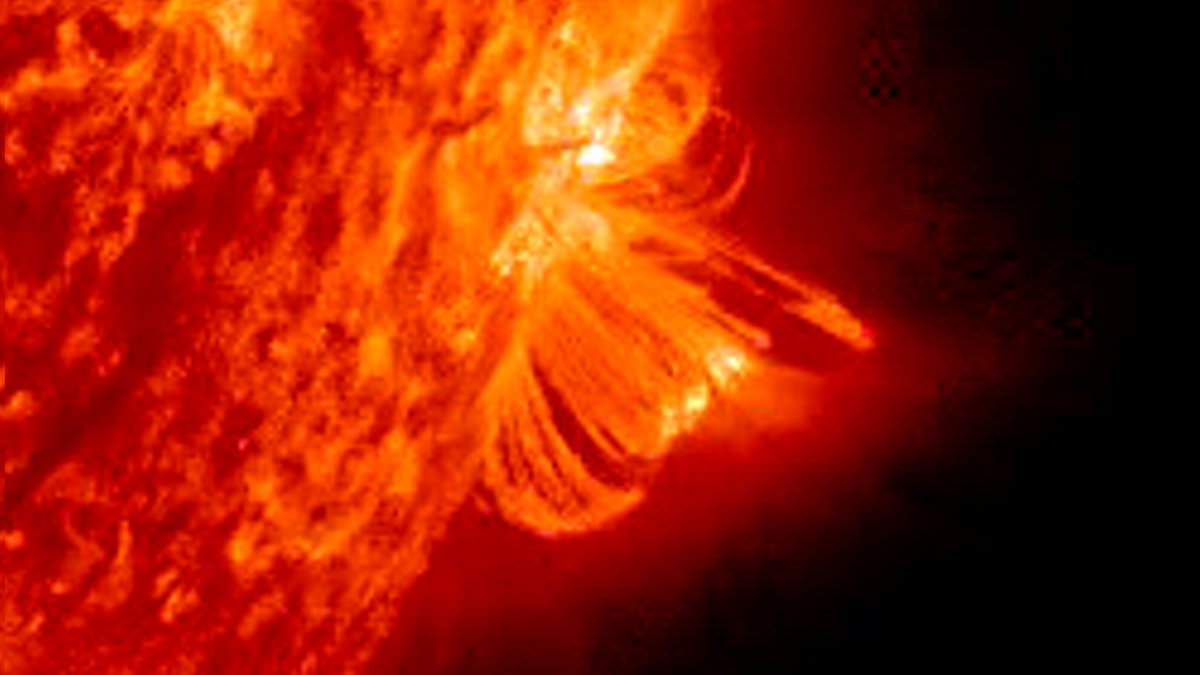


Scientists have warned that humanity is not prepared for extreme space weather as a solar storm is predicted to smash into Earth this week.
They conducted a ‘solar storm emergency drill’, simulating what would happen if a major geomagnetic storm hit Earth.
Results showed power grids failed, blackouts were triggered and communication broke down across the US.
The exercise involved conducting four simulations of geomagnetic storms with varying degrees of intensity. These storms are temporary disturbances in Earth’s magnetic field caused by a significant release of charged plasma from the sun’s outermost layer.
One scenario featured a ‘solar superstorm’ severe enough to trigger an ‘internet apocalypse,’ leading to disruptions in the power grid across the United States. The eastern seaboard experienced blackouts that persisted for weeks.
In addition to affecting power grids, the storms caused railways and pipelines to be knocked offline, resulting in mass travel disruptions and a significant increase in gas prices.
Scientists are now calling for a whole-of-government planning approach, arguing it will be critical for protecting America from cosmic disaster.
That would include deploying more satellites to monitor space weather, enhance real-time data collection to improve forecasting models, and provide earlier warnings.
The report comes as NASA warns a massive solar storm is heading toward Earth this week, which could turn the simulations into a reality.
The imminent solar storm is the result of a powerful X-class flare, which could trigger the event simulated in the exercise.
These are the most powerful solar flares, and they often coincide with coronal mass ejections (CMEs), which are large eruptions of plasma and magnetic fields.
The sun has unleashed powerful streams of energized particles several times in the past few days with the most recent on May 19.
NASA warned that more is to come, saying the bursts could continue to impact ‘radio communications, electric power grids, navigation signals, and pose risks to spacecraft and astronauts’.
The latest exercise was conducted in May 2024 by the Space Weather Operations, Research, and Mitigation (SWORM) task force, which includes agencies like the National Oceanic and Atmospheric Administration (NOAA) and the Department of Homeland Security (DHS).
The fictional scenario was set on January 29, 2028, and involved a series of massive solar flares and high-energy radiation from the sun aimed at Earth.
Solar flares are intense bursts of radiation that come from sunspots — darker, cooler areas on the sun’s surface — and are among the most powerful explosions in the solar system. These flares can last from a few minutes to several hours.
The drill tasked scientists with tracking an active solar region rotating toward Earth, testing protocols and response times in the face of a potentially catastrophic solar storm.
In the simulation, the solar activity disrupted critical systems such as damaging satellites and knocking out power grids across the US.
Scientists observed intense radiation exposure to satellites, astronauts and commercial aviation, and radio communications outages and disruptions.
Participants identified the greatest challenge was forecasting impact of a coronal mass ejection (CME)—a massive burst of plasma and magnetic field from the sun.
The current technology could only detect a CME about 30 minutes before it reaches Earth, when the magnetic orientation becomes clear, which makes preparation impossible.
The report recommends investing in advanced space weather satellites, deploying more sensors to monitor solar activity, and increasing cooperation between US. agencies, international allies, and private industry.
‘Ongoing preparedness efforts for a space weather event are crucial because an extreme event has the potential to severely impact our nation’s critical infrastructure and threaten our national security,’ the report stated.
‘Just as we prepare for earthquakes, hurricanes, and cyberattacks, our nation must take action before a major space weather event occurs.’
Coincidentally, the exercise was conducted at the same time the Gannon Storm, Earth’s most powerful solar storm in two decades, hit on May 10, 2024.
That storm triggered a mass satellite migration, temporarily making Earth’s orbit unsafe, and caused local power outages as well as widespread radio and satellite communication blackouts.
Now, a year later, NASA issued the warning after a powerful burst of energy from the sun on May 14, which measured as an X2.7-class solar flare, the highest category for solar flares and coronal mass ejections (CMEs).
The flare has caused radio blackouts across Europe, Asia, and the Middle East, along with some power degradation in the eastern US. But the space agency suggested more are to come.
While NASA warned more blackouts and communication interference are expected in a matter of days, the agency also noted that several US states will witness stunning northern lights.
Those include Alaska, Washington, Idaho, Montana, North Dakota, South Dakota, Minnesota, Michigan, Wisconsin, and Maine, as well as parts of nearby states, including New York.
Solar flares are grouped into five categories: A, B, C, M, and X, with each level representing a tenfold increase in energy output. A is the weakest, and X is the strongest.
The UK’s Met Office reported that up to five sunspot regions are currently visible on the side of the sun facing Earth, with a new magnetically active region rotating into view over the southeastern solar horizon.
The agency also noted that a region near the sun’s northwest limb may have produced a moderate-class flare earlier on May 19.
‘Solar activity is expected to remain mostly low, but with an ongoing chance of isolated moderate-class flares,’ the Met Office added.
This uptick in solar activity highlights the importance of monitoring space weather, especially as our society becomes more reliant on technology.
As the sun continues through its active phase, more solar flares and potential geomagnetic storms could occur in the coming days and weeks.


