
Share this @internewscast.com
Researchers suggest that restaurants should integrate animal images into their menus to encourage customers to opt for vegetarian meals over meat options.
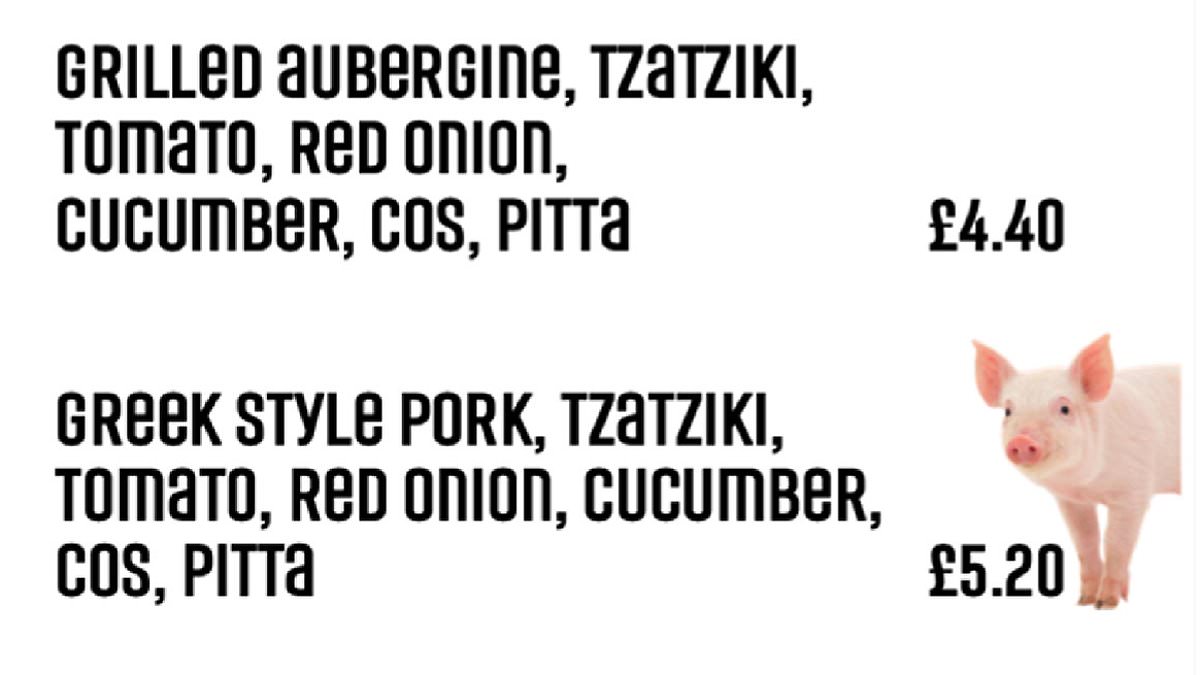
In a recent investigation, specialists from the University of East Anglia experimented by placing pictures of live animals next to meat dishes on a university cafeteria menu in the UK.
For instance, a picture of a cow accompanied the beef bolognese, a pig was shown with the pork gyros, and a chicken was depicted alongside the sweet and sour chicken.
The findings revealed that these visual additions had a notable influence on what diners chose to eat.
Specifically, the likelihood of selecting a vegetarian dish increased by 22 percent, and this trend was consistent across all types of meat.
The researchers concluded that “visual reminders of meat’s animal origins can affect actual food selections in real-world settings.”
‘By displaying images of live animals alongside meat–based dishes on university cafeteria menus, we observed a significant increase in the proportion of vegetarian meals sold.
‘These findings demonstrate that linking meat to its animal source can produce measurable behavioral changes, and highlight the practical potential of simple, low–cost animal–meat reminders in everyday dining contexts.’

In a new study, experts from the University of East Anglia added images of living animals alongside meat–based dishes on a cafeteria menu at a British university
For the study, the researchers set out to understand whether reminding people of meat’s animal origins would impact their willingness to eat it.
‘Many people who eat meat experience unease about the idea of causing suffering to animals,’ the researchers explained in their study, published in the Journal of Environmental Psychology.
‘This tension – known as the “meat paradox” – reflects a form of cognitive dissonance arising from the conflict between valuing animal welfare and consuming meat.
‘To lessen this tension, it is argued that humans have developed strategies to increase the psychological and physical separation between meat production and meat consumption.’
The team set up in a British university canteen, where they displayed menus over two periods.
During the first period, diners saw menus with only the dish descriptions on them, while during the second, they also saw images of animals next to the corresponding meat dishes.
An analysis of sales revealed that the odds of ordering a vegetarian meal were 22 per cent higher when the animal images were displayed.
‘The intervention effect appeared to be generally consistent across different types of meat suggesting that the psychological mechanisms underlying the meat paradox – such as empathy for animals and heightened moral or disgust responses – are presumably activated by the recognition of any animal source, rather than being restricted to certain meats that are culturally or emotionally more salient,’ the researchers explained.

For the study, the researchers set out to understand whether reminding people of meat’s animal origins would impact their willingness to eat it (stock image)
The experts do note several limitations to the study.
The study only looked at immediate choice, and it remains unclear if people who opted for vegetarian meals in the canteen went on to avoid meat later.
What’s more, the study took place in a university canteen with mostly young diners, who may be more emotionally engaged with environmental issues than older age groups.
However, the researchers hope the findings highlight the impact of animal images on diner choices.
‘Unlike interventions that seek to change behavior through information, monetary incentives, or restrictive policies, animal-image interventions are low-cost, scalable, and easy to implement,’ they added.