
Share this @internewscast.com
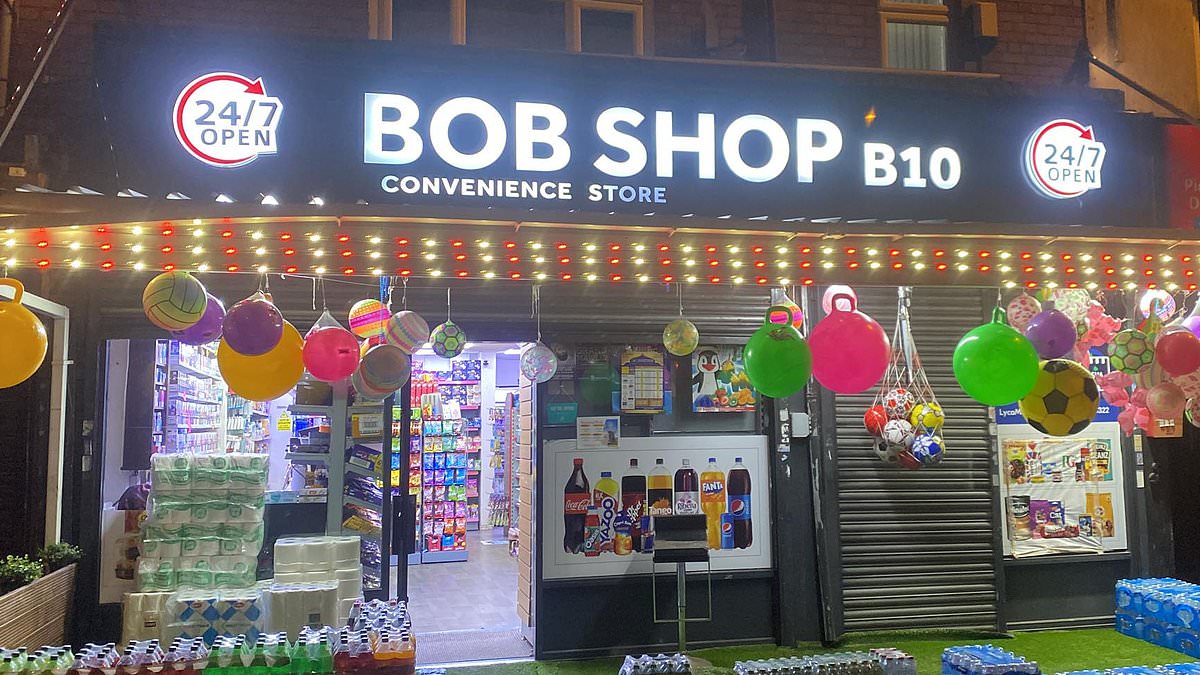
The Bob Shop convenience store made its debut in Birmingham in 2022. Known as Bob Shop 1, it quickly became a local landmark on a bustling road northeast of the city center. Its eye-catching neon signs, round-the-clock hours, and vibrant storefront drew in curious onlookers.
Following the success of the initial store, more Bob Shops began to appear, each numbered in sequence. Rapid expansion led to a current total of 15 locations scattered across the city.
Prominently featured in many of these outlets are vapes and cigarettes, presented in bright displays and available to customers at any hour.
However, beneath the lively façade of these stores lies a more troubling reality. These shops are actually a front for organized criminal activities.
The chain and its employees have faced no less than nine prosecutions for crimes such as selling counterfeit cigarettes, distributing banned items like nitrous oxide canisters, and employing illegal immigrants.
According to sources cited by the Daily Mail, an additional seven prosecutions are expected to be filed.
Yet despite the dawn raids and repeated successful prosecutions the authorities have struggled to shut down the tacky outlets, which have become a blight on the streets of Britain’s second largest city.
To find out why, the Daily Mail has investigated the Bob Shop phenomenon. As a resident of Birmingham, I also had a personal interest.

Bob shops quickly caught the attention of passers-by with their gaudy, flashing, neon signs at the entrance
I had had my own suspicions about the shops after I first visited one a couple of years ago, hoping to buy some wine after missing closing time at the local supermarket. Having passed under the garish flashing sign which makes the store stand out so spectacularly, I was baffled to find it did not sell a drop of alcohol.
This is not suspicious in itself, of course. But why was the shop open at this hour if it wasn’t catering for the most likely evening customers – those buying alcohol? How could it possibly be financially viable when it was open for 24 hours a day and mostly empty?
This, in turn, raised another question. Could the convenience store be a means of laundering money – processing ‘dirty’ cash through its business accounts and declaring it as shop revenue?
It certainly seemed possible. When I asked Dave Benbow, head of the trading standards team at Birmingham City Council that brought the prosecutions, he made the same point about the Bob Shop opening hours. ‘The striking thing with them is that there has never been any alcohol on sale at those shops,’ he said.
‘They were open 24 hours while not being licensed and not selling the type of products that ordinary people would look to be buying at those times.’
It was within months of the first branch opening that the prosecutions began, and Bob Shop’s Afghan director, Javid Ahmadzai, started to become the focus of investigations by police and other enforcement agencies after being fined £750 in 2023 for supplying tobacco products without the correct health warnings.
The following year, enforcement action kicked up a gear. In the early hours of January 31, 2024, co-ordinated dawn raids were carried out by West Midlands Police, trading standards and immigration enforcement at 13 Bob Shops and Mr Ahmadzai’s home.
Fifteen people were arrested, including a man and a woman aged 40 who were detained at Mr Ahmadzai’s address on suspicion of money laundering.

Despite the dawn raids and repeated successful prosecutions, the authorities have struggled to shut down the tacky outlets
Although Mr Ahmadzai was convicted of tobacco-related offences linked to Bob Shops, charges never followed for the most serious allegations, leaving him and a small network of Afghan men free to continue opening branches while bragging about their luxury lifestyle in TikTok videos.
The police, not to be outdone, also uploaded a slickly edited video package of the raids to YouTube.
At the time, the Regional Organised Crime Unit for the West Midlands said 11 of those arrested were detained for a range of immigration offences – with six of them held pending their removal from the UK.
Six of the Bob Shop branches employing illegal workers were served with civil penalty fines totalling £120,000.
Police were also said to be investigating the sale of nitrous oxide, which has been illegal since November 2023. Known as laughing gas or ‘nos’, it is inhaled from balloons to intoxicate users and is becoming increasingly popular among young Muslims.
It should have been a knockout blow for Bob Shop. But it wasn’t. Since then, branches have continued to open, even though many are under investigation.
Following one of the convictions linked to the dawn raids – of Afghan asylum seeker Asif Khan, who received a suspended sentence for selling hundreds of illicit products at Bob Shop 6 in the Sparkbrook area – Judge Dean Kershaw told Birmingham Crown Court: ‘It does not take a judge in a crown court to tell the public what they know is really going on with Bob Shops. It’s obvious. Everybody knows what’s going on.
‘Certainly, those that the courts have dealt with and those under investigation, the vast majority are fronts for money laundering.’

A sniffer dog on a raid in the early hours of January 31, 2024, carried out by West Midlands Police, trading standards and immigration enforcement at 13 Bob Shops
Mr Benbow echoed this belief, saying: ‘We are aware of connections to organised crime, and I think that’s probably as much as I would say at the moment.’
Indeed, such is Bob Shop’s notoriety that it is even being discussed in Westminster.
In January, Preet Kaur Gill, Birmingham Edgbaston MP, asked Rachel Reeves in the House of Commons: ‘My constituents are fed up with seeing more and more dodgy Bob Shops.
‘Can the Chancellor say what the Government are doing to tackle money laundering and other financial crimes involving the dodgy shops blighting our high streets?’
The Chancellor said she ‘could not agree more’, and the Government wanted to ‘crack down on illegal high-street activity’.
This newspaper can today reveal that Mr Ahmadzai is suspected to be the main player behind the Bob Shop empire and is under investigation by authorities who believe he is part of a criminal conspiracy involving the chain.
The 43-year-old lives in a semi-detached house in the Saltley area of Birmingham, outside which several expensive sports cars are parked. It was this address that was raided by police, who seized two sports cars, including a Lamborghini, from his drive. Both had personalised number plates that referenced Bob Shop.
Mr Ahmadzai posts videos of his jet-set lifestyle on TikTok, showing him regularly returning to Afghanistan as well as cruising the streets of Birmingham in a variety of flash cars. He is viewed reverentially by other members of the city’s Afghan community, who keenly post videos of any interaction they have with him.
Company records show Mr Ahmadzai is the director of businesses including Bob Shop Franchise Ltd, Bob Shop Holdings Ltd, as well as the first director of Bob Shop 1, 4, 7, 9, 12 and 13.
He has since resigned his directorship roles in the numbered Bob Shop outlets.
Approached by the Daily Mail at his home, Mr Ahmadzai’s wife insisted that her husband no longer had any involvement with Bob Shop, although she confirmed that it was their house that had been raided by police.
The Daily Mail then approached Mr Ahmadzai directly as he left his house – only for him to pretend to be someone else.
But how has Bob Shop survived despite repeated enforcement action for offences ranging from hiring illegal workers to selling dangerous counterfeit products?
One explanation comes in the Daily Mail’s discovery that the network of registered companies behind Bob Shop – run by members of Mr Ahmadzai’s family or other Afghan nationals – have serially avoided publishing full accounts, which effectively prevents their financial workings from being scrutinised. Instead, using so-called phoenix tactics, the companies are dissolved on a regular basis rather than publishing their finances, and new ones are then registered at the same address under different names.
This has left authorities feeling as if they are playing whack-a-mole, while the ever-changing cast of directors has headed off the risk of compliance breaches over the failure to file accounts.
What is more, the manner of operation is utterly brazen, according to Mr Benbow.
He said: ‘A lot of shops or individuals looking to deal illicitly try to remain under the radar as much as possible, but what was significant about Bob Shop was they were all numbered with different numbers, indicating some sort of franchise, which was the initial indication something different was happening here…It was also just an explosion of these shops.’ The Daily Mail has discovered that police are finally trying to ramp up efforts to shut the chain down for good.
Mr Benbow said there were limits on how easily problem shops could be shut down by trading standards. Prosecutions for illegal trading alone are not enough.
‘For us to look at closure orders, as well as having offences that are being committed, there has to be some connections to anti-social behaviour,’ he said.
‘We can’t just go and say, “You’re selling some illegal counterfeit goods, we’re shutting down your shop”. It doesn’t work like that.
‘For a closure order you have to show some offending – but also some ongoing, repetitive anti-social behaviour.’
West Midlands Police confirmed to the Daily Mail last night that officers were working to introduce closure orders that are easier to implement ‘to put the stores out of business’.
The problem of high street businesses being used by criminals has spread nationwide in recent years, most notably in the sudden proliferation of vape shops and Turkish barbers being used as fronts for money-laundering operations.
It is estimated that at least £12billion in criminal cash is generated in the UK each year, which is typically either smuggled out of the country or integrated into financial systems by using businesses to create the impression the proceeds of crime are legitimate earnings.
The National Crime Agency (NCA) has raided thousands of businesses over the past year as part of Operation Machinize, which it describes as a ‘national initiative targeting the criminal exploitation of high street businesses’.
During a huge crackdown last November, 2,734 premises were ‘visited and raided’ and 924 individuals were arrested – many on suspicion of similar offences to those alleged at Bob Shop.
In addition, more than 111,000 illegal vapes were seized, along with 4.5million illegal cigarettes and 622kg of illegal tobacco on which duty had not been paid. Some 341 referral notices were issued for illegal working.
The nationwide blitz followed a series of similar NCA-led raids in April last year.
Speaking to the Daily Mail about the blight of money laundering on high streets, Sal Melki, deputy director of the national economic crime centre at the National Crime Agency, said: ‘If you are a criminal or a group of criminals, the high street still remains an attractive place for you to conduct criminal operations.’
Referring the raids last April, he added: ‘We found quite a broad range of criminality on the high street and that gave us the impetus and the evidence base to think this is quite widespread.
‘Then come November we went again, but with every police force in the country, HMRC, trading standards and immigration enforcement.’
The offending they uncovered was ‘very diverse’ and led investigators to conclude that ‘it is not one crime family controlling all criminality on the high street’, but a great deal of ‘lower-level criminality’, too.
Mr Melki said: ‘There are thousands of shops that are suspicious, and we know the high street will feel safer, more secure and more prosperous if we do something about those shops.’
West Midlands Police said of its operations against Bob Shop: ‘Officers including our [organised crime group] team, neighbourhood officers, dog unit and forensic teams worked alongside trading standards, HMRC and others to carry out 15 simultaneous warrants on 24/7 shops in 2024.
‘They had come to our attention following complaints of anti-social behaviour, illegal sale of nitrous oxide and crime and disorder. But we know the public are still concerned by crime and anti-social behaviour linked to these shops, and our neighbourhood officers are continuing to work with partners to introduce closure orders to put the stores out of business.
‘We work with other agencies to gain a greater understanding of how the shops are operating, and to take action to disrupt organised crime associated with them.’