
Share this @internewscast.com
The video is grainy and lacks clarity, shot from afar by an outdated black-and-white security camera.
A dark vehicle drives into a parking area adjacent to a condominium complex known as Huntington on the Green in Orlando, Florida.
Exiting the car is an unidentified figure who swiftly departs the scene around noon on the day Jennifer Kesse, aged 24, vanished.
Despite efforts to enhance the footage, even with assistance from NASA, the combination of fencing and poor video quality has made it impossible to capture a clear image of the person’s face.
However, the video does reveal a distinct characteristic: the individual’s right ear.
In an interview with the Daily Mail, Jennifer’s parents, Joyce and Drew Kesse, expressed hope that this unique feature could finally provide the crucial lead needed to resolve their daughter’s disappearance.
They are pinning their hopes on the possibility that the Florida Department of Law Enforcement (FDLE) in tandem with AI company Veritone can find a match to that ear in the grainy image.
‘AI will take that picture and run it against every single picture in every known database in the world, and it will find that ear again. And then we will know who that person is,’ Drew explained.

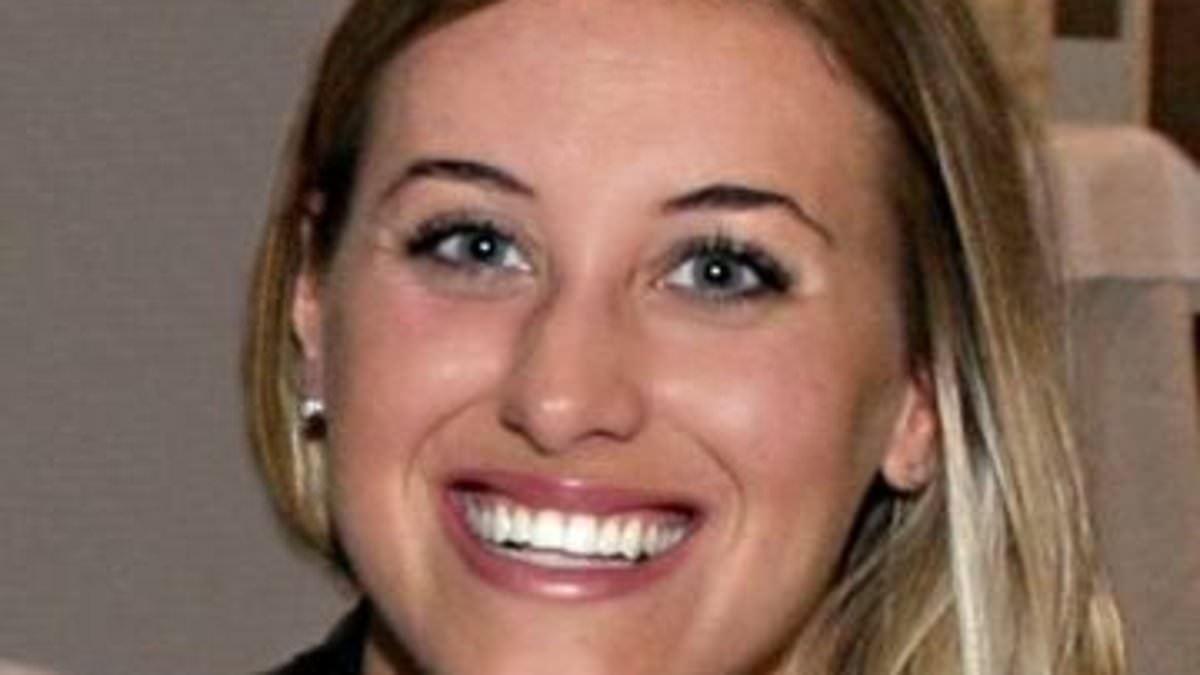
Jennifer Kesse, a 24-year-old finance manager, vanished in chilling circumstances on January 24, 2006

Drew, Jennifer, Logan and Joyce Kesse together. Drew and Jennifer spoke to Daily Mail ahead of the 20th anniversary of their daughter’s disappearance
Joyce added: ‘An ear is as unique as your fingerprints and your eyes.’
She wonders if the match might even be found in news footage from the time of Jennifer’s disappearance.
‘The first month after Jen’s abduction, there were probably a half dozen satellite trucks at the condo complex and they took footage of the crowds and the people coming and going,’ she said. ‘And we know that a lot [of perpetrators] go back to the scene.’
Identifying that person in the footage would be a long time coming for the Kesse family.
They have faced years without answers, no arrests and no knowledge of whether their daughter is even dead or alive.
‘It would almost have been easier if she would have been murdered and found because then we could have grieved and healed,’ Joyce said. ‘We have heavy hearts. Twenty years is an ambiguous hell.’
It was January 24, 2006, when Jennifer vanished from her condo complex, the Mosaic at Millenia in Orlando.
The 24-year-old had just returned home from a trip to St Croix in the Virgin Islands with her boyfriend Rob and his family and, on the night of January 23, she had called family and friends telling them what a great time they had.

Surveillance footage captured a person of interest leaving Jennifer’s car at a condo complex

A shadowy figure was captured in the footage on the day Jennifer’s car was abandoned
But the next morning, Jennifer failed to show up for her job as a finance manager at Central Florida Investments Timeshare Company.
Her parents instantly knew something must be terribly wrong.
Inside Jennifer’s condo, all the signs indicated she had gotten ready and left for work as normal.
Her pajamas were on the floor, a damp towel was left by the shower, her hair tools had recently been used and the front door was locked.
Jennifer’s 2004 Chevy Malibu was gone, as was her cellphone, purse, iPod and keys.
Thinking about what Jennifer might have gone through that day is heartbreaking for her mother.
‘We wonder what it must have been like in those moments when she realized she was in trouble,’ Joyce said.
‘That scares the bejesus out of me thinking of what it must have been like for her. But we know she fought – and the most important thing is she knew how much she was loved.’

Investigators noticed signs of what appeared to be a struggle on the hood of Jennifer’s vehicle

The Mosaic at Millenia condo complex in Orlando where Jennifer lived. Inside her condo, everything appeared to be as it should be on the morning of her disappearance
Two days later, Jennifer’s car was found abandoned around one mile away at the condo complex at Huntington on the Green.
Quickly, the haunting surveillance footage was unearthed revealing the shady figure who had left her car there.
This person of interest is believed to be a man around 5ft 3ins to 5ft 5ins tall with unusually large feet for his height and dressed in workman’s clothes.
No suspects were ever identified, no arrests made and the case went cold.
Feeling the case was hampered from the get-go by Orlando Police, Joyce and Drew took matters into their own hands, pouring $700,000 of their own money into the case and hiring private investigators to carry out their own work.
In 2018, they took the unprecedented step of suing the Orlando Police to get them off the case and hand over all 16,000 pages of records and 67 hours of video and audio.
Among the records, a private investigator found several leads that were not followed up on properly at the time, the Kesses said.
Among them were signs of a struggle on the hood of Jennifer’s car – marks that were never tested for DNA.

Jennifer with her father Drew Kesse. The Kesses are hopeful that AI, an ear, and advances in DNA testing could lead to answers
Orlando PD did not answer questions put to them by the Daily Mail.
The FDLE took over the case in 2022 and, since then, has found DNA evidence which is being tested for the very first time.
Advancements in DNA testing means latent prints and hair fibers found inside Jennifer’s car can be forensically examined in ways not possible 20 years ago.
The FDLE has also narrowed down persons of interest to a finite number of people.
AI is also being used to comb through the 16,000 pages of records in the case for potential leads.
Joyce and Drew told Daily Mail that the FDLE has also scheduled a meeting with them for early February – something they are taking as a good sign that there is a probable update in the investigation.
The FDLE told the Daily Mail that agents from its Cold Case Missing Persons Division have been ‘working diligently on reviewing thousands of documents and following up on new leads that may help find her’ since taking the case. ‘The investigation remains active, and FDLE continues to be steadfast in its pursuit of justice in this case,’ the statement read.
‘They’re running at great next speed right now and the FDLE said they truly believe they’re going to solve Jennifer’s case. So that gives us hope,’ Drew said.
Finally, solving Jennifer’s case feels in touching distance.

Despite what they have gone through, the Kesses refuse to let Jennifer’s disappearance tear their family apart
‘I’ve felt hopeful for 20 years because that’s how I get out of bed every morning. But I’m more hopeful now,’ Joyce said.
Despite those hopes – and a defiance to fight for their daughter ‘until we die’ – the Kesses are also trying to prepare themselves for a possible future where they don’t ever learn the truth.
‘I’m also bracing myself for the fact that we may never get any answer,’ Joyce said.
‘Not all crimes are solved. And I’m praying to God that Jen’s case gets solved, but our family may wind up coming to a point in time that we have to accept the fact it may never be.
‘That’s what I’m personally working on. I’m hopeful for an answer, but I’m kind of preparing in case the other shoe drops.’
Given the passage of time, the Kesses no longer mark the anniversary of Jennifer’s disappearance.
‘We’ve done this for so long. There’s no more dog and pony show. We used to do activities to bring awareness and thank the community. But it’s just increasingly more difficult,’ Drew said.
Instead, this year, they plan to stay home with close friends, look through photo albums and ‘reminisce about happy times.’

Thinking about what Jennifer (pictured) might have gone through that day is heartbreaking for her mother
‘It’ll be a weekend of comfort… we’ll toast to her. But it’s not celebratory. On her birthday, we celebrate. But January 24, I would rather stay in bed all day,’ Joyce said. ‘It’s the worst day of the year.’
Despite what they have gone through, the Kesses refuse to let Jennifer’s disappearance tear their family apart.
‘Our family has held together tremendously. Joyce and I are together 50 years, married 47,’ Drew said. ‘You can’t let something like this break a family up.’
Their son Logan – Jennifer’s brother – married and has two daughters, aged 10 and 14.
Being grandparents to them has ‘brought joy back into our lives,’ Joyce said.
‘The hole remains in our hearts for Jen, but it’s more filled with the love of our grandchildren.’
And Jennifer’s memory lives on through them.
‘Seeing Jennifer in them and their mannerisms and facial expressions, it’s so uncanny and they never met Jennifer,’ Joyce said. ‘That’s a comfort.’
If anyone has information about Jennifer Kesse’s disappearance, call the FDLE Orlando office at (407) 245-0888, or email OROCColdCaseTips@fdle.state.fl.us