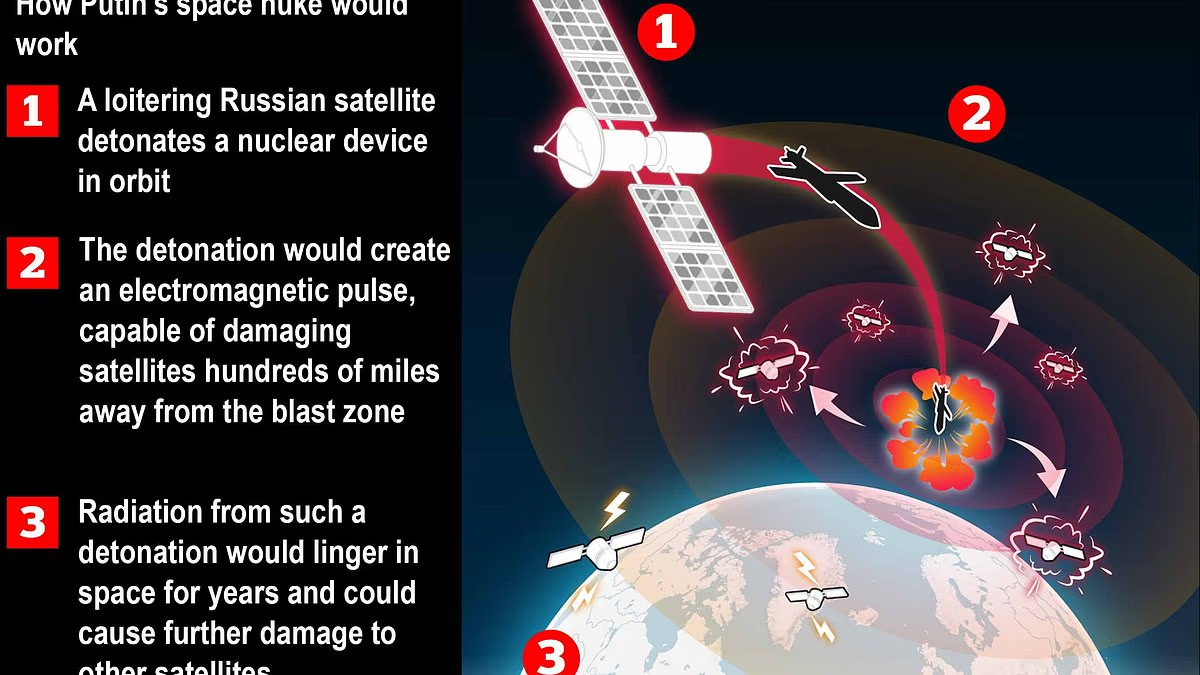
Russia could launch a nuclear-armed space weapon before the end of this year, according to Western intelligence agencies.
The satellite, reportedly known as ‘Sputnik-S’, is said to have been fully built and stored in the wider Moscow region for several years.
If deployed, it could disrupt Western precision-guided weapons, military drones and communications linking troops, aircraft, tanks and command centres.
A large-scale satellite failure could also interfere with navigation networks, electricity grids and food distribution.
Germany’s Space Command believes ‘Sputnik-S’ could be launched as early as December.
The Russian embassy said it had no information about the reported developments and categorically rejected ‘all unfounded allegations concerning the space activities of the Russian Federation’.
It described the claims as ‘part of a propaganda campaign’, insisting that Russia’s space exploration measures complied with ‘international obligations’ and were intended for ‘exclusively peaceful purposes’.
To model the possible consequences, the German Wargaming Centre at the Helmut Schmidt University of the Federal Armed Forces in Hamburg brought together officials, business representatives and disaster-relief experts at the former government bunker in Bad Neuenahr.

US intelligence has warned that Russia is developing nuclear space weapons capable of destroying thousands of satellites (stock image)
The exercise quickly ran into severe difficulties in maintaining supplies for the population.
Project manager Philipp Jan Schäfer said: ‘In the worst-case scenario, there will be looting or riots, the likes of which we probably only know from disaster movies.’
The German Wargaming Centre concluded that Germany has no ‘immediately available’ strategy for a ‘long-term failure of space-based services’, reported Westdeutscher Rundfunk (WDR).
‘We are far from prepared for a “spaceout” scenario, where many satellites fail,’ said Enrico Fels, a security and space specialist at the Centre for Advanced Security, Strategic and Integration Studies at the University of Bonn.
He added: ‘The problem is, as a society, we currently don’t even know exactly where our dependencies on space lie.’ No contingency plans currently exist for such an event at federal, state or local level.
Following the investigation, Germany’s Federal Ministry of the Interior plans to issue crisis-management guidance for the space sector.
The US first issued an internal warning in February 2023 that Moscow was working to put a nuclear weapon in space. Lawmakers briefed by intelligence officials at the time called it a ‘serious threat to national security’.
Last October, the US Defense Intelligence Agency (DIA) published a space assessment stating: ‘Russia is developing a satellite designed to carry a nuclear weapon.’
MUST READ: Strictly Sex Noise Prankster Could Face Criminal Charges
The report said such a move would breach the 1967 Outer Space Treaty, which bars the ‘placing of objects carrying nuclear weapons or other types of weapons of mass destruction into Earth orbit’.
According to the DIA, there would be few effective countermeasures once an armed satellite entered orbit, meaning the use of such a weapon might be impossible to stop.
Experts warn that a nuclear explosion in space could have devastating consequences.
US Space Command chief Stephen Whiting recently predicted that ‘probably about a third of all satellites in low Earth orbit would fail immediately, within the first hours to days. And then, over the following months, the remaining satellites would gradually fail.’
Alongside the loss of civilian and military satellites, a space-based nuclear detonation could generate a debris cloud capable of threatening satellites that escaped the initial blast.
The powerful electromagnetic pulse produced by such an explosion could also cause widespread failures in technical systems on Earth.
Major General Armin Fleischmann of the Cyber and Information Space Command (CIR) said a detonation would have ‘immense’ consequences for life in Germany, including power cuts and serious disruption to communications and navigation.
However, making national systems sufficiently ‘hard’ against such effects would be ‘very expensive’, Tagesschau reported.
Fleischmann suggested that Berlin could instead develop ‘counterspace capabilities’—defensive tools designed to ‘engage with enemy satellites, including nuclear-armed ones, and ideally neutralise them’.
The widespread loss of satellites would affect GPS navigation, banking systems, electricity grids and mobile networks.
For militaries, some weapons systems would be barely usable, while reconnaissance and communications among armed forces and their allies would be severely curtailed.
Investigations by WDR, NDR and SZ found that Western militaries rely on satellites considerably more heavily than Russia’s armed forces.
As a result, detonating a nuclear weapon in space could provide Moscow with at least a temporary military advantage during a conflict.
In 1962, during the military project ‘Starfish Prime’, the United States detonated a nuclear bomb at an altitude of 400 kilometres above the Pacific Ocean.
The blast created a bright flash in the sky, while its electromagnetic pulse knocked out streetlights in Hawaii and disrupted telecommunications equipment and other technology.
Several satellites were also destroyed, including Britain’s first satellite and the first US civilian satellite.
With tens of thousands of satellites operating today, however, the potential impact would be far greater.