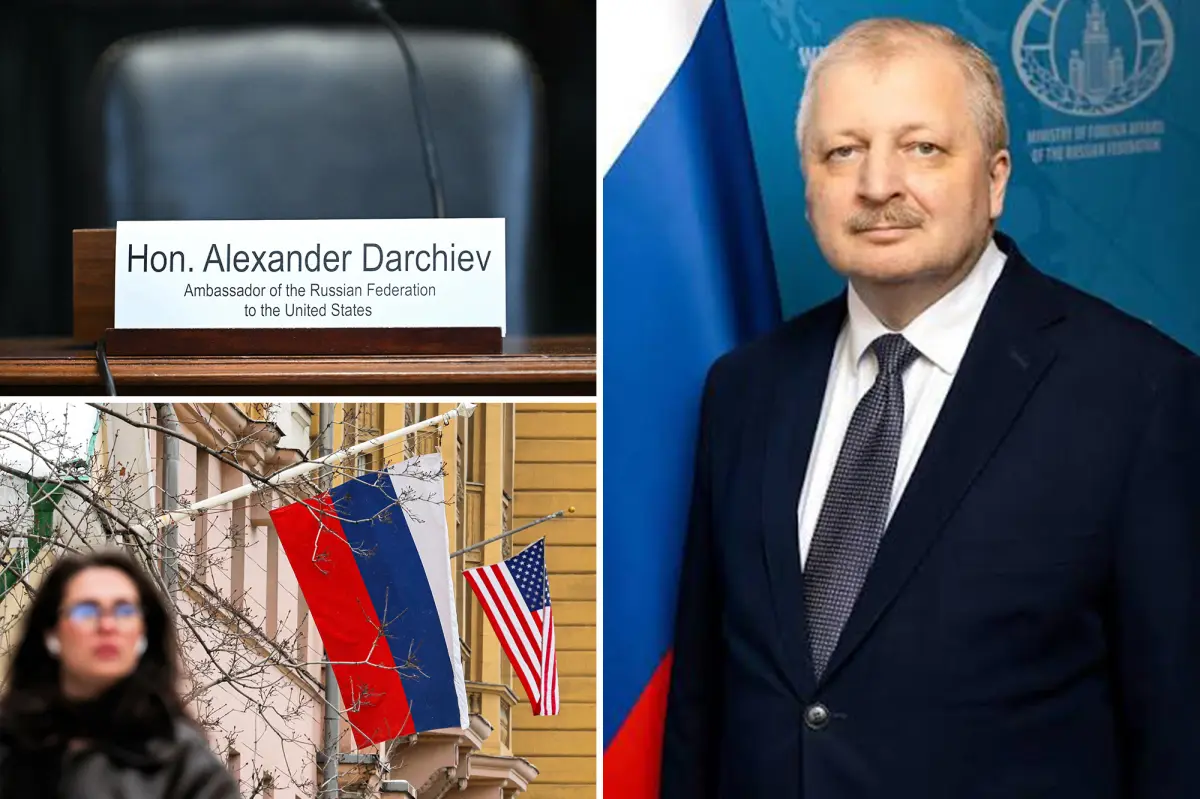

WASHINGTON — Alexander Darchiev, Russia’s ambassador to the United States, has died suddenly, the Russian Foreign Ministry said Wednesday. He was 66.
The ministry did not disclose a cause of death. In a statement, it remembered Darchiev as “an outstanding diplomat, an experienced leader, a kind colleague and a mentor.”
“An exceptional professional and a distinguished expert on the United States, Alexander Darchiev served in one of the most demanding areas of Russian foreign policy,” the ministry said.
Darchiev had represented the Kremlin in Washington since March 2025, during a period of severely strained relations between the two nuclear powers following Russia’s invasion of Ukraine.
Before becoming ambassador, Darchiev led the Russian Foreign Ministry’s North America Department. He also served as Russia’s ambassador to Canada from 2014 to 2021.
Born in Hungary to a Soviet diplomatic family, Darchiev was known for his forceful and often combative criticism of the West.
“Apparently, Washington will need time to get used to the fact that its hegemony is in the past, and will have to reckon with the national interests of Russia, which has its own sphere of influence and responsibility,” he told Interfax in March 2022, several weeks after Russia invaded Ukraine.
News of Darchiev’s death came as American, Russian and Ukrainian diplomats held a new round of trilateral talks in Abu Dhabi aimed at ending the war in Ukraine.
After two days of negotiations in the United Arab Emirates, special envoys Steve Witkoff and Jared Kushner were expected to travel to Moscow for a meeting with Russian President Vladimir Putin.
“These were very substantive. They were some pretty tough discussions after, I think, almost eight months of not being together,” Kushner told reporters. “The conversations were very thorough. We covered all the relevant issues.”
Ukrainian negotiator Davyd Arakhamia offered a more somber assessment, describing Wednesday’s discussions as “one of the toughest ones.”
“I think the Russians came with very, very strict directives,” Arakhamia said. “And it was very hard to actually soften the discussion.”


