
Share this @internewscast.com
In a startling revelation today, the Defence Secretary announced that Russia had conducted a covert operation aimed at critical energy and data cables in British waters, lasting more than a month.
John Healey reported the presence of three Russian submarines in the North Atlantic, prompting the deployment of a warship and aircraft as countermeasures.
To thwart Russian intentions, sonar buoys were deployed. These devices are designed to detect underwater movements using acoustic signals, safeguarding the cables which transmit substantial volumes of vital data.
In a direct message to Russian President Vladimir Putin, Mr. Healey warned, “We are aware of your activities concerning our cables and pipelines. You should understand that any attempt to harm them will be met with severe repercussions.”
During a press briefing at Downing Street, Mr. Healey noted that the submarines withdrew once their operations were brought to light.
He highlighted that both Britain and its allies, including Norway, have been actively monitoring an uptick in Russian activities in the Atlantic, even as global attention is diverted by the Middle East crisis.
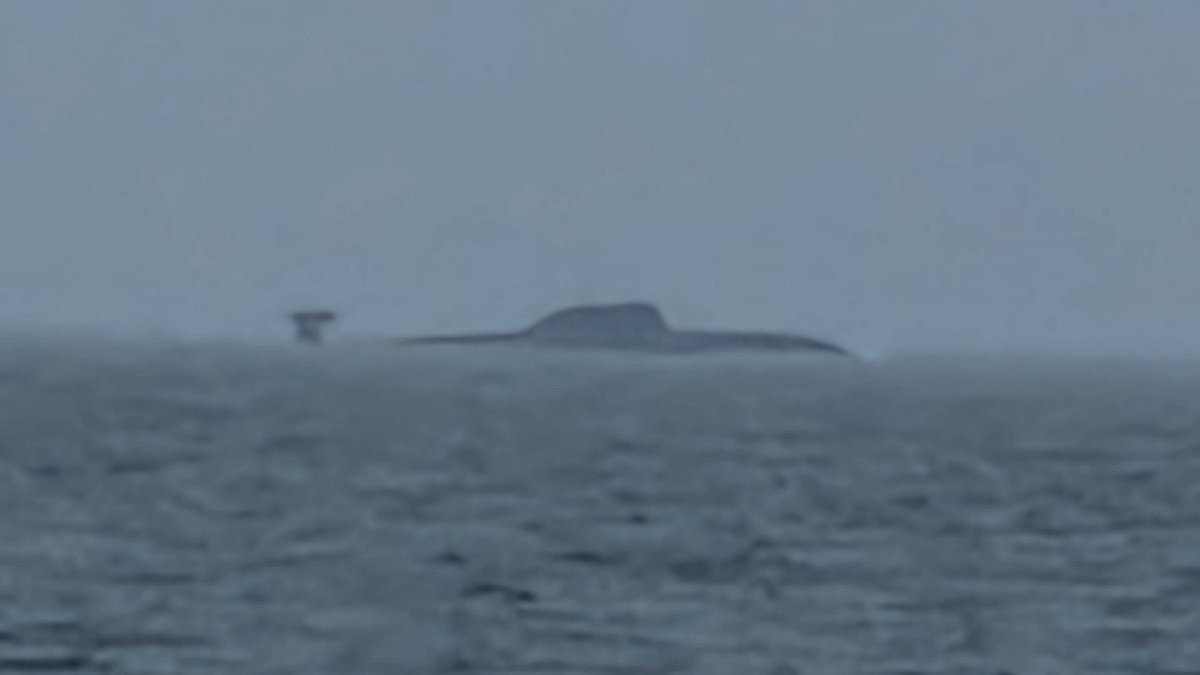
This involved a Russian Akula-class nuclear-powered attack submarine and two specialist submarines from Russia’s ministry of defence deep sea research programme known as GUGI (Main Directorate of Deep-Sea Research).

John Healey revealed the ‘covert’ Russian operation in a media briefing at 9 Downing Street

A Russian Akula-class nuclear-powered attack submarine in waters near Norway in 2022
Mr Healey said: ‘In response to the Russian submarines, I can confirm that I deployed our armed forces to track and to deter any malign activity by these vessels.
‘A Royal Navy warship and Royal Air Force P8 aircraft alongside allies ensured that the Russian submarines were monitored 24/7.
‘The Akula submarine subsequently retreated home, having been closely tracked throughout and we continued to monitor the two GUGI submarines in and around wider UK waters.
‘Our armed forces left them in no doubt that they were being monitored, that their movements were not covert, as President Putin planned, and that their attempted secret operation had been exposed.
‘Those GUGI submarines have now left UK waters and headed back north.’
He said the month-long operation had now concluded.
The senior minister said the attack submarine acted as ‘a likely decoy to distract us from the Gugi submarines as they ‘spent time over critical infrastructure relevant to us and our allies in the North Atlantic’.
He continued: ‘Because we were watching them, we wanted to ensure that we could warn them that their covert operation had been exposed and reduce the risk that they may attempt any action that could damage our pipelines or our cables.
‘And I’m confident, we have no evidence that there has been any damage, but with allies, were sure that this is now verifiable.’

Putin pictured today handing Russia highest medal to 23-year-old soldier Alexei Asylkhanov
Mr Healey was asked why the UK was letting Russia-flagged vessels pass through the Channel despite having announced British armed forces could begin seizing shadow fleet tankers in British waters.
The Defence Secretary said Moscow ‘still poses a threat and we will continue to do what we’ve done as a matter of course, which is ensure that we can escort any Russian warships through our waters and, in the case of this operation, to ensure that we can track any potentially malign activity, and that we can monitor and make clear that we have exposed any covert operations that Putin wants to mount that may threaten our vital interests’.
Deploying all UK military assets and personnel to the Middle East was not in Britain’s national interest, John Healey said as he warned the “greatest threats are often unseen and silent”.
The Defence Secretary said: “When a crisis erupts noisily and dangerously, as it has done in the Middle East, I understand people questioning why all UK military assets and personnel have not been deployed to deal with it, but that is not in Britain’s national interest.
“The greatest threats are often unseen and silent, and as demands on defence rise, we must deploy our resources to best effect.”
He added that Vladimir Putin “would have wanted us, I expect, to be distracted and my purpose today is to demonstrate to him publicly that we have not been – that we have our eye on him, that we recognise he and Russia pose the primary threat to UK security and Nato security.”
Russia was likely sharing intelligence and training Iranian forces in drone tactics, with Moscow’s attacks on Ukraine “reflected” in many of the ways that Iran is attacking Middle East countries, he said.