
Fertility breakthrough as scientists create eggs from human SKIN cells

Babies could soon be born without biological mothers – as scientists have come up with a way to create human eggs from skin cells. 

The technique opens the possibility for DNA from a man’s skin cells being placed indside a donor egg, before being fertilised by another man. 

In theory, this could allow two men to have a baby, withou any DNA from a woman. 

The breakthrough could also help women experiencing problems with their eggs to have their own  genetic children. 

Although additional research is required to confirm safety and effectiveness before moving to clinical trials, specialists have hailed the development as a ‘significant breakthrough.’

‘Many women are unable to start a family because they have lost their eggs due to various reasons, such as after undergoing cancer treatment,’ explained Professor Richard Anderson, Deputy Director of MRC Centre for Reproductive Health at the University of Edinburgh, who was not part of the study.

‘The capability to create new eggs would represent a major breakthrough. The study demonstrates that genetic material from skin cells can be utilized to produce a cell similar to an egg, containing the correct chromosome count needed for fertilization and early embryo development.’

‘There will be very important safety concerns but this study is a step towards helping many women have their own genetic children.’ 

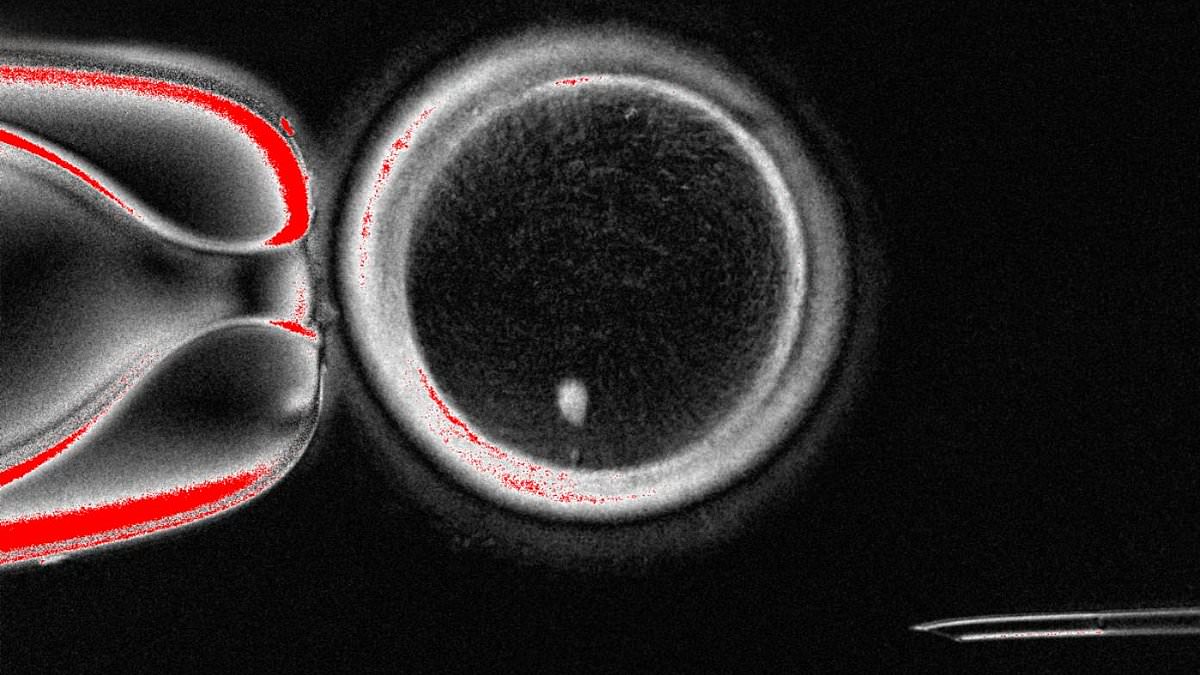
Experts from Oregon Health & Science University have created fertilizable eggs from human skin cells for the very first time

Experts from Oregon Health & Science University have created fertilizable eggs from human skin cells for the very first time

For some couples struggling to conceive, in virto fertilization (IVF) can be an option. 

This treatment sees the eggs fertilized by sperm in a lab, and the resulting embryo then placed in the woman’s uterus.

However, if there’s a problem with the egg itself, IVF can be ineffective.  

Previous studies have suggested that a method called ‘somatic cell transfer’ could be an alternative approach.

This process involves transferring the nucleus from one of the patient’s own somatic cells, like skin cells, into a donor egg cell that has had its nucleus removed, allowing the cell to transform into a viable egg.

Nonetheless, while normal eggs possess half the typical number of chromosomes (one set of 23), cells derived from skin cells offer two sets of chromosomes (46).

Without intervention, this would cause the differentiated eggs to have an extra set of chromosomes. 

So far, a method to remove this extra set has been developed and tested in mice – but is yet to be tried in humans.

For some couples struggling to conceive, in virto fertilization (IVF) can be an option. This treatment sees the eggs fertilized by sperm in a lab, and the resulting embryo then placed in the woman's uterus (stock image)

For some couples facing challenges with conception, in vitro fertilization (IVF) may be a viable option. In this treatment, eggs are fertilized by sperm in a laboratory setting, with the subsequent embryo being placed in the woman’s uterus (illustrative image).

How does it work?

Somatic cell transfer involves transplanting the nucleus from a patient’s own skin cells into a donor egg cell with the nucleus removed, enabling the cell to differentiate into a functional egg. 

However, while standard eggs have half the usual number of chromosomes (23), cells generated from skin cells have two sets of chromosomes (46).

Without intervention, this would cause the differentiated eggs to have an extra set of chromosomes. 

The team resolved this issue by inducing a process they’ve named ‘mitomeiosis’, which mimics natural cell division and causes one set of chromosomes to be discarded.

During tests, the researchers produced 82 functional eggs using this process, which were fertilised in a lab. 

In their new study, the team resolved this issue by inducing a process they’ve named ‘mitomeiosis’. 

‘[Mitomeiosis] mimics natural cell division and causes one set of chromosomes to be discarded, leaving a functional gamete,’ the researchers explained in a statement. 

During tests, the researchers were able to produce 82 functional eggs using this process, which were then fertilised in a lab. 

Approximately nine per cent went on to develop the the blastocyst stage of embryo development. 

However, the researchers did not culture the blastocysts beyond this point, which coincided with the time at which they would usually be transferred to the uterus in IVF treatment.

While the findings raise the tantalising possibility of women with problems with their eggs having their own genetic children, the experts note several limitations with their study.

Importantly, the vast majority (91 per cent) did not progress beyond fertilisation. 

What’s more, several of the blastocysts were found to contain chromosomal abnormalities. 

Regardless, experts have called the research an ‘exciting proof of concept’. 

‘This breakthrough, called mitomeiosis, is an exciting proof of concept,’ said Professor Ying Cheong, a professor of reproductive medicine at the University of Southampton, who was not involved in the research. 

‘In practice, clinicians are seeing more and more people who cannot use their own eggs, often because of age or medical conditions. 

‘While this is still very early laboratory work, in the future it could transform how we understand infertility and miscarriage, and perhaps one day open the door to creating egg– or sperm–like cells for those who have no other options.’

How does IVF work?

In-vitro fertilisation, known as IVF, is a medical procedure in which a woman has an already-fertilised egg inserted into her womb to become pregnant.

It is used when couples are unable to conceive naturally, and a sperm and egg are removed from their bodies and combined in a laboratory before the embryo is inserted into the woman.

Once the embryo is in the womb, the pregnancy should continue as normal.

The procedure can be done using eggs and sperm from a couple or those from donors.

Guidelines from the National Institute for Health and Care Excellence (NICE) recommends that IVF should be offered on the NHS to women under 43 who have been trying to conceive through regular unprotected sex for two years.

People can also pay for IVF privately, which costs an average of £3,348 for a single cycle, according to figures published in January 2018, and there is no guarantee of success.

The NHS says success rates for women under 35 are about 29 per cent, with the chance of a successful cycle reducing as they age.

Around eight million babies are thought to have been born due to IVF since the first ever case, British woman Louise Brown, was born in 1978.

Chances of success

The success rate of IVF depends on the age of the woman undergoing treatment, as well as the cause of the infertility (if it’s known).

Younger women are more likely to have a successful pregnancy.

IVF isn’t usually recommended for women over the age of 42 because the chances of a successful pregnancy are thought to be too low.

Between 2014 and 2016 the percentage of IVF treatments that resulted in a live birth was:

29 per cent for women under 35

23 per cent for women aged 35 to 37

15 per cent for women aged 38 to 39

9 per cent for women aged 40 to 42

3 per cent for women aged 43 to 44

2 per cent for women aged over 44


You May Also Like

Pro-Life Groups Urge Todd Blanche to Settle FDA Mail-Order Abortion Pill Case

WASHINGTON — A coalition of anti-abortion organizations is urging the Trump White…

Giannis Antetokounmpo Sparks Fan Frenzy With Cryptic Tweet

As NBA Draft week and the start of free agency draw closer,…

Judge Bars Trump Administration From Using Federal Database for Citizenship Checks, Warns of Voter Purge Risk

A federal judge in Washington, DC, on Monday barred the Trump administration…

Several Injured After Shooting Breaks Out at Montreal Grocery Store

  A gunman opened fire in Montreal on Monday, killing a police…

Met Police Brings Live Facial Recognition to London’s West End in Major Expansion

Millions of visitors to London’s West End could soon have their faces…

Trump Education Department to Move 7.5 Million Borrowers Off Biden Student Loan Plan Ruled Unlawful

WASHINGTON — The Department of Education is notifying borrowers enrolled in Biden-era…

Orlando Bloom, 49, Spotted With 28-Year-Old Model Girlfriend in Hotpants

Orlando Bloom and his model girlfriend Luisa Laemmel have brought their growing…

Haaland Joins Messi and Mbappe in Scoring Race as Norway Reach Last 32

The name printed across his shirt may be a little different at…

Poll Shows 89% of Mail Readers Want Burnham to Call a Snap Election

Andy Burnham could be entering Downing Street within three weeks, even as…

Teen Who Planned Columbine-Style Attack Kills Two, Police Say

A California teenager who allegedly hoped to carry out a “Columbine-style massacre”…

Trump Clashes With ‘Pro-Algae’ Protesters as National Guard Is Deployed

President Donald Trump criticized what he called “crazy pro-algae” protesters at the…

Savannah Guthrie Tears Up as New Ransom Note Revelations Emerge

Savannah Guthrie made an emotional appeal on Tuesday’s Today show, calling for…