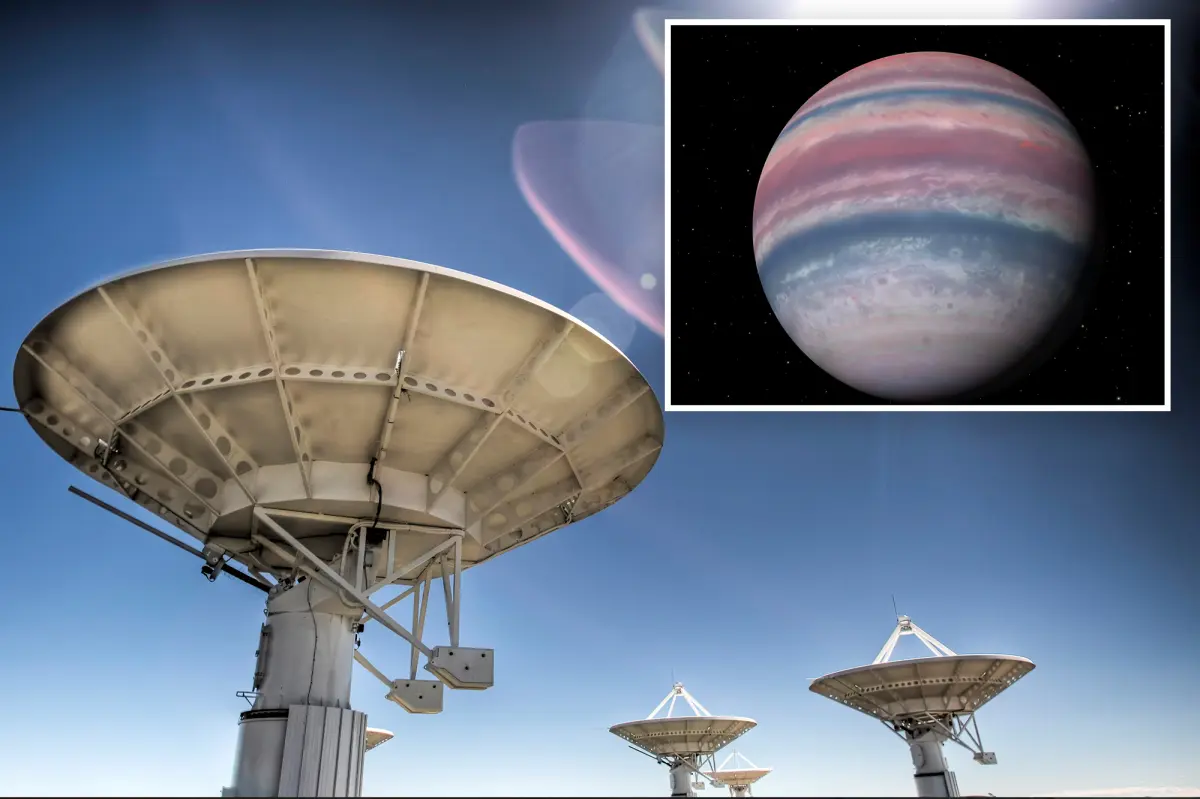

Astrophysicists have detected a radio signal from a planet beyond the solar system for the first time, according to new research that could open a fresh window onto distant worlds.
The breakthrough could help scientists identify and study exoplanets across the galaxy, while offering clues about which worlds might have conditions capable of supporting life.
Researchers from Harvard and the University of Oregon, Eugene, say recurring bursts of radio emission appear to be powered by powerful auroras on Beta Pictoris b. Their findings are detailed in a paper that has not yet undergone peer review.
Auroras form when high-energy particles plunge into a planet’s atmosphere near its magnetic poles, colliding with gas molecules and atoms and producing radiation.
Beta Pictoris b is a young, massive exoplanet located roughly 64 light-years from Earth. Classified as a gas giant, it is about 12 times more massive than Jupiter.
Led by Harvard and Smithsonian astrophysicist Kevin Ortiz Ceballos, the team used the MeerKAT radio telescope array to make the detection. The facility consists of 64 interconnected radio dishes spread across South Africa’s Karoo semi-desert in the Northern Cape.
DON’T MISS: NYC Student Sues College Over Metal Found in Dining Hall Sandwich
After confirming that the signal came from Beta Pictoris b rather than its host star—the star bound to the planet by gravity and orbited by it—the researchers traced the emission to auroral radio activity.
Auroras are often seen as shimmering ribbons or rays of colored light near a planet’s magnetic poles. On distant worlds, however, they can also generate detectable radio waves.

The researchers calculated that Beta Pictoris b has a magnetic field strength of about 1,250 gauss—nearly 291 times stronger than Jupiter’s 4.3-gauss magnetic field.
The study also represents the first measurement of an exoplanet’s magnetic field. Magnetic fields act as protective shields, helping planets resist the erosion of their atmospheres by charged particles.
The team hopes to apply the same radio-observation technique to other giant exoplanets and learn more about their magnetic environments.
Ortiz Ceballos did not immediately respond to a request for comment.


