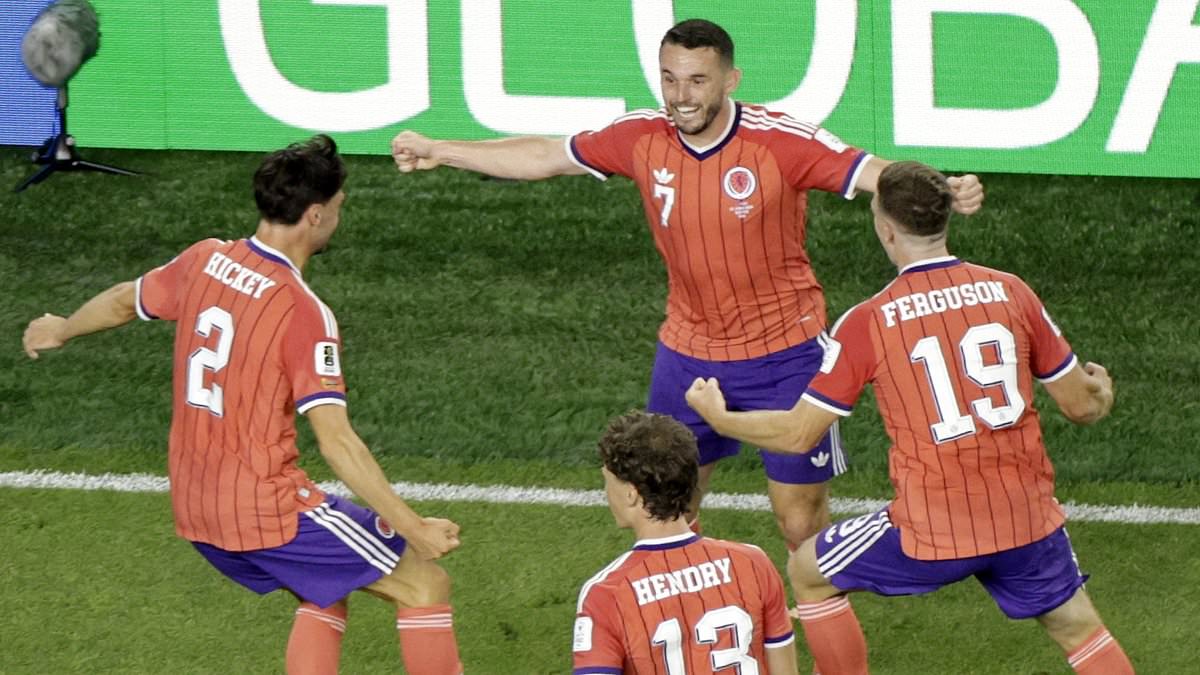

After a 28-year wait to return to the World Cup, Scotland needed just 28 minutes to turn their long-awaited reunion with the tournament into a night of celebration. Fittingly, it was John McGinn — recently dismissed by Roy Keane as a “pub player” — who provided the moment that set the party in motion.
McGinn’s winning goal in this Group C clash was hardly a thing of beauty in the conventional sense. It was scrappy, awkward and full of ricochets, a messy sequence of deflections that eventually found its way into Haiti’s net.
Yet for Scotland, it was perfect. The goal carried significance far beyond its aesthetics, offering a cathartic release for a nation absent from this stage since 1998 and for a player who had found himself on the receiving end of Keane’s cutting assessment in recent days.
In fairness to Keane, his criticism was aimed at McGinn on an off day. But this occasion was never going to be about that. It belonged to Scotland and the thousands of supporters in tartan who have spent the past week transforming Boston into a sea of noise, celebration and expectation.
They erupted when McGinn’s effort finally squirmed over the line, and the sense of joy only deepened when the tension of the closing stages gave way to the final whistle. Steve Clarke responded with a clenched-fist salute, and understandably so. Scotland sit top of the group, even if relief may have outweighed satisfaction by the end.
That, however, is where the harder assessment begins. For all the emotion of the result, Scotland know sterner tests lie ahead against Morocco and Brazil. If they are to compete seriously in those matches, the level of performance will need to rise considerably.
John McGinn scored the only goal as Scotland beat Haiti 1-0 on the return to the World Cup
McGinn’s shot was fortunately deflected into the Haiti net, but Scotland will not care
Scotland fans celebrate in the stands after seeing the national team’s first World Cup win since 1990
Because, frankly, they weren’t so hot here. They laboured to get their lead and they laboured to protect it and they laboured to get to the line. All of which is a credit to Haiti – a team cobbled together against a backdrop of domestic chaos fought brilliantly. With better finishing, they likely would have got a point.
But those are the hypotheticals that count for little in a short-form league table. All that mattered was the win and for Scotland there hadn’t been one of those at a World Cup since 1990 and none in their past two trips to the European Championship. As for McGinn, his goal was the first since Craig Burley scored against Norway in 1998, 10,255 days ago.
From under such weighty history, Scotland climbed. Let their fans enjoy it and leave it to Clarke to see if a victory can cure the nerves that so clearly affected his side in the second half here. With Morocco next on Friday, he doesn’t have much time on that front.
But he does have a hell of a position to build on, and one that will likely secure passage to the knockouts even if the next two games are lost. Such is the nonsense of this bloated format, of course, but take the breaks where you can get them.
Knowing what was at stake for even a single win, Clarke had adopted an aggressive stance for the task at hand. He retained the same 4-4-2 shape with which his side battered Bolivia in their final warm-up and kept all but one of the components, too, with McGinn favoured over Ryan Christie. For his biggest theoretical dilemma, Clarke opted for Jack Hendry over John Souttar as the centre-half partner for Grant Hanley. No controversies there and no surprises either.
As for their opposition, there were names tangentially familiar to UK interests – Wilson Isidor of Sunderland, for one, and Wolves winger Jean-Ricner Bellegarde for another. Between that pair, there were more than 100 Premier League appearances, so let’s swerve some of the temptations to cast Haiti as a collection of strays.
And yet we know their tale is remarkable. Remarkable, heartening and sad, all at once. That’s less about their long wait to make this stage, which trumped Scotland’s by a full 24 years, and more the extreme circumstances of Sebastien Migne’s work as manager.
By now, you might be aware the Frenchman has never set foot in Haiti and only a single member of their squad – Woodensky Pierre – plays in their domestic league. The rest have been assembled from leagues spanning 15 countries and a sizeable chunk are the diaspora of a nation whose government lost control long ago. Gangs run Haiti now and, truly, it is a humanitarian crisis, so them being here is a fine thing indeed.
Steve Clarke’s side laboured for victory against a Haiti team who played fast and physical football
McGinn went closest to doubling Scotland’s lead but shot wide of the post in the second half
But there is also a risk with this line of thought. One that can slip too far into the context of a team and away from its sporting merits, because on the latter Haiti are decent. Let’s not forget, in the past fortnight they did a far better job than England by crushing New Zealand 4-0. They can play. And they play fast and physically.
For Scotland, those traits made for recurring problems. Louicius Deedson, of FC Dallas, was an occasional menace to Andy Robertson, sometimes with the directness of his running off the right wing and with his elbows, too. Same went for Ruben Providence on the left – he regularly reached the spaces behind Aaron Hickey and, like Deedson, served tricky deliveries. He also left some bruises.
But Scotland were the better side in the first half. Initially, it was Scott McTominay at the forefront – one header from a Robertson cross cleared the bar and a later drive cracked the post. He lost control of the middle as the game developed, but benefited from the presence of Lewis Ferguson in the centre and Ben Gannon-Doak on the right wing – the 20-year-old was excellent. The World Cup always carries potential to expand profiles and Gannon-Doak’s early marker was impressive. If McTominay can find effective ways to set him loose on full-backs, Scotland have great growth potential.
The more tangible contribution in the here and now came from McGinn, of course. The finish benefited from multiple deflections but who cares? The artistic merit came earlier in the move when Che Adams cushioned Hanley’s long ball as if his boot was wrapped in a pillow, before spreading play out to Ben Gannon-Doak. He returned the ball low and hard to the middle, Adams had his shot smothered, and the rebound fell to McGinn. The ricochets did the rest.

Frantzdy Pierrot headed narrowly wide for Haiti in the closing stages as Scotland held on
For Scotland, that was enough for a lead but not comfort. A chance came early in the second half, with Robertson a familiar source by bending a vicious ball behind the Haitian defence and into Lawrence Shankland’s path. The striker was half a foot short of reaching it, but the delivery was exceptional – Tottenham need not worry about any technical decline in their new left back.
From there, not much followed to raise pulses as the game trickled towards its second drinks break (a commercialised, absurd contrivance revealed for what it was here at the Gilette Stadium by a 370-foot wide screen announcing that it was sponsored by Powerade). But the resumption brought drama – first, McGinn shot wide and pleaded flimsily for a penalty before Isidor lunged close to an equaliser at the other end.
The jeopardy was evident. So too the reminders of Scotland struggling against minnows – Peru, Iran and Costa Rica all echoed from the past in those moments. And more so when Frantzdy Pierrot outjumped Hanley and headed wide. It was close, very close.
But Scotland had waited a long time, very long, and had their reward at the whistle. Cue the bagpipes, cue the bedlam. The noise was fantastic and overdue. Other worries about performances were gladly drowned out by the sound.
Which England star has 7 GCSEs? Who has lost half of his finger? Test your knowledge of Thomas Tuchel’s squad with our exclusive quiz HERE