
Share this @internewscast.com
Seattle is facing turmoil as its newly elected mayor has instructed police officers not to detain individuals caught using drugs publicly, a move that has sparked concern in a city already grappling with crime and homelessness.
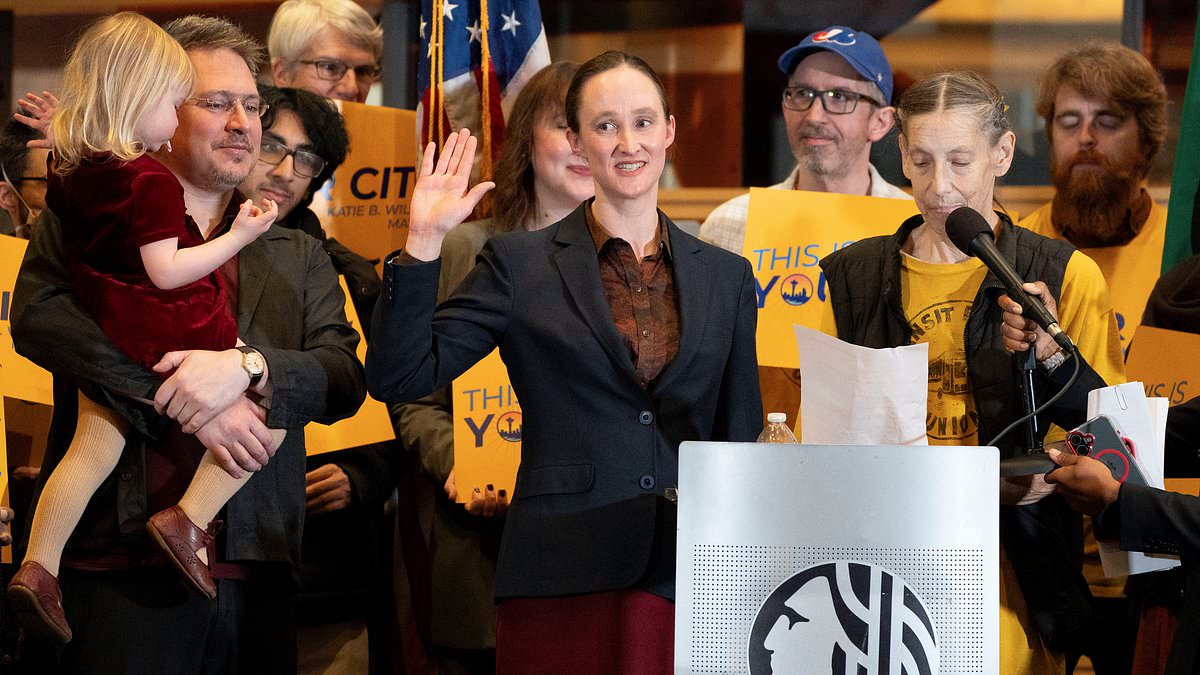
Katie Wilson, a 43-year-old Democratic socialist, assumed office as Seattle’s 58th mayor on Friday with promises of change.
A co-founder of the Transit Riders Union, Wilson has quickly implemented measures that critics, including law enforcement and concerned citizens, fear could be detrimental to the city’s future.
Wilson’s approach, which some describe as lenient on crime, includes directives for police to overlook public drug use, a policy that the Seattle Police Officers Guild (SPOG) argues has previously led to negative outcomes.
“The recent naive, ignorant political decision to not arrest offenders for open drug use in the City of Seattle is horrifically dangerous and will create more death and societal decay,” stated SPOG President Mike Solan in a Sunday release.
Solan expressed his disapproval, emphasizing the flawed belief that accommodating individuals struggling with addiction, without enforcement, is the right strategy for recovery.
Solan, who leads the union representing all 1,300 members of the Seattle Police Department (SPD), slammed the policy as ‘suicidal empathy.’
He also denounced the Law Enforcement Assisted Diversion (LEAD) program, describing the initiative to offer community-based services to drug offenders instead of prosecuting them as a ‘waste of time.’

Democratic socialist Katie Wilson, 43, was sworn in as the city’s 58th mayor on Friday

A bowl of heroin syringes were collected from a Seattle homeless encampment in 2022

A homeless man was seen checking on his friend who passed out after smoking fentanyl at a homeless encampment in 2022
The program excludes those selling drugs and people with histories of violent felonies and sex offenses, as well as people already being supervised by the Department of Corrections.
Last week, SPD Chief Shon Barnes – who was appointed as interim chief in January 2025 and sworn in to the permanent role by the City Council in July – announced that LEAD will be implemented for all drug possession and use cases.
An email Barnes sent to the department, obtained by local conservative radio station Seattle Red 770AM, stated: ‘Effective immediately, all charges related to drug possession and/or drug use will be diverted from prosecution to the LEAD program.
‘All instances of drug use or possession will be referred to Law Enforcement Assisted Diversion (LEAD) – a program designed to redirect low-level offenders in King County from the criminal justice system into supportive social services.’
Barnes reportedly wrote that if drug offenders refuse to comply with LEAD, prosecutors can then intervene.
‘We’ve all seen how our streets can be filled with death, decay, blight and crime when ideology like this infects our city, Solan continued in his statement.
‘Now with this resurrected insane direction, death, destruction and more human suffering will be supercharged.’
Wilson has not publicly discussed these efforts. The Daily Mail has contacted her, the SPOG and SPD for more information.

An encampment at the site of an old store in Seattle’s Ballard neighborhood was seen littered with garbage in June
Lawmakers and residents have reacted to this news in horror – as the city already has a raging homelessness epidemic that they believe this lax drug policy will only amplify.
From 2019 to 2024, the homeless population in King County spiked by 46 percent to 16,385 people, according to Seattle-based public policy think tank Discovery Institute.
‘The new mayor of Seattle has issued an imbecile order that police shall not arrest criminals using illegal drugs openly in public,’ Republican Washington state Representative Jim Walsh wrote on X.
‘This is just stupid.’
‘Seattle will continue to be a sanctuary city for open air use of illicit and lethal drugs, inviting people in droves where they won’t be arrested,’ We Heart Seattle, a nonprofit devoted to cleaning up public spaces and getting drug users off the streets, said.
Up until February 2021, drug possession for personal use was a felony in Washington state. But the state’s Supreme Court struck down the law as unconstitutional in State v. Blake.
The case eliminated the felony charge, and legislators passed a temporary law classifying the crime as a simple misdemeanor.
From 2021 to 2023, arrests and prosecutions for drug possession plummeted, sparking fear among residents.
By the Spring of 2023, Washington state introduced a permanent law to re-criminalize drug possession as a gross misdemeanor.

SPD Chief Shon Barnes sent an email to his department announcing that all drug cases will now be handled by the LEAD program

Seattle’s City Council was reluctant at first, but passed a law that October that made possession and public use gross misdemeanors, giving police officers clear authority to make arrests in these cases.
The Seattle Metro Chamber released an index in October 2023, demonstrating Seattle voters’ negative attitudes toward their city – specifically regarding crime and drug use.
From 2021 to 2023, concerns about public safety spiked by 20 points, with 60 percent of the 700 voters surveyed feeling less safe in their neighborhoods.
‘Respondents overwhelmingly agree Seattle’s hands-off approach to people using fentanyl and meth in public has contributed to rampant street crime and hampered downtown’s recovery,’ the Chamber wrote.
The US Drug Enforcement Administration (DEA) reported that 1,067 people died from fentanyl poisonings and overdoses in King County in 2023 – a 47 percent increase from the previous year.
Two-thirds of voters disagreed with Seattle not enforcing laws against public drug use, and 74 percent said they wanted the city to hire more cops.
Seattle residents’ top concerns are still homelessness, crime, drugs and public safety, according to the October 2025 index.
The city’s lack of urgency in addressing the sweeping homeless encampments riddled with drug paraphernalia and filth popping up in the area has caused immense frustration.

SPOG President Mike Solan denounced the mayor’s decision in a statement on Sunday

An unsanctioned homeless encampment, seen in late November, has popped up near Seattle iconic Space Needle attraction
‘A few of us in the neighborhood have been complaining every day,’ local Brandon Herman told KOMO News on Friday, of a homeless encampment at a city-owned property that has been heavily ignored.
‘There’s an open-air drug market and trash and human waste.’
Herman said that city officials had cleared out the vacant building and property, but those living there have already begun moving back in.
‘There’s nothing keeping people out, no fence up, no body patrolling the area.’