Share this @internewscast.com
The United Kingdom government is planning to allow 16 and 17-year-olds to vote in all elections, sparking renewed discussions about whether Australia should implement a similar change.
By doing this, the UK will align itself with nations like Austria, Germany, Argentina, and Brazil, which have already reduced the voting age to 16.
Proponents argue it is an overdue enhancement of democratic rights, with many Australians in favor of amending local voting laws accordingly.
Independent MP Monique Ryan expressed that lowering the voting age would benefit young people and the country’s future, vowing to propose another bill in parliament.

“I believe extending enfranchisement to as many Australians as feasible, including young individuals, is important to ensure those affected by government decisions have a voice in those matters,” Ryan mentioned to SBS News.

“Early participation in the electoral process has been shown to improve political engagement. Young people can leave school, get a job, and pay taxes. They should have a say in who represents them and their interests in government.”

In Australia, decreasing the voting age would necessitate altering the Commonwealth Electoral Act of 1917 through federal legislation, which requires backing from the federal government—a stance the Albanese government currently does not support.

What would happen if Australia lowered its voting age?

The move has prompted many to question whether lowering the voting age would influence electoral outcomes or increase the political representation of young people.
But a lack of comparative data makes it difficult to fully understand the potential impact of the change.
Critics of the UK’s recent move have said the change could benefit left-wing parties due to younger voters’ political tendencies.

Across the democratic world, there is a trend that young voters tend to prefer left and centre-left parties and candidates more than older voters.

The Australian Election Study, undertaken after each federal election, has found the same trend from 1987 — the younger voters are, the more likely they are to be left-leaning. As age increases, so too does Coalition support.
In the 2022 election, around one in four voters under the age of 40 voted for the Coalition, while 38 per cent of voters in the same age bracket supported Labor.
Among gen Z voters — born between 1997 and 2012 — 26 per cent voted for the Coalition, while 67 per cent voted for either the Greens or Labor.

The study found that no other generation included in the research had such a strong political preference at the same stage of life.

However, the political impact of giving 16 and 17-year-olds the vote may not be significant enough to decide elections.
According to 2021 Census data, 16 and 17-year-olds in Australia make up a small proportion of the population — around 2.31 per cent of the total population — with experts saying their impact on results is likely to be negligible.
Christine Huebner, a lecturer in quantitative social sciences at the University of Sheffield, said her research indicated that including 16 and 17-year-olds in UK elections would not change election outcomes or make elections less representative.

“They will have a minimal impact on vote shares [in the UK], and only in the most extreme (and unlikely) case where all 16 and 17-year-olds participate in voting and choose the same option,” she explained in The Guardian.

Are there problems with lowering the voting age?

Dr Sarah Cameron, a political scientist at Griffith University, said most Australians don’t support lowering the voting age.
“The Australian Election Study has been asking whether the public supports lowering the voting age to 16 in various surveys over the last ten years,” she told the ABC. “What this shows is that it’s about 15 per cent who believe that the voting age should be lowered to 16.”
“Whereas the vast majority of about 85 per cent think it should stay as it is now at 18 [years old],” said Cameron, who is also a researcher for the Australian Election Study.

She said support is slightly higher among young people, but still a minority, at 20 to 30 per cent in favour.

Cameron’s statements contrast with a 2024 study from the Western Australian Commissioner for Children and Young People, which surveyed almost 2,000 young people across Australia about lowering the voting age.
It found more than half of the participants aged 15 and under would like to vote, including 49 per cent who said they’d like it to be optional and another 12 per cent who said they supported it fully. However, 39 per cent said they did not want to vote at 16.

Young people aged 16 and older were more evenly split — 52 per cent said they thought they should have been able to vote at 16, while 48 per cent said they should not have been able to.
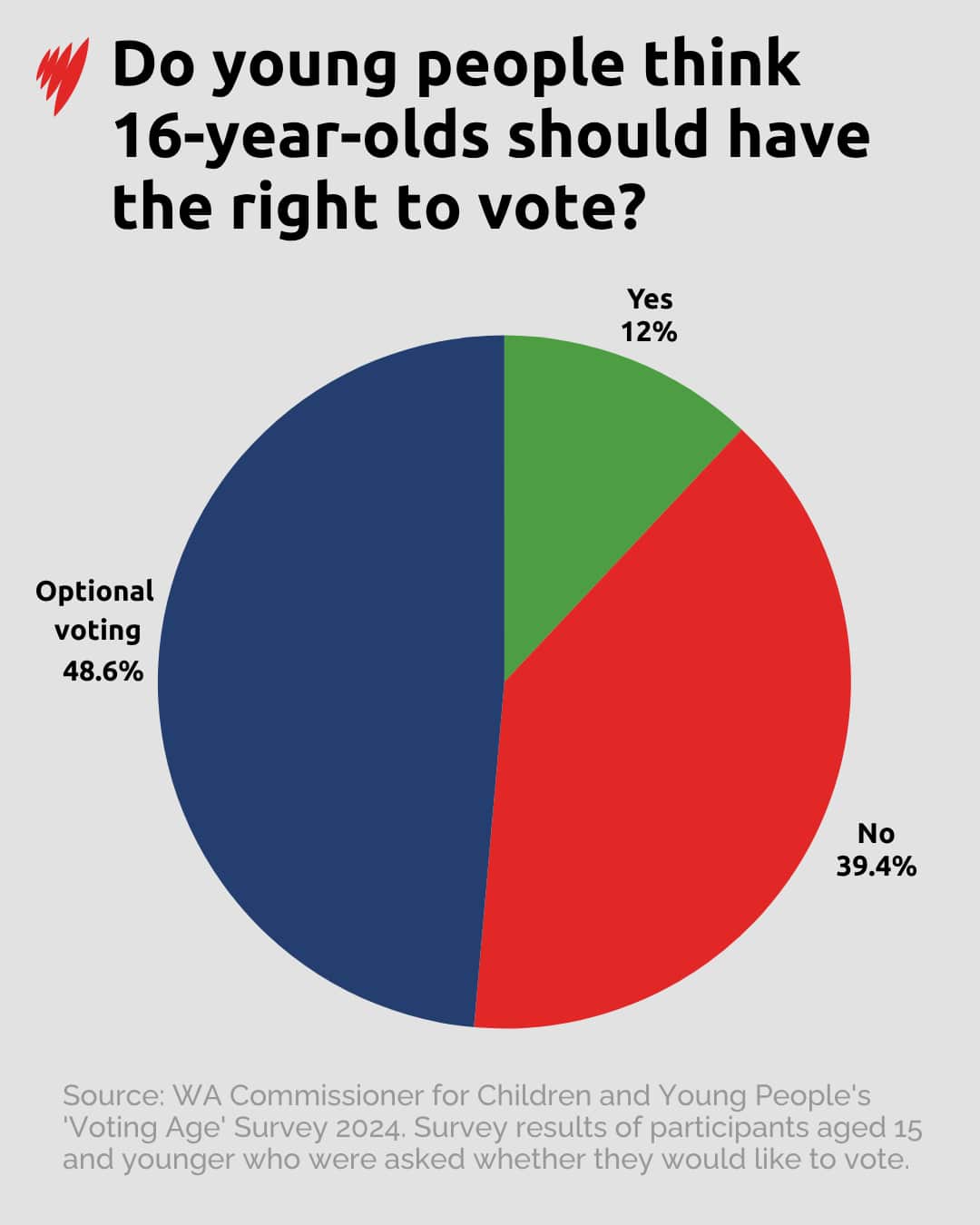
A pie graph showing how if young people think they should vote.

A 2024 study from the Western Australian Commissioner for Children and Young People found overall support for lowering the voting age in Australia among those aged 15 and under. Source: SBS News

A key point of contention is how the policy would be implemented, with debate around whether 16 and 17-year-olds would be subject to Australia’s compulsory voting laws.

Cameron said making it voluntary for that age group could undermine long-term youth participation “by setting a habit of being able to not vote as opposed to setting a habit of voting and having it be compulsory”.
Making it compulsory would mean that eligible younger people could be fined for not voting.

Ryan said she is in favour of compulsory voting for those aged 16 and above, but would support waiving fines for those under 18.
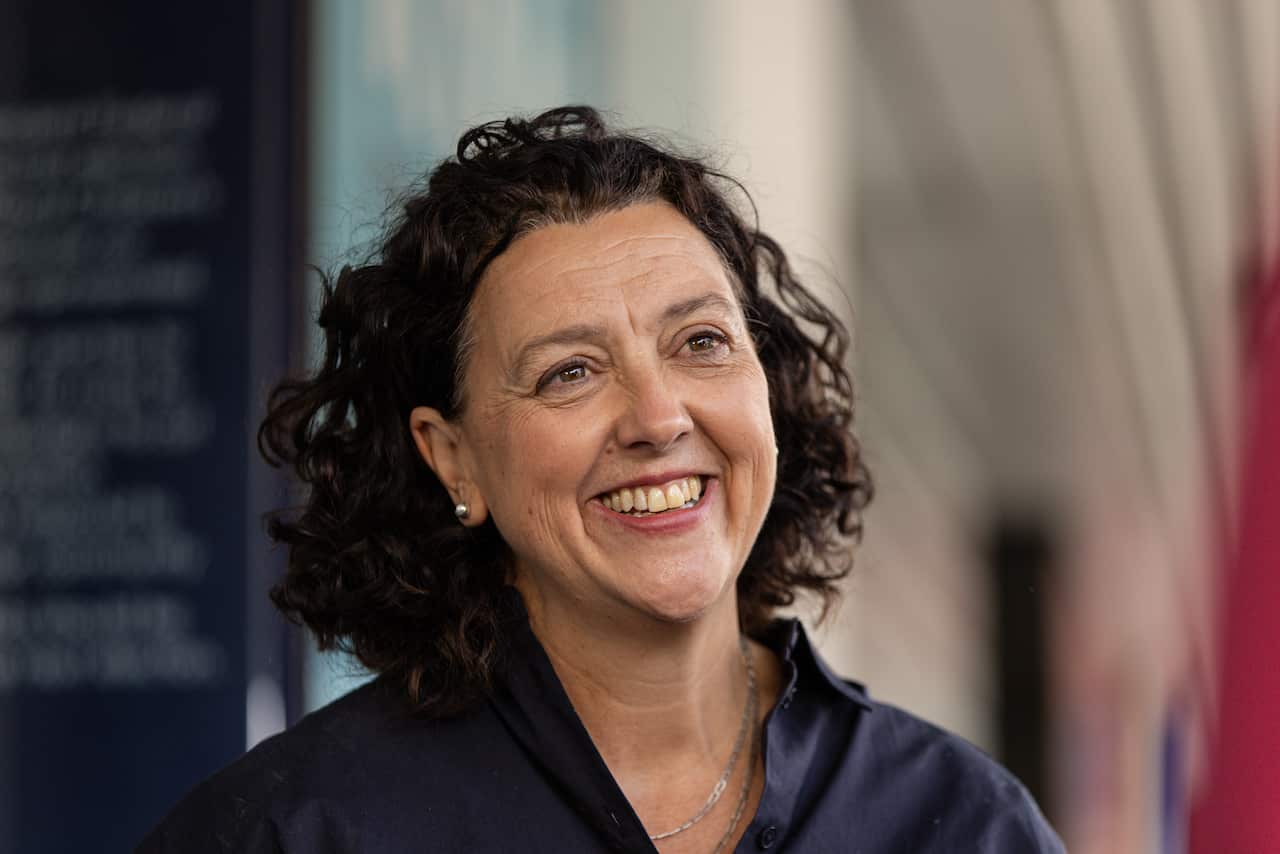
A woman with curly brown hair smiling.

Independent MP Monique Ryan has been advocating for the voting age to be lowered since before she was elected and says young people should “have a say in who represents them”. Source: AAP / Diego Fedele

Where do the pollies stand on it?

It’s not the first time the subject has been brought up. Ryan pushed for a similar move in 2022.
The Greens have long called for lowering the voting age. In 2018, Western Australian senator Jordon Steele-John introduced a bill to lower the voting age, resulting in a Senate inquiry. The major parties did not support the change and it failed to progress.
Again in 2023, Greens MP Stephen Bates introduced another bill to lower the voting age, but it did not progress to Senate consideration.

Just this week, Greens MLC Robert Simms called for the South Australian state government to lower the voting age for state and local elections.


Labor has also previously been in support of the move. In 2015, then Opposition leader Bill Shorten vowed to lower the voting age to 16 or 17, saying it was important to “tackle the apathy and cynicism of young people towards politics”.
But on Friday, Labor frontbencher Matt Thistlethwaite rejected the idea of the Albanese government pushing for the change, telling the ABC: “We are not open to it at the moment, it is not our policy.”
He said that, while it was “good to see young voices heard”, many nations would be looking to see how the UK’s change played out.
Ryan said she had some support from crossbenchers and noted previous support from senior Labor politicians, including Shorten.
“With the decision by the UK government to lower the voting age, there should be a strong impetus for us review the issue in Australia,” Ryan said.
“We’re similar countries with similar values and should look to other countries for how they keep their democratic process fair and inclusive.”

Share this @internewscast.com
You May Also Like
Chris Cairns is pictured with his estranged wife Melanie Crosser and their children before the triple health blow that almost killed him and left him paralysed

Cricket Legend Overcomes Cancer Struggles to Share Emotional Story of Marriage Split

Renowned cricket legend Chris Cairns has revealed details about the end of…
The world's longest flight recently took its first journey, taking 29 hours and covering 12,400 miles. And while it may seem like a nightmare to some, it has been celebrated as a landmark success for long-haul travellers who no longer need to take a connecting flight. Launched on December 4, the China Eastern Airlines route sets off from Shanghai and lands in Buenos Aires. The flight from China to Argentina takes more than 25 hours, with the return journey taking four hours longer.

Record-Breaking 12,400-Mile Flight Sets New Benchmark for Longest Journey

The world’s longest commercial flight has officially taken off, marking a significant…

Why Swiss Commuters Are Taking the Plunge: A River Commute Revolution That Australia Might Need

Each summer in Switzerland, families, leisure-seekers and commuters pack their dry bags…
Launched on December 4, the China Eastern Airlines route sets off from Shanghai and lands in Buenos Aires. The flight from China to Argentina takes more than 25 hours, with the return journey taking four hours longer (stock image)

Historic 12,400-Mile Nonstop Flight Successfully Lands After 29-Hour Journey

The aviation world has reached a new milestone with the debut of…

Chinese Student Shares Harrowing Experience of Bondi Lifeguard Rescue Amidst Gunfire

Floating on the sea, Chinese international student Levi Xu could see the…
Claudio Neves Valente, the suspect in Brown University shooting, at a rental car place in Boston, Massachusetts.

Reddit Sleuths Aid Police in Capturing Elusive Brown University Shooter: A Digital Manhunt

Police lights flashed for hours as law enforcement officers surrounded a storage…

Bondi Lifesaver Ahmed Al-Ahmed Questions Merit of $2.5 Million Donation

Ahmed Al-Ahmed, the tobacco shop owner who was wounded after disarming one…

Sydney Bakery Offers Ben More than Just Employment Opportunities

For many refugees and asylum seekers in Australia, finding work can take…
The final missing piece of the creature to be found was the beak and the three arms (pictured) which washed onto shore last Thursday

Unveiling Scotland’s Mystical Find: The Rare ‘7-Legged’ Octopus That Inspired Demogorgon Legends

Visitors to a Scottish beach were astounded by the discovery of a…
One teen said she made a new account to get around the ban

Albanese’s New Social Media Ban Faces Immediate Challenges as Students Find Ways to Circumvent Restrictions

Australia’s new social media restrictions for those under 16 are now in…
Inaccurate glucose readings pose direct risks. A falsely high reading may cause a diabetic to miss a dangerous low reading, while a falsely low reading can prompt an insulin overdose and severe hypoglycemia (stock)

Critical Alert: Faulty Diabetic Monitors Recalled Across 17 Countries – What You Need to Know

Abbott, a global leader in healthcare solutions, has initiated an extensive recall…
NSW Premier Chris Minns

Premier Addresses Planned Protests with Urgent Message on Public Safety

Chris Minns, who is pushing for parliament to grant “extraordinary powers” to…