
Spanish voters turned out in record numbers on Sunday as the country faced the possibility of the far right returning to government for the first time since General Francisco Franco’s death.
An exit poll for national broadcaster TVE forecast a win for the conservative People’s Party (PP), projecting it would take between 131 and 136 seats, equivalent to 32.6 per cent of the vote, El Pais reported.
With ballots still being counted and no party expected to secure an outright majority, the PP is likely to need support from the anti-immigration Vox party to form a government.
Polling stations closed at 8pm local time, or 7pm GMT, across mainland Spain. Voting ended an hour later in the Canary Islands, which operate in a different time zone.
The election put socialist Prime Minister Pedro Sanchez’s political future on the line after he acknowledged a series of high-profile ‘mistakes’ during a key televised debate 10 days before voters went to the polls.
Turnout stood at 68.1 per cent by 6pm local time, up sharply from the 53.1 per cent recorded at the same stage of the previous national election in July 2023, according to the interior ministry. The final figure was expected to surpass 78 per cent.
Spanish media said it was the strongest turnout recorded by that point in a general election since the country returned to democracy after the death of dictator Francisco Franco in 1975.
Spain prohibits the publication of opinion polls during the five days before an election. Surveys released before that blackout, however, consistently indicated a conservative victory, with the PP and Vox positioned to make major gains.

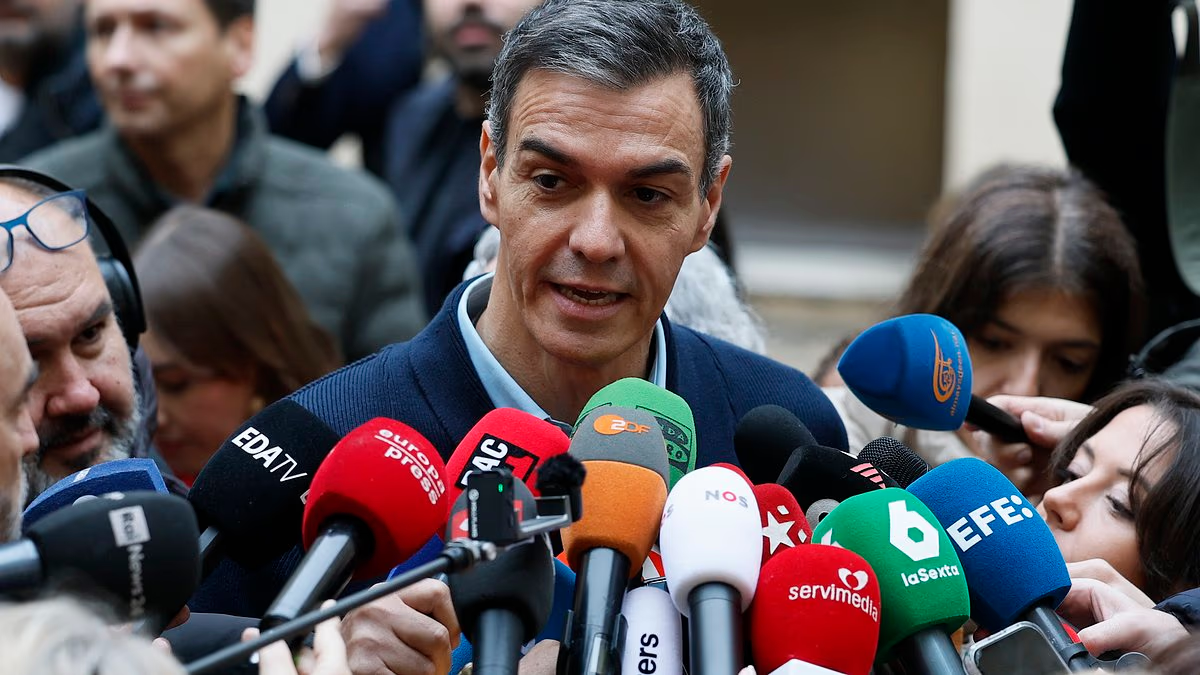
Spanish Prime Minister and re-election candidate Pedro Sanchez casts his ballot at a polling station in Madrid on Sunday morning

Workers prepare election materials before a polling station opens in Madrid, Spain, on November 29, 2026

The main contenders in Spain’s 2026 election include (l-r) Prime Minister and Spanish Socialist Party (PSOE) candidate Pedro Sanchez; conservative People’s Party (PP) leader Alberto Nunez Feijoo; far-right Vox leader Santiago Abascal; and left-wing Frente Amplio candidate Ada Colau
Sanchez was among the first voters as polling stations opened nationwide at 9am local time, or 8am GMT, for 11 hours. Nearly 50 million people were eligible to vote.
The result is being watched closely across Europe, which is entering a year of elections that could reshape the continent’s political landscape. Upcoming contests include a presidential election in France and legislative elections in Poland and Italy.
Sanchez, one of Europe’s few remaining left-wing leaders, has become an international figurehead for the progressive movement. At home, however, his deeply divisive reputation appeared to threaten his eight-year tenure.
The prime minister has repeatedly survived political crises that once seemed insurmountable, and he remained confident heading into the vote. ‘I can’t conceive of us losing,’ he told radio station SER on Friday.
The TVE projection nevertheless suggested Sanchez had not secured the late surge among progressive and undecided voters that the left needed. Left-wing parties would have required at least 176 seats in the 350-member parliament to govern comfortably.
Sanchez had argued that a final turnout of 75 per cent or higher would probably deliver a progressive majority.
Almost every pre-election poll, however, indicated that the PP and Vox were on course to reach the 176-seat threshold needed to take power together.
Vox has attracted widespread controversy after its leader, Santiago Abascal, promoted a series of hardline proposals, including ‘remigration’—a plan to remove migrants who depend on public benefits.
Abascal has also called for an end to the naturalisation of undocumented immigrants and proposed a two-tier welfare system that would give native-born Spaniards ‘national priority’.
Sanchez, 54, warned that a coalition between the PP and Vox would represent a ‘regression’ for social rights, particularly those of women. He also said it would threaten efforts to rehabilitate the victims of Franco, which the opposition has promised to repeal.
During the campaign, Sanchez highlighted Spain’s economic performance while also emphasising his confrontations with US President Donald Trump and Israel.
Marta Ramirez Jimenez, a 23-year-old medical student, said political debate had become ‘much more polarised’ and criticised the ‘intolerable opinions that are being given a voice’.
‘We’re living at a time in which we risk suffering a rollback of rights that were taken for granted,’ she said.

Migration has been a central issue in the election, with thousands of migrants arriving by boat in Spain’s Canary Islands in recent weeks
READ MORE: Influencer Pleads for Release of His Nordic Wife From ICE Detention

Vox leader Santiago Abascal, pictured voting in Madrid on Sunday, has demanded the ‘remigration’ of immigrants who rely on benefits and appears poised to enter government in coalition with the People’s Party
PP leader Alberto Nunez Feijoo, whose party won the most seats in the 2023 election but could not assemble a government, rejected what he described as Sanchez’s campaign of ‘fear’.
Feijoo, 65, governed the north-western region of Galicia for 13 years and has sought to present himself as a steady, experienced and competent leader.
The PP has spent years attacking Sanchez over a series of corruption scandals, agreements with Catalan separatists and his failure to pass a national budget.
Two high-speed train crashes this year, which together killed 115 people, as well as July’s surge of migrants into Spain’s North African city of Ceuta from Morocco, gave the PP and Vox further grounds to criticise the government.
A recent increase in migrant boats reaching the Canary Islands has also intensified scrutiny of Sanchez’s outspoken support for a more open immigration policy.
Spain’s ageing population has expanded largely through immigration, which the government says is helping sustain economic growth.
Sanchez also sought to capitalise on public anger over the country’s long-running housing crisis, introducing new measures aimed at tenants earlier this month.
The Right has blamed successive Sanchez governments for rising housing costs. Its rejection of emergency housing decrees in October helped prompt the prime minister to call an election that had originally been scheduled for 2027.
Domingo Perez, a 55-year-old retiree, said: ‘There needs to be a change, because of everything that’s happened, so much corruption, the Spaniards who can’t make ends meet.’
Vox has made immigration the centrepiece of its campaign, linking it to housing pressures and other social problems in an effort to channel frustration—particularly among younger voters.
The party, led by 50-year-old Abascal, supports deporting irregular migrants, foreign nationals convicted of crimes and people it believes are dependent on public benefits.
In July, the Spanish government said more than 609,000 undocumented migrants had been granted temporary work permits through a scheme introduced by Sanchez.

By 6pm, turnout in Spain’s election was the highest recorded by that point since the country returned to democracy after the death of dictator Francisco Franco (pictured) in 1975
The initiative began in April with the aim of integrating foreigners living and working in Spain without official authorisation, as governments elsewhere in Europe tightened immigration rules under pressure from growing far-right parties.
A total of 1,174,978 applications were filed between mid-April and June 30, when the application period closed. More than 600,000 were already being processed, migration secretary of state Pilar Cancela told reporters in Madrid.
The total was more than twice the 500,000 applications anticipated by the government, according to data from Mercurio, the platform that records submissions from across Spain.
Immigration officials have warned that as many as three million migrants and relatives could enter Spain over the next year through family reunification linked to the roughly 1.2 million people who applied for legal status.
Officials told Spanish newspaper El Mundo that ‘for every person whose status is regularised, at least three more will be added if they apply for and are granted family reunification’.
They have also accused Sanchez’s government of intentionally removing the National Police from the process and transferring responsibility to the Ministry of Migration.
Critics say that change could weaken checks on the validity of documents and increase the risk of errors, including in criminal-record screenings.
Spain’s Cortes Generales, or national parliament, consists of two chambers: the upper house, known as the Senado, and the lower house, the Congreso de los Diputados.
The 350 members of the Congress of Deputies will choose the country’s next prime minister.
Unlike in the UK, where voters elect individual MPs, Spanish voters choose party lists in 52 constituencies. Each constituency sends between one and 38 deputies to the lower house.
Turnout in the mid-summer 2023 election reached 66.6 per cent. The PP won the largest number of votes but failed to secure enough support in parliament to form a government.