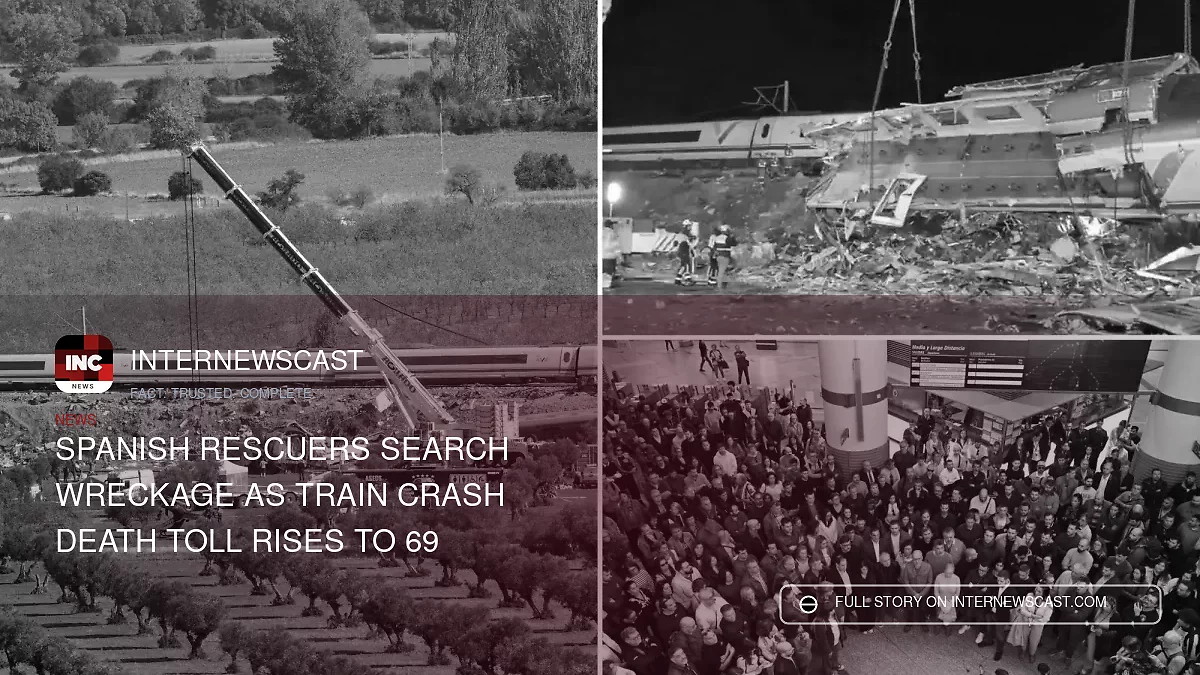

URDA, Spain — Rescue teams combed through the twisted remains of train carriages on Thursday as the death toll from Spain’s second deadly high-speed rail crash of the year climbed to 69. With hopes of finding more survivors rapidly diminishing, the operation shifted toward recovering victims and clearing the wreckage.
Crane crews worked through the night to remove sections of the trains following Wednesday’s collision. In the central province of Toledo, emergency responders were seen carrying what appeared to be a body covered by a blanket from one of the damaged carriages.
Emiliano Garcia-Page, the regional leader of Castilla-La Mancha, confirmed that 69 people had died and said rescuers had recovered human remains during the overnight operation. Crews were continuing to use heavy machinery, particularly around a carriage that remained overturned.
“We do not believe there could be any more fatalities beneath that one, but I say this with caution,” he said.
UNIONS BLAME LACK OF FUNDING
Spanish train drivers proceeded with a previously announced strike, calling for greater investment in rail safety just one day after Europe’s deadliest train disaster since the 2013 derailment in Santiago de Compostela.
“We will continue demanding the necessary measures to make this sector safe again … It must have all the safety systems required to maintain the quality standards we have always had,” said Diego Martín, a representative of the SEMAF train drivers’ union.
“We cannot tolerate, under any circumstances, this type of incident happening again. Everyone should be able to travel without the risk of suffering this kind of accident,” he told reporters at Madrid’s Atocha station.
The disaster, which came after another fatal crash in January involving the same rail companies on the same route, has also disrupted campaigning ahead of Spain’s snap election on November 29. Leaders of the country’s two largest parties have suspended their campaign appearances.
The Spanish government announced three days of national mourning for the victims. Transport Minister Oscar Puente said the crash occurred after several trains halted because of a signaling failure. He said a state-owned Renfe train was then cleared to continue at normal speed, despite a stationary Iryo train ahead on the line.
Rail unions have accused authorities of failing to provide sufficient funding or political commitment to improve safety, saying negotiations launched after January’s accident were abandoned in April. The government, meanwhile, has described the decision to allow the Renfe train to proceed as “inexplicable.”
POPE SENDS CONDOLENCES
SEE ALSO: Dozens of House Democrats Break With Rep. Ilhan Omar as Party Seeks to Block Trump Immigration Probe
The Vatican said Pope Leo had expressed his condolences to the victims’ families, wished those injured a swift recovery and offered his support to everyone affected. He also encouraged emergency personnel to continue their rescue and recovery work.
Authorities said 57 injured people remained hospitalized.
The crash triggered a large-scale emergency response involving more than 800 military and police personnel, according to Spain’s Interior Ministry. The operation also included over 200 vehicles, three helicopters, a mobile command center, drones, mounted units and search dogs.
As investigators began examining the circumstances of the collision, a Toledo judge imposed a 2-kilometer (1.2-mile) exclusion zone in both directions along the Madrid-Seville high-speed rail route. Only emergency workers, security personnel, medical staff and judicial officials were permitted to enter the site.
Socialist Prime Minister Pedro Sanchez traveled to Toledo for a meeting focused on coordinating the response. He said authorities were working “day and night” to assist survivors and relatives of the victims and to “get to the bottom of every last detail of this tragedy.”
Alberto Nuñez Feijoo, leader of the center-right People’s Party, which is ahead in current opinion polls, was expected to visit Urda. Residents of the town were among those who rushed to the scene to help in the immediate aftermath of the crash.
FOREIGN NATIONALS AMONG CASUALTIES
Spain’s Foreign Ministry said preliminary information indicated that 42 foreign nationals from seven countries were involved in the accident. At least one of them was killed and seven others were injured.
Wednesday’s crash has intensified scrutiny of safety standards across Spain’s railway system, the longest high-speed network in Europe and for years a source of national pride.
SEMAF said train drivers would maintain their strike campaign in support of structural improvements to rail safety and was considering additional action.
Renfe said the walkout had caused major disruptions to rail services. The company said passengers could change or cancel their tickets without charge and would receive notifications if their journeys were affected.