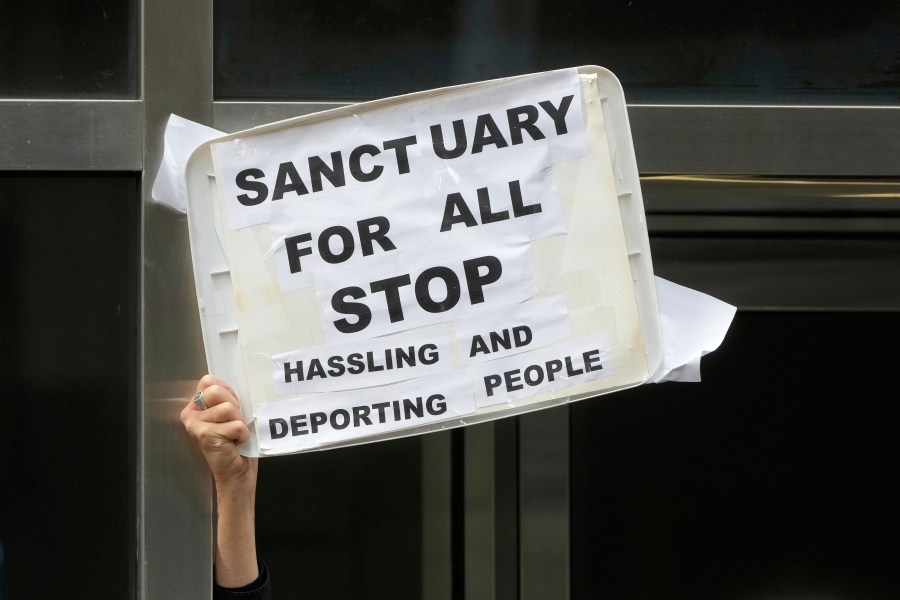


As President Donald Trump’s administration goes after states and local governments that refuse to collaborate with federal immigration authorities, lawmakers in some Democratic-led states are pushing back by toughening state laws that limit such cooperation.
In California alone, over a dozen bills favoring immigrants cleared either the Assembly or Senate this week, including legislation that stops schools from permitting federal immigration officials into nonpublic areas without a judicial warrant.
Additional state initiatives aim to protect immigrants in housing, employment, and interactions with police, even as the Trump administration has increased arrests as part of his agenda for mass deportations.
In Connecticut, legislation pending before Democratic Gov. Ned Lamont would expand a law that already limits when law enforcement officers can cooperate with federal requests to detain immigrants. Among other things, it would let “any aggrieved person” sue municipalities for alleged violations of the state’s Trust Act.
Two days after lawmakers gave final approval to the measure, the U.S. Department of Homeland Security included Connecticut on a list of hundreds of “sanctuary jurisdictions” obstructing the enforcement of federal immigration laws. The list later was removed from the department’s website after criticism that it errantly included some local governments that support Trump’s immigration policies.
States split on whether to aid or resist Trump
Since taking office in January, Trump has enlisted hundreds of state and local law enforcement agencies to help identify immigrants in the U.S. illegally and detain them for potential deportation. U.S. Immigration and Customs Enforcement now lists 640 such cooperative agreements, a nearly fivefold increase under Trump.
Trump also has lifted longtime rules restricting immigration enforcement near schools, churches and hospitals, and ordered federal prosecutors to investigate state or local officials believed to be interfering with his crackdown on illegal immigration. The Department of Justice sued Colorado, Illinois and New York, as well as several cities in those states and New Jersey, alleging their policies violate the U.S. Constitution or federal immigration laws.
Just three weeks after Colorado was sued, Democratic Gov. Jared Polis signed a wide-ranging law expanding the state’s protections for immigrants. Among other things, it bars jails from delaying the release of inmates for immigration enforcement and allows penalties of up to $50,000 for public schools, colleges, libraries, child care centers and health care facilities that collect information about people’s immigration status, with some exceptions.
Polis rejected the administration’s description of Colorado as a “sanctuary state,” asserting that law officers remain “deeply committed” to working with federal authorities on criminal investigations.
“But to be clear, state and local law enforcement cannot be commandeered to enforce federal civil immigration laws,” Polis said in a bill-signing statement.
Illinois also has continued to press pro-immigrant legislation. A bill recently given final approval says no child can be denied a free public education because of immigration status — something already guaranteed nationwide under a 1982 U.S. Supreme Court decision. Supporters say the state legislation provides a backstop in case court precedent is overturned.
The bill also requires schools to develop policies on handling requests from federal immigration officials and allows lawsuits for alleged violations of the measure.
Legislation supporting immigrants takes a variety of forms
Democratic-led states are pursuing a wide range of means to protect immigrants.
A new Oregon law bars landlords from inquiring about the immigration status of tenants or applicants. New laws in Washington declare it unprofessional conduct for bail bond agents to enforce civil immigration warrants, prohibit employers from using immigration status to threaten workers and let employees use paid sick leave to attend immigration proceedings for themselves or family members.
Vermont last month repealed a state law that let law enforcement agencies enter into immigration enforcement agreements with federal authorities during state or national emergencies. They now need special permission from the governor to do so.
As passed by the House, Maryland legislation also would have barred local governments from reaching immigration enforcement agreements with the federal government. That provision was removed in the Senate following pushback from some of the seven Maryland counties that currently have agreements.
The final version, which took effect as law at the start of June, forbids public schools and libraries from granting federal immigration authorities access to nonpublic areas without a judicial warrant or “exigent circumstances.”
Maryland Del. Nicole Williams said residents’ concerns about Trump’s immigration policies prompted her to sponsor the legislation.
“We believe that diversity is our strength, and our role as elected officials is to make sure that all of the residents within our community — regardless of their background — feel safe and comfortable,” Williams said.
Many new measures reinforce existing policies
Though legislation advancing in Democratic states may shield against Trump’s policies, “I would say it’s more so to send a message to immigrant communities to let them know that they are welcome,” said Juan Avilez, a policy associate at the American Immigration Council, a nonprofit advocacy group.
In California, a law that took effect in 2018 already requires public schools to adopt policies “limiting assistance with immigration enforcement to the fullest extent possible.” Some schools have readily applied the law. When DHS officers attempted a welfare check on migrant children at two Los Angeles elementary schools in April, they were denied access by both principals.
Legislation passed by the state Senate would reinforce such policies by specifically requiring a judicial warrant for public schools to let immigration authorities into nonpublic areas, allow students to be questioned or disclose information about students and their families.
“Having ICE in our schools means that you’ll have parents who will not want to send their kids to school at all,” Democratic state Sen. Scott Wiener said in support of the bill.
But some Republicans said the measure was “injecting partisan immigration policies” into schools.
“We have yet to see a case in California where we have scary people in masks entering schools and ripping children away,” said state Sen. Marie Alvarado-Gil. “Let’s stop these fear tactics that do us an injustice.”
___
Associated Press writers Susan Haigh, Trân Nguyễn, Jesse Bedayn, John O’Connor and Brian Witte contributed to this report.