When predatory dinosaurs drove their teeth into prey, they may not have bitten in the simple downward motion often shown in films.
Instead, new research indicates that many of these fearsome hunters likely tore flesh by pulling their heads sharply backwards.
Experiments with a purpose-built device called DinoSAW showed that replica dinosaur teeth cut through flesh-like material with roughly one-third less force when dragged backwards at an angle.
The teeth’s curved, serrated design made this movement particularly effective, engaging both cutting edges in much the same way as a steak knife.
The results suggest theropods may have fed in a manner similar to modern birds of prey, using powerful neck muscles to wrench pieces of meat from a carcass.
‘We often imagine carnivorous dinosaurs simply crunching straight down on their victims, but the shape of their teeth suggests a different action,’ said Dr Manabu Sakamoto, a palaeobiologist at the University of Reading who led the study.
‘Their teeth curve backwards and carry serrations along both edges, so we tested whether drawing them through flesh was more effective than biting vertically. The difference was clear.’

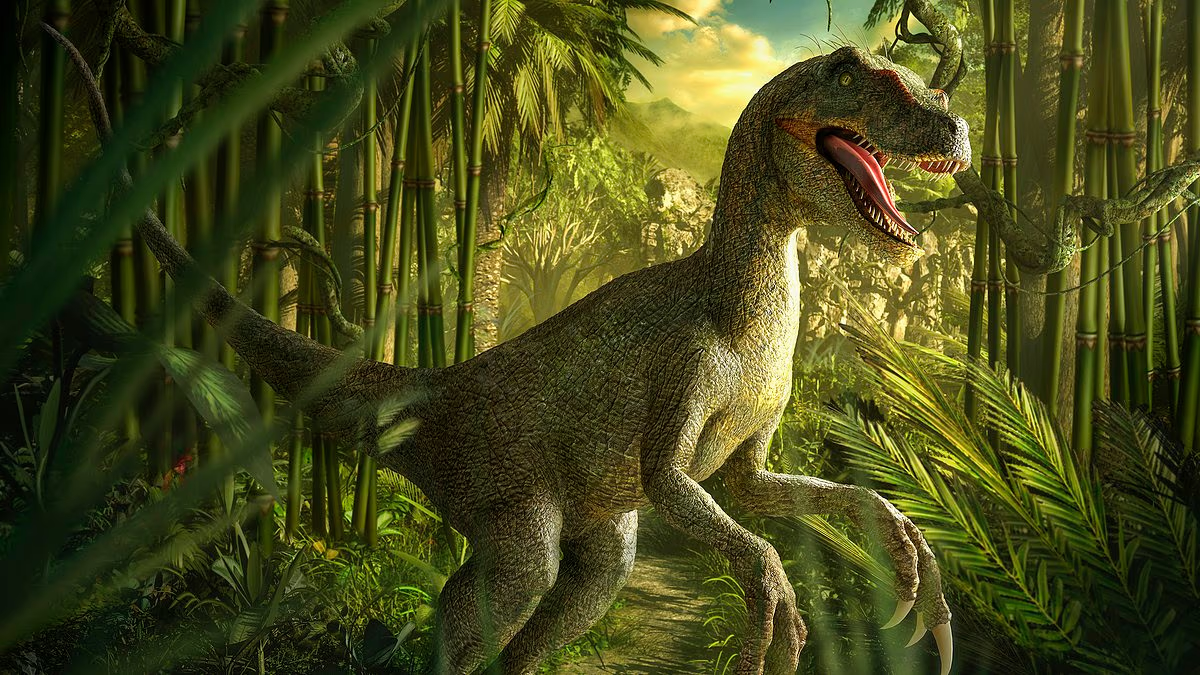
Researchers say dinosaurs such as Velociraptor probably tore flesh with a forceful backwards pull instead of simply chomping down on prey (stock image)

Replica dinosaur teeth required about one-third less force to cut flesh-like material when pulled diagonally backwards (right) than when driven straight down (left)
Theropods include Allosaurus and Velociraptor, two of the most formidable predators of the dinosaur era.
To test how they may have fed, the researchers drove a replica theropod tooth into ballistics gel, a substance commonly used as a stand-in for flesh. They tested both a straight downward bite and a diagonally backward pull while sensors measured the forces generated.
The diagonal motion produced an average peak force of 14 newtons, compared with 21.4 newtons for the vertical bite.
The team also recorded the gel under polarised light to track how stress travelled through the material.
Straight-down biting produced bright flashes showing tightly concentrated stress, while the backward pull distributed stress more evenly and at lower intensity.
CHECK THIS OUT: Taylor Swift Faces an Annus Horribilis as Her Public Image Cracks
‘The results point to a feeding style more like an eagle tearing into a carcass—driving the teeth in and then pulling back with the neck,’ Dr Sakamoto said.
‘They also show that models of dinosaur skulls and teeth must account for the direction of movement, not simply the amount of force involved.
‘In that sense, this may be the most cutting-edge dinosaur research yet.’

The researchers drove a replica theropod tooth into ballistics gel, which is frequently used to simulate the properties of flesh

A vertical bite engages only the tooth’s front serrated edge, but a backward pull follows its curve and activates both serrated edges
The study, published in the journal Palaeontology, attributes the difference in force to the distinctive shape of theropod teeth.
A downward bite mainly relies on the serrated edge at the front of the tooth. By contrast, pulling backwards along the tooth’s curve brings both serrated edges into action.
That finding supports the idea that dinosaurs used their strong, S-shaped necks to pull and slice through flesh.
Modern birds of prey, which are living descendants of theropods, use a comparable technique. Komodo dragons also feed in a similar way and are the only living reptiles with teeth of this type.
Groove-like bite marks preserved on dinosaur bones provide further support, as they indicate that teeth were dragged across the surface rather than pressed straight in and withdrawn.
The findings also challenge the earlier view that theropods first bit down before pulling. According to the new analysis, that sequence would be inefficient; the backward motion likely created both the initial puncture and the cutting action.
‘We cannot observe an extinct animal directly, so there will always be limits to what we can know about its behaviour,’ said study co-author Dr Philip Anderson, a professor of evolution, ecology and behaviour at the University of Illinois Urbana-Champaign.
‘However, applying principles and techniques from physics and engineering lets us examine which feeding behaviours would have required less effort and may therefore have been more likely.’
The researchers now plan to use DinoSAW to examine other tooth shapes and feeding movements, including the specialised cookie-cutter incisors of extinct sabre-toothed cats.