

As the countdown to the 2026 midterm elections accelerates, a fierce battle over redistricting has erupted between Democrats and Republicans across the United States. Both parties have been actively redrawing district maps since July 2025, but recent developments have significantly tilted the scales.
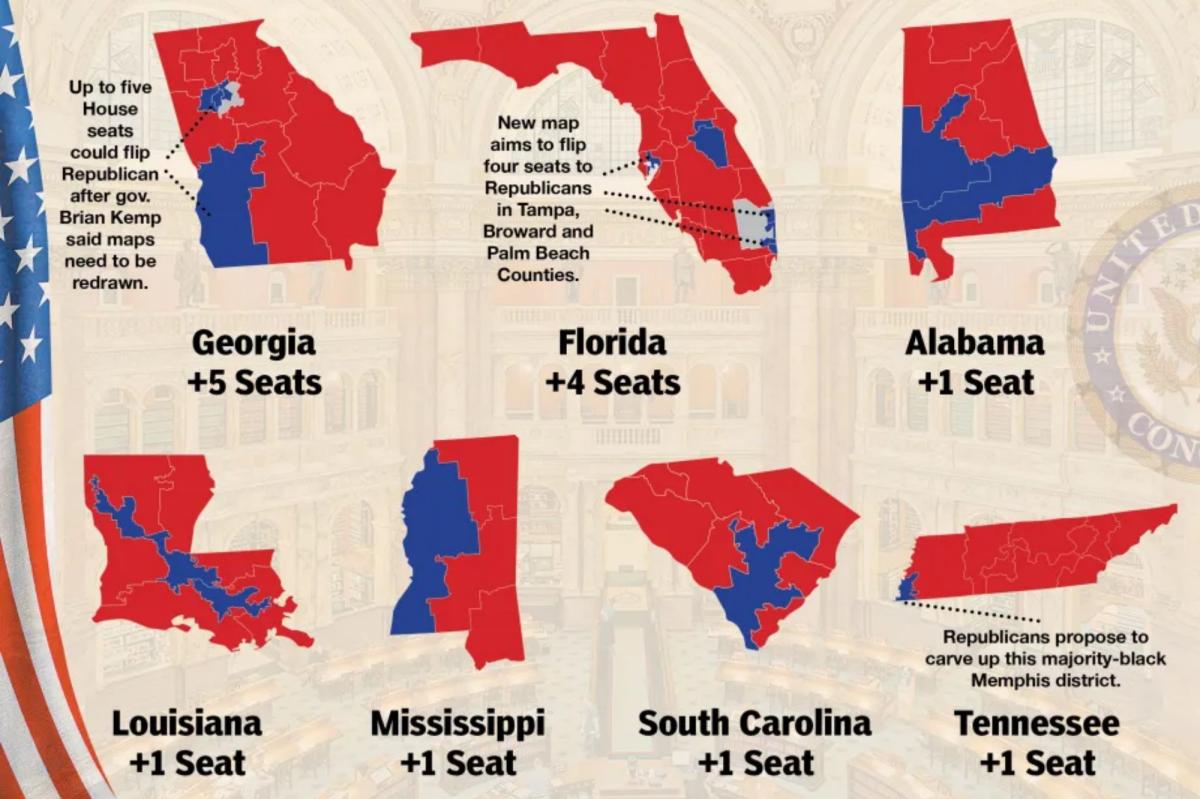
In a dramatic turn of events, Republicans appear on the brink of gaining up to 14 additional seats in the U.S. House of Representatives. This shift follows a pivotal Supreme Court decision that deemed Louisiana’s racial gerrymandering unconstitutional, setting a new legal standard for how voting districts are configured.
This landmark ruling has triggered a wave of redistricting efforts in several southern states, including Florida, Louisiana, Tennessee, Mississippi, Alabama, and South Carolina. These efforts could potentially bolster Republican representation in these regions, reshaping the political landscape ahead of the elections.
Currently, Republicans maintain a narrow lead in the House with 217 seats, compared to the Democrats’ 212. The balance is further complicated by the presence of an independent, former Republican Kevin Kiley from California, and five vacant seats, at least three of which are expected to be filled before the November 3rd midterms.
Should Republicans succeed in securing these additional 14 seats, their hold on the House would be significantly strengthened. According to analysis from 270towin.com, the existing distribution sees 212 seats as safe or likely for Democrats and 205 for Republicans, leaving 18 seats in contention. These developments underscore the high stakes and intense maneuvering as both parties vie for control of Congress’s 435 seats.
With 14 more Republican seats, the party would go a long way to keeping the house. According to website 270towin.com current standings are 212 safe and likely seats for the Democrats and 205 safe and likely Republican seats, leaving 18 up for grabs in Congress to make up its 435 total.
“Obviously it’s encouraging,” said Republican political strategist and pollster Adam Geller, CEO of National Research Inc. “But I really think that right now we have to wait and see where things land, and wait until districts are drawn and certified.”
That’s because the political map is changing almost daily.
California, Missouri, North Carolina, Ohio and Texas have already passed new congressional maps and a lawsuits led by a voting rights groups in Utah also resulted in a new congressional map.
Here’s where things have already changed, and where they stand to shift following the Supreme Court decision on the Voting Rights Act:
Projected Republican Wins
Louisiana
The court ruled the state’s congressional map included unconstitutional gerrymandering, using race to create a black majority district. Republican Governor Jeff Landry delayed the state’s House primary elections last week in order to redraw the electoral map to account for population changes. The Republicans currently hold four of Louisiana’s six House seats, which Landry is now hoping to take from the Democrats to make six.
Tennessee
In Tennessee, Republican Gov. Bill Lee called a special legislative session last week to redraw the state’s congressional map. Lee said legislators “owe it to Tennesseans to ensure our congressional districts accurately reflect the will of Tennessee voters.” Lee is targeting the sole Democratic House seat in Memphis.
Alabama
In Alabama, Republican Gov. Kay Ivey called a special session in order to redraw a map giving Republicans the advantage in all seven of the state’s congressional districts. The new maps could result in flipping two seats from the Democrats so Republicans would control all of the state seats in the House of Representatives.
Florida
On Monday, Florida Gov. Ron DeSantis signed into effect a new congressional map that could see the Republicans flip four of the Democrats’ eight current House seats. The state has 28 seats in the US House of Representatives, and DeSantis has redrawn 21 districts to favor his party.
Texas
Last month, the US Supreme Court approved a new Texas map after a lower court struck it down. Republicans currently have 24 congressional seats in Texas, while Democrats have 13. With the new map, GOPers are hoping to squeeze out as many as five additional seats.
North Carolina
In October, the state legislature approved a new map which would flip one Democratic seat. The result would give Republicans control of 11 of North Carolina’s 14 House seats.
Washington, DC
Perhaps the most radical plan of all has been introduced in Washington DC, which is a new Republican-led bill launched to “Make DC Square Again.” This would return land in Arlington County and the city of Alexandria that was taken by Virginia in 1846, largely to protect the local slave trade from federal abolition efforts.
The measure came about after voters in Virginia passed a referendum last month which favors Democrats.
Projected Democratic Wins
California
In response to the Texas redraw, California Gov. Gavin Newsom passed an amendment to change the state’s congressional map to benefit Democrats. Voters passed a gerrymandered California map, under Proposition 50, to carve out five more Democratic seats in Congress. The measure passed in November, but the Supreme Court ruling could throw a wrench into the new maps, experts said. Last year, California Republicans immediately sued arguing that the new maps were nothing more than racial gerrymandering
Virginia
Last month, voters in Virginia approved a redistricting plan that could create four additional Democratic House seats. Republicans are challenging the new map, arguing that Democratic legislators did not follow the law when approving a referendum. The updated voting districts could result in Democrats taking 10 of the state’s 11 seats in the House in November.
New York
Not all attempts to redistrict have been successful. In March, the US Supreme Court blocked New York Democrats from redrawing New York City’s lone Republican House seat in Staten Island following an emergency appeal from Rep Nicole Malliotakis. The order grants a stay, barring a state judge from redrawing the 11th Congressional District map ahead of the midterm elections.
However, following the Supreme Court’s decision on Louisiana last month, New York lawmakers have called to amend the state Constitution to “reform” its ban on partisan gerrymandering in the state.
Maryland
Gov. Wes Moore put forward a map to redistrict the state and boost Democrats chances in the midterms, but it was rejected by the state legislature, controlled by Democrats, as they were concerned it would not pass under judicial review.
Illinois
The Illinois House of Representatives last week paused a proposed amendment to redistrict according to race, following the recent Supreme Court decision. Republicans currently hold three of the state’s 17 US House seats.
Utah
The state could add a Democratic seat after a state judge rejected a congressional map drawn by the Republican-controlled state legislature last year. Judge Dianna Gibson adopted a map drawn by a centrist group which had filed suit against a previous Republican proposal.
Redistricting usually takes place every ten years following the national census, in order to accommodate population changes. The only state which was originally due to redistrict in 2026 had been Ohio.
“We’ve gone from redistricting every ten years to what feels like every five minutes,” said David Wasserman, an elections analyst for the Cook Political Report, a nonpartisan newsletter. “We’re in an era of manic redistricting. And if one party doesn’t seize the opportunity, the other party will.”
The first move was made by Texas last year, after President Trump called on the state’s Republicans, to redraw their voting maps to gain a Republican edge in the 2026 midterms. The effort resulted in up to five additional US House seats for Republicans in Lone Star State.


