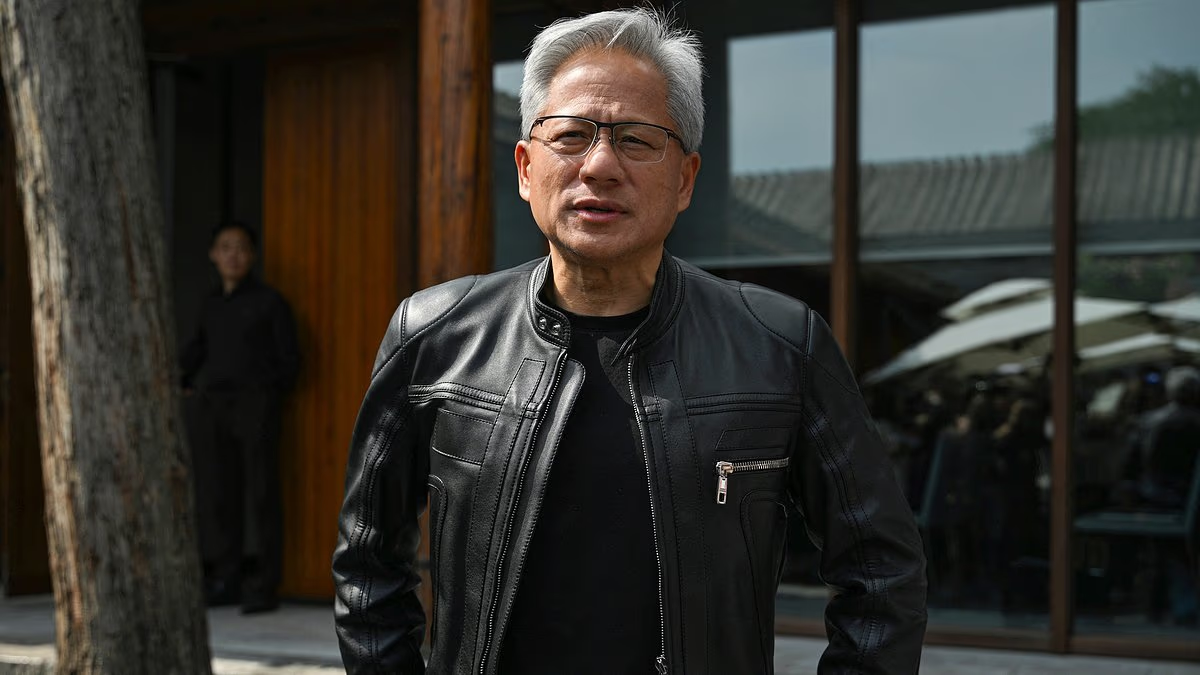

The leather jacket was the first clue. It looked less like ordinary clothing than a wearable Porsche—an accessory projecting effortless confidence, youthful swagger and a touch of calculated machismo.
Silicon Valley’s answer to Tom Cruise.
In hindsight, it was always a risky image to cultivate.
Jensen Huang, like Bill Gates and Jeff Bezos before him, has become the subject of commentary suggesting that extraordinary success may have brought its own form of personal reckoning. The theory is familiar: overlooked young men grow into powerful adults and seek validation in ways that can damage the people closest to them.
Gates, 70, has publicly acknowledged infidelity during his marriage to Melinda French Gates. Bezos was also reported to have begun a relationship with Lauren Sanchez while he was still married to MacKenzie Scott.
Now Huang’s private life has drawn attention after Nvidia grew into the world’s first $5 trillion company. It is an old story wrapped in the most futuristic of industries: immense power, relentless ambition and personal choices that threaten to overshadow professional achievement.
For anyone watching their retirement savings wobble alongside the technology market, the latest controversy has been particularly unsettling. Nvidia has reportedly lost billions in market value amid the revelations and speculation of the past week.
Huang, 63, founded Nvidia in 1993, initially building computer chips for the video-game industry. That early connection to gaming culture now feels like an unintended detail in the story of a technology executive whose public image has long blended youthful energy with corporate power.

The leather jacket became part of Huang’s signature look, projecting a blend of youthful confidence, calculated cool and Silicon Valley bravado
Huang has been married to Lori since 1985. The couple met at Oregon State University when they were both 17 and working as lab partners. Huang has described himself as too shy to ask her out, eventually finding the courage after roughly six months.
Lori was his first girlfriend. They married in their early 20s and went on to raise two children, both now adults.
Last weekend, reports claimed that Huang acknowledged being unfaithful with a 42-year-old woman named Alice Huang, who is not related to him. Further reports have raised questions about her background, including unverified suggestions that she may have links to Chinese intelligence.
Those claims have intensified scrutiny because of the US restrictions on selling some of the world’s most advanced computer chips to China. The central concern, if the allegations prove accurate, would be whether sensitive business information was ever at risk.
Or perhaps the entire episode is simply another example of how quickly speculation can outrun confirmed facts when a powerful executive’s private life enters the public arena.
The story became still more complicated when video reportedly surfaced showing Huang behaving affectionately toward Kimberly Powell, 48, Nvidia’s vice president of healthcare. Powell is also married, according to reports.
In major American companies, relationships involving senior executives and employees can create serious ethical and governance concerns. The issue is not only potential industrial espionage but also questions of trust, workplace power and whether company rules have been followed.
Huang’s position became even more uncertain after reports from Reuters suggested that a third, unnamed woman connected to Nvidia may also have been involved. The claims have not all been independently verified.

Huang and Lori met as teenagers while studying at Oregon State University and have been married since 1985

Reports have alleged that Huang was unfaithful with Alice Huang, although the wider claims surrounding her background remain unverified
The pace and scale of the allegations have been extraordinary. How do executives running global companies find the time for high-risk personal entanglements—along with interviews, podcasts and constant public appearances? After reports suggested Huang had stepped aside, Colette Kress was named interim chief executive.
Elon Musk, who has had a highly public personal life of his own, then appeared to respond almost immediately, saying he would be “honored to hire Huang” and describing him as someone who “rocks.”
It was a comment that prompted an obvious question: are these men still behaving like teenagers in short trousers?
Huang can hardly have been short of stimulation. Running a global AI and semiconductor company demands extraordinary concentration, yet some powerful figures still seem willing to gamble their reputations in an era when almost every encounter can be recorded.
Perhaps the danger is part of the attraction—the belief that professional triumph has made them untouchable. Once one challenge has been conquered, does the next become a question of who else, and what else, can be claimed?
The women involved are often discussed as symbols in the story, rather than as people with their own lives and reputations. That, too, says something uncomfortable about the way these scandals are covered.
Do these powerful men ever confront the damage caused to the partners who supported them? The spouse who absorbed the pressure, managed the household, endured the travel and absences, soothed the anxiety, defended the ambition and helped create the conditions for success?
Still, the more difficult question remains: why do some accomplished, intelligent and influential men risk everything after obtaining almost everything they once wanted?

Reports later claimed that Huang was filmed behaving affectionately toward Kimberly Powell, Nvidia’s vice president of healthcare, who is also married
For some—not for everyone—the bargain appears to be ambition at any cost.
Huang built a reputation for an extreme work ethic, speaking openly about operating around the clock and rarely taking time away from Nvidia. He has also acknowledged that such a life would not have been possible without Lori’s support.
“If you’re going to build a company, you need somebody strong and somebody amazing like my wife. And she took care of everything,” Huang said on a podcast in May.
“Lori took care of everything. And I don’t remember her complaining even one time, one nanosecond or even one instance. That’s the gift that she gave me,” he added.
It is a striking tribute—and, in light of the allegations, a painful way to describe the debt he owed her.
Now, the consequences of Huang’s private decisions appear to be catching up with his public career.
It is hard not to question whether the charitable foundations and carefully packaged initiatives created by billionaires sometimes serve as reputation-management exercises. Can philanthropy become a way for powerful men to reassure themselves that they are fundamentally good, even after causing profound personal harm?
The first responsibility of charity, surely, begins at home.
“I’ve always felt safe taking risks. Maybe it’s because I know that when I get home, Lori is still there,” Huang told a podcaster this year.
By that measure, he may have taken the one risk that could cost him more than any business decision ever did.


