
Share this @internewscast.com
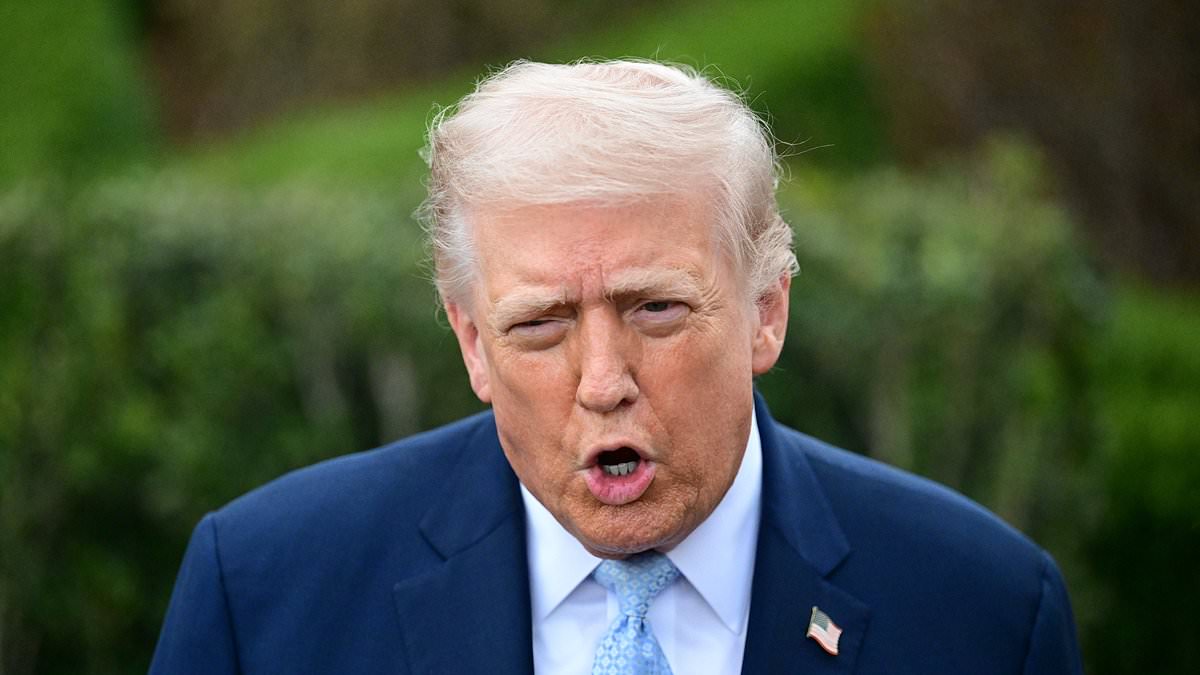
President Donald Trump has boldly proclaimed that Iran has been “blown off the map” and that its military strength has been dismantled “weeks ahead of schedule.”
This sweeping assertion is at odds with the more nuanced and sometimes contradictory reports coming from within his own administration regarding the situation on the ground.
On Saturday evening, Trump took to X to vehemently address his critics, asserting that the military campaign had not only met but exceeded expectations.
“The United States has blown Iran off the map,” Trump declared in his post, taking aim at analyst David Sanger for suggesting otherwise. “I have met my goals, and weeks ahead of schedule!”
He continued with a string of statements about the current condition of Iran’s military forces.
“Their leadership is gone, their navy and air force are decimated, they have no defense left, and they are eager to negotiate. I am not! We are weeks ahead of schedule,” he insisted.
The post also targeted David Sanger, the White House and National Security Correspondent for The New York Times, accusing the outlet of misrepresenting the success of the campaign.
But Trump’s triumphant tone stands in sharp contrast to a series of mixed and sometimes conflicting signals emerging from his administration about the trajectory of the war with Iran which is now entering its fourth week.

President Donald Trump claimed the US has ‘blown Iran off the map’ and achieved its war goals ‘weeks ahead of schedule’

Trump made the explosive claim in a Saturday night post on X, declaring the US had ‘blown Iran off of the map’ and surpassed its military objectives ‘weeks ahead of schedule.’

Civilians look upon the remains of a residential and commercial building on Saturday in the Shahrak-e Gharb neighborhood of Tehran, Iran. The building was hit on March 16 amid US and Israeli attacks and resulted in several civilian deaths and missing persons
Within hours on Friday, Trump suggested the US could soon begin winding down its military operations writing: ‘We are getting very close to meeting our objectives as we consider winding down our great Military efforts in the Middle East.’
At the same time, however, his administration confirmed it is sending additional forces into the region including three more warships and roughly 2,500 Marines.
It brings the number of US personnel supporting the conflict to around 50,000.
The buildup has raised fresh questions about whether the war is truly nearing an end – or expanding.
Compounding the uncertainty, the administration also made the unusual decision to ease some sanctions on Iranian oil, allowing previously restricted shipments already at sea to enter global markets.
The move was framed as an effort to ease pressure on soaring energy prices, even as the US continues military operations against Tehran.
Treasury Secretary Scott Bessent acknowledged the strategy’s complexity in a post on X.
‘At present, sanctioned Iranian oil is being hoarded by China on the cheap.’
He added that unlocking the supply would bring ‘approximately 140 million barrels of oil to global markets,’ though analysts note that amount represents only a few days’ worth of global demand.

A plume of smoke rises from the site of a strike in Tehran on March 17, 2026

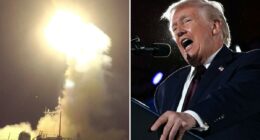
Video shared by US Central Command showed targeted missile strikes including strikes aimed at trucks carrying weapons

Moments later the truck is seen being blasted to bits

Iranian families gather behind the ruins of a building in Tehran

Trump posted a similar message online on Friday as he suggested the war would soon be ‘winding down’
The economic fallout from the conflict has already been significant.
A combination of military strikes, disruption to key oil shipping routes, and instability around the Strait of Hormuz (through which roughly one-fifth of the world’s oil passes) has rattled global markets.
US stocks fell sharply on Friday, with the S&P 500 dropping 1.5%, while fuel prices surged amid fears of prolonged disruption.
Trump himself has sent mixed messages on the critical waterway.
In one post, he suggested the US would step back from securing it, writing: ‘The Hormuz Strait will have to be guarded and policed, as necessary, by other Nations who use it – The United States does not!’
Yet in the same breath, he added that the US would assist if asked, ‘but it shouldn’t be necessary once Iran’s threat is eradicated.’
Even within his own party, the contradictions have drawn scrutiny.