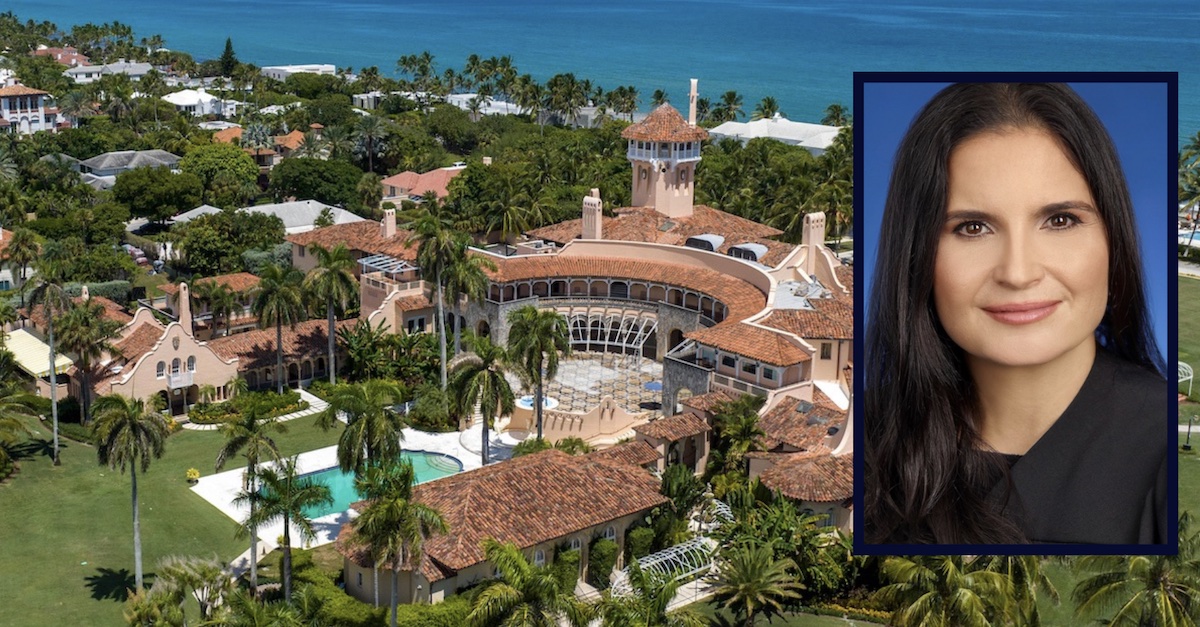

Main: An aerial view of former President Donald Trump”s Mar-a-Lago club in Palm Beach, Fla., on Aug. 31, 2022 (AP Photo/Steve Helber/File). Right inset: U.S. District Judge Aileen Cannon (U.S. District Court for the Southern District of Florida).
While President Donald Trump and the Department of Justice advocate for the dismissal of ex-special counsel Jack Smith’s report on the Mar-a-Lago investigation, two organizations are urging an appeals court to unveil its findings through a straightforward directive.
The groups, American Oversight and the Knight First Amendment Institute at Columbia University, have petitioned the 11th U.S. Circuit Court of Appeals to mandate U.S. District Judge Aileen Cannon to include a redacted version of Volume II of Smith’s report in her court records.
While the first volume, which pertains to the January 6 investigation, has been accessible to the public since January 2025, the second volume has remained confined to Judge Cannon’s office.
Judge Cannon, appointed by Trump, had previously dismissed his Espionage Act charges and determined Smith’s appointment as special counsel was unauthorized. For a year, she has withheld Volume II from public release, initially citing the need to prevent “prejudice” against Waltine Nauta and Carlos de Oliveira, a former Trump property manager at Mar-a-Lago, both of whom had pending appeals.
However, these appeals were withdrawn after the Trump administration decided to drop the cases following his inauguration, eliminating any imminent legal threats to Nauta and de Oliveira, as noted by the Knight Institute.
A brief submitted by the Institute asserted, “There is also no risk that a future administration will revive the charges, as the five-year statute of limitations will expire in 2028, prior to President Trump completing his term.” The brief further criticized the claim that Nauta and de Oliveira remain in “jeopardy,” arguing that concerns for their due process rights do not outweigh public interest in the report’s disclosure.
While there isn’t anything more than a “highly speculative” chance that Trump will face Espionage Act charges again after his second term in office expires, there also isn’t a reason to block the public from reading about Smith’s investigation in the absence of pending charges and before the statute of limitations has run, the parties argue.
After all, the brief said, the reports of special counsels Robert Mueller and Robert Hur were each released.
“Although the ten-year statute of limitations that applies to the Espionage Act charges against President Trump will not expire until 2033, whether a future administration would revive the charges is highly speculative. Furthermore, President Trump claims that presidential immunity protects him from the Espionage Act charges, because they ‘stem directly from official acts by [him] while in office,’” the brief said. “It is also important to note that other Special Counsel reports were released to the public even though the individuals targeted faced the possibility that a future administration would bring charges against them within the applicable statute of limitations for the conduct alleged in the reports.”
For that reason, the group stated Cannon’s denial of the Knight Institute’s attempt to intervene in the case for the purpose of lifting the injunction and securing the release of Volume II was “legally erroneous.”
American Oversight likewise argued that the purpose of Cannon’s original injunction, set to automatically expire on Feb. 24, “no longer exists.”
Before the expiration date, Trump and his former co-defendants have each supported Cannon issuing an order which would “permanently” block the DOJ from releasing “so-called Special Counsel” Smith’s “unlawfully prepared” report and destroy it.
“When American Oversight sought to intervene to have the district court’s injunction order barring the release of the report dissolved, the district court denied intervention but provisionally dissolved the injunction effective February 24, 2026,” the brief said. “However, the court’s order expressly provided that the parties could challenge that relief. Not surprisingly, that is exactly what the former defendants have now done. Indeed, two have gone even further and sought to have the report destroyed so that the public will never have access to the Special Counsel’s findings.”
The 11th Circuit should not allow that to happen, the filing added.
“But both are relevant to determining the intervention issue because the nominally adverse party, the United States, is aligned with all three former defendants so that no party, absent intervention, will resist the effort to bury or destroy Volume II,” the brief continued. “It is critical that American Oversight be permitted to intervene in the district court to vindicate its federal rights, and to assure that the facts and historical record will be preserved.”
The groups have separately asked Cannon to stay proceedings until the 11th Circuit rules.
American Oversight Executive Director Chioma Chukwu said in a statement that the group “will not allow the president and his guard dogs to bury information that belongs to the American people.”
“For more than a year, Judge Cannon has kept the Special Counsel’s final report under seal, long after any legitimate claims by Trump’s co-conspirators expired,” Chukwu said. “By blocking our effort to challenge her gag order, the court handed President Trump a roadmap for burying the report through delay and procedural gamesmanship.”
Trump attorney Kendra Wharton recently dismissed the Knight Institute and American Oversight as “liberal organizations” and “purported” nonpartisan, nonprofit organizations that have no right to obtain the “work product” of a prosecutor Cannon found to be illegally appointed.
Allowing the public to read Volume II, Wharton argued, would “improperly endorse and give legal effect to Smith’s unlawful investigation and prosecution in the Southern District of Florida and would irreparably harm President Trump and his former co-defendants.”