
Share this @internewscast.com
Donald Trump has declared that the United States will impose a blockade on the Strait of Hormuz following the breakdown of peace negotiations with Iran.
In a post made on Truth Social just before 9:00 AM on Sunday, Trump stated, “Iran Is Unwilling To Give Up Its Nuclear Ambitions.”
On Saturday, the USS Franklin Petersen and the USS Michael Murphy, both American naval vessels, navigated the strategic waters of the Strait of Hormuz.
This critical waterway, measuring a mere 21 miles at its narrowest, is fraught with dangers, including mines and the threat of missiles and drones launched from Iran’s mountainous terrain. Any attempt by the U.S. Navy to blockade or secure the strait by force could potentially lead to considerable losses.
In his Sunday morning post, Trump further accused Iran of breaking its commitment to keep the Strait of Hormuz open, labeling this failure as deliberate.
He claimed, “This has caused anxiety, dislocation, and hardship for many individuals and nations worldwide. They claim to have mined the waters, despite the fact that their entire navy and most of their ‘mine droppers’ have been completely destroyed.”
‘They may have done so, but what ship owner would want to take the chance? There is great dishonor and permanent harm to the reputation of Iran, and what’s left of their “Leaders,” but we are beyond all of that,’ Trump continued.

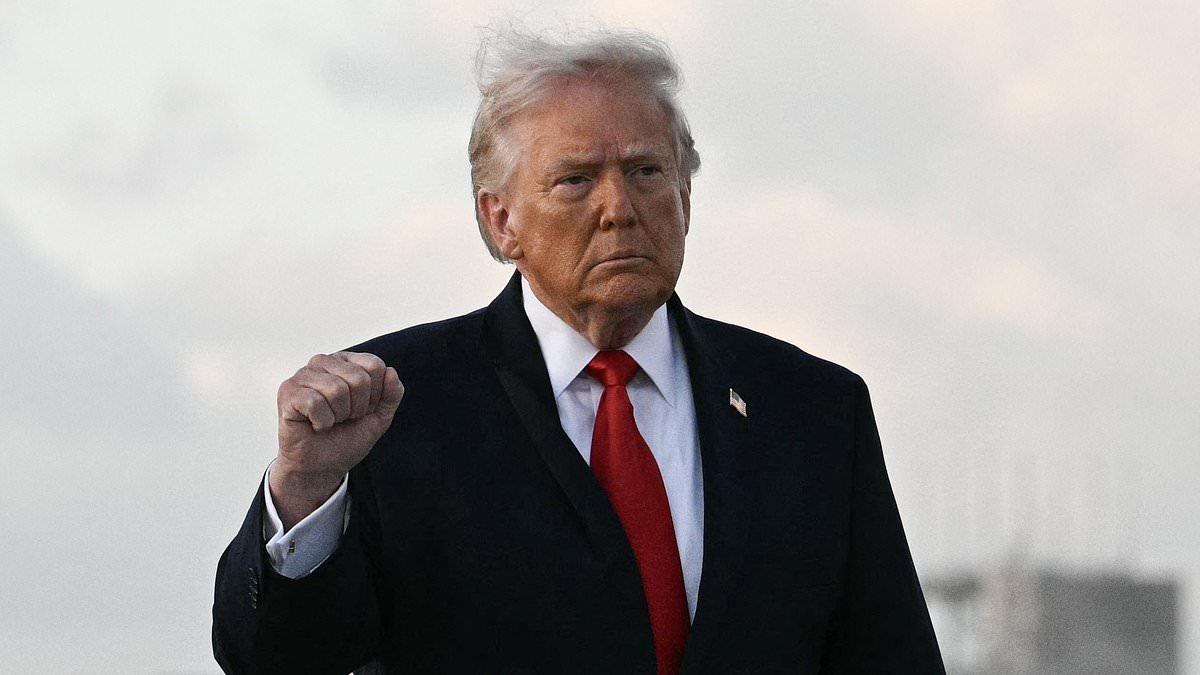
US President Donald Trump makes a fist upon arrival at Miami International Airport in Miami, on April 11, 2026

President Donald Trump on Truth Social, Sunday, April 12th, 2026

President Donald Trump on Truth Social, Sunday, April 12th, 2026

U.S. Central Command (CENTCOM) forces began setting conditions for clearing mines in the Strait of Hormuz, April 11, as two U.S. Navy guided-missile destroyers conducted operations
‘As they promised, they better begin the process of getting this International Waterway Open and Fast! Every Law in the book is being violated by them,’ the President added.
Trump also said the U.S. was ready to ‘finish up’ Iran at the ‘appropriate moment, stressing that Tehran’s nuclear ambitions were at the core of the failure to end the war.
Face-to-face talks ended earlier Sunday after 21 hours, leaving a fragile two-week ceasefire in doubt.
U.S. officials said the negotiations collapsed over what they described as Iran’s refusal to commit to abandoning a path to a nuclear weapon, while Iranian officials blamed the U.S. for the breakdown of the talks without specifying the sticking points.
Neither side indicated what will happen after the 14-day ceasefire expires on April 22. Pakistani mediators urged all parties to maintain it. Both said their positions were clear and put the onus on the other side, underscoring how little the gap had narrowed throughout the talks.
“We need to see an affirmative commitment that they will not seek a nuclear weapon, and they will not seek the tools that would enable them to quickly achieve a nuclear weapon,” Vice President JD Vance said after the talks.
Iran’s parliament speaker Mohammad Bagher Qalibaf, who led Iran in the negotiations, said it was time for the United States ‘to decide whether it can gain our trust or not.’
He did not mention the core disputes in a series of social media posts, though Iranian officials earlier said the talks fell apart over two or three key issues, blaming what they called U.S. overreach.
Iran has long denied seeking nuclear weapons but has insisted on its right to a civilian nuclear program. It has offered ‘affirmative commitments’ in the past in writing, including in the landmark 2015 nuclear deal. Experts say its stockpile of enriched uranium, though not weapons-grade, is only a short technical step away.
Since the U.S. and Israel launched the war on Feb. 28, it has killed at least 3,000 people in Iran, 2,020 in Lebanon, 23 in Israel and more than a dozen in Gulf Arab states, and caused lasting damage to infrastructure in half a dozen Middle Eastern countries. Iran’s grip on the Strait of Hormuz has largely cut off the Persian Gulf and its oil and gas exports from the global economy, sending energy prices soaring.