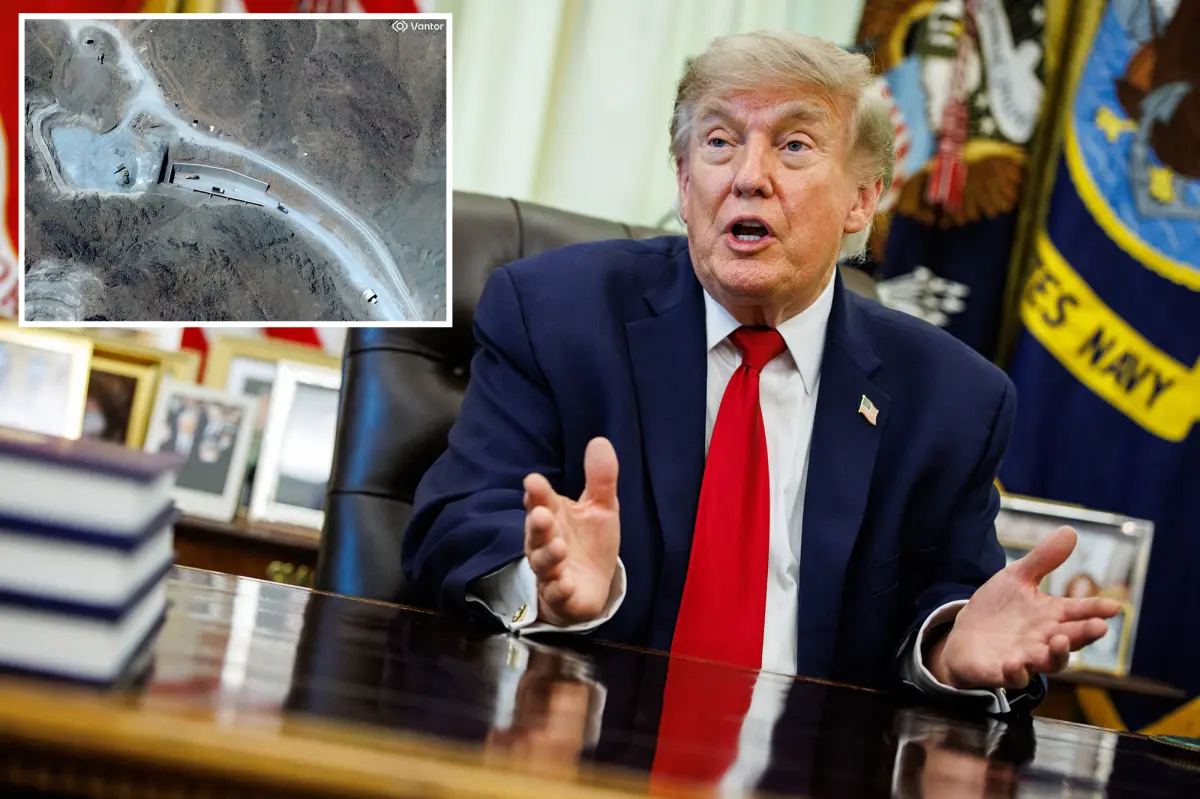
President Trump has weighed the possibility of returning to a broader military confrontation with Iran, though for the moment he is choosing to keep diplomacy at the center of his strategy.
The Wall Street Journal reported Wednesday that Trump has held discussions with War Secretary Pete Hegseth and Gen. Dan Caine, chairman of the Joint Chiefs of Staff, about moving away from peace talks and authorizing additional strikes against the Islamic Republic. For now, however, he has concluded that negotiations offer the best path toward ensuring Iran dismantles its nuclear weapons program.
The diplomatic clock is already running. Under a memorandum of understanding signed June 17, the United States and Iran have 60 days to reach a final peace agreement addressing several major issues, including the status of Tehran’s enriched uranium, billions of dollars in frozen Iranian assets, and potential relief from US and international sanctions.
“They’re agreeing to everything that I want, and they have to,” Trump told reporters last week when asked about the negotiations. “Otherwise, we just go back and do what we have to do.”
According to the Journal, Trump has signaled that he may allow talks to continue beyond the Aug. 18 deadline if he believes progress is still possible. At the same time, he is reportedly prepared to order limited, one-off strikes if he determines that Iran has violated the terms of the MOU.
The latest pause in fighting came Monday, when the US and Iran halted hostilities after four days of exchanged attacks in the Strait of Hormuz.
Vice President JD Vance said Tuesday night on Fox News’ “The Ingraham Angle” that the continuing talks, which had resumed earlier that day in Qatar through indirect channels, are intended “to see how serious” Iran is about pursuing peace.
“They’ve got to not just say the right things, they’ve got to make real concessions,” Vance told host Laura Ingraham. “So whether it’s the president, me, anybody else in the negotiation, we care a lot less about what the Iranians say, we care a lot more about what they do. We see some positive signs. Obviously we see some negative signs.”
MORE STORY: Unmasking the Church: Hugh Jackman's Faith and Emily Watson's Chilling Accusations
“What the president has told us is, work the problem, see where the negotiation is going to lead, and if it doesn’t lead to a successful resolution on the diplomatic side, we still have at lot of optionality and we’ve still accomplished a whole lot for the American people.”
The US is represented in Qatar by special Middle East envoy Steve Witkoff and Trump’s son-in-law, Jared Kushner. Iran’s deputy foreign minister, Kazem Gharibabadi, is leading the Tehran delegation.
Technical talks between diplomats began Wednesday, said two regional officials, who spoke on condition of anonymity to discuss the closed-door discussions, with differences between the two sides over the status of the Strait of Hormuz and Israel’s campaign against Hezbollah in Lebanon emerging as key sticking points.
The US and Iran agreed to allow ships to pass uncharged for 60 days as part of the MOU, but Tehran insisted it must control the routes of the vessels and later charge fees for passage, upending decades of practice.
Washington and many Gulf Arab states say they won’t agree to the charges. An effort by Oman and a UN agency to launch a new route this past weekend triggered attacks by Iran on at least two ships, one of which was carrying crude oil from Qatar.
Doha confirmed a meeting early Wednesday involving Kushner, Witkoff and Qatari Foreign Minister Sheikh Mohammed bin Abdulrahman Al Thani. A readout from Qatar’s Foreign Ministry said the men talked about the interim deal “along with the efforts aimed at promoting security and stability in the region through dialogue and diplomacy.”
Al Thani also met with Gharibabadi and other Iranian officials. An Iranian statement said they discussed “the implementation process of the memorandum of understanding on ending the imposed war, as well as the existing challenges and obstacles to its implementation.”
Pakistani mediators also were on hand.
With Post wires


